First Time Diving in Ecuador - A Beginner's Complete Guide
Everything you need to know before your first dive in Ecuador
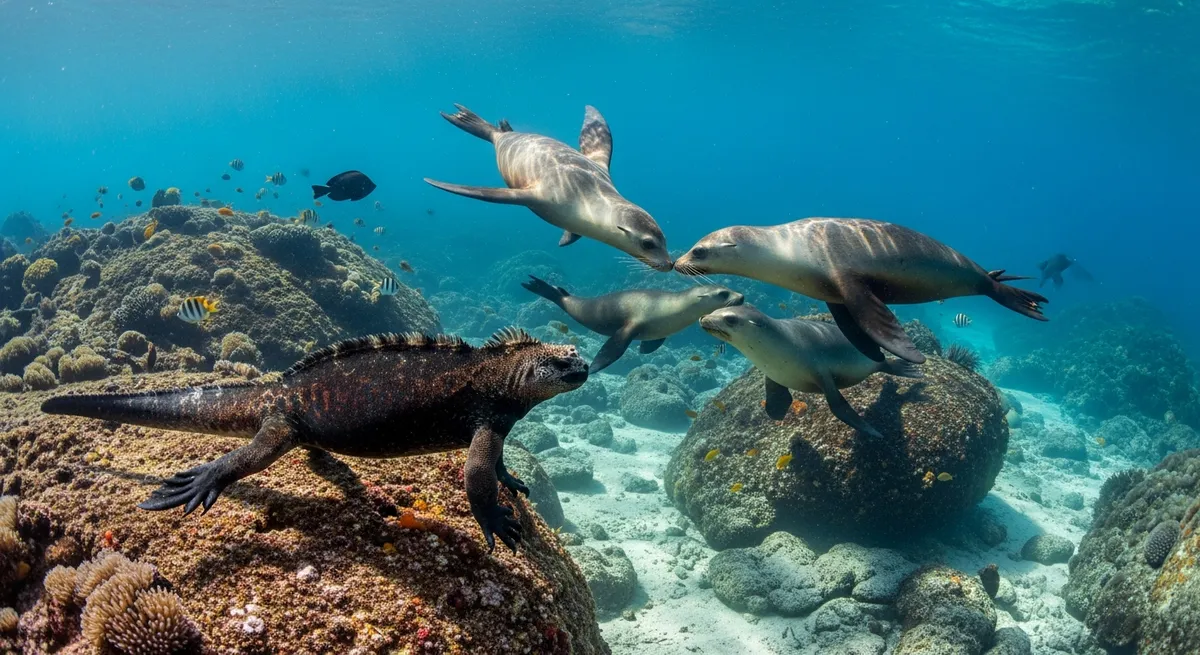
Why Ecuador for Your First Dives?
Ecuador, with its diverse marine environments, offers a unique entry point for beginner divers, though it's important to set realistic expectations. While many associate Ecuador with the advanced diving of the Galápagos Islands, the country also boasts more sheltered and accessible dive sites, particularly along its mainland coast and the Isla de la Plata region. Water temperatures vary, but generally range from 20-28°C (68-82°F) in warmer months and regions, making for comfortable diving. Visibility can be excellent, often exceeding 15 meters (50 feet), especially in the dry season.
For first-time divers, the key is to choose the right region. While the Galápagos are globally renowned for their incredible, often large-pelagic encounters and strong currents, making them largely unsuitable for absolute beginners, other areas provide a gentler introduction. These calmer sites allow new divers to focus on buoyancy and basic skills without the added challenge of strong currents or deep dives. Expect to see colorful reef fish, sea turtles, rays, and various invertebrates in these more protected areas, offering a rich initial experience without overwhelming conditions.
Best Beginner-Friendly Regions
Isla de la Plata
Often called "the poor man's Galápagos," Isla de la Plata is an excellent choice for beginners. Located off the coast near Puerto López, it offers calmer waters and shallower dive sites compared to its famous counterpart. Divers can expect good visibility and comfortable temperatures. Specific sites like 'El Acuario' are known for their abundant reef fish, sea turtles, and various rays, providing a gentle introduction to marine life in a relaxed environment.
Mainland Coast (Salinas, Ayangue)
The Ecuadorian mainland coast, particularly around towns like Salinas and Ayangue, offers several sheltered coves and bays perfect for initial dive experiences. These areas typically feature calmer conditions, making them ideal for discovery dives or open water training. You'll often find colorful smaller reef fish, moray eels, and sometimes even seahorses. Dive operators in these towns are well-versed in catering to new divers, providing a supportive learning environment.
Esmeraldas & North Coast
The Esmeraldas region, further north, also presents opportunities for beginner divers, especially in its more protected bays. While less explored by international dive tourism compared to the south, local operators offer dives that can be suitable for those just starting out. Conditions can be variable, but during calmer periods, these sites offer a chance to explore a different segment of Ecuador's underwater world, often with good visibility and interesting rock formations.
What Certification Do You Need?
To participate in guided fun dives in Ecuador, you will generally need to hold a PADI Open Water Diver certification or an equivalent certification from another recognized agency such as SSI, NAUI, or CMAS. If you're completely new to diving, you can start with a Discover Scuba Diving experience, which allows you to try diving under direct instructor supervision without needing a certification. For a full certification, local dive centers across the beginner-friendly regions offer PADI Open Water Diver courses, which typically take 3-4 days to complete. These centers are well-equipped and follow international safety standards. PADI is the most widely recognized certification agency in Ecuador.
Best Time to Visit
The best time to visit Ecuador for diving depends on the region and what you wish to see, but generally, the dry season (June-December) offers the best conditions for beginner divers on the mainland and Isla de la Plata. During this period, water temperatures on the mainland average 20-24°C (68-75°F), and visibility is typically at its best, often exceeding 15-20 meters. The weather is generally sunnier with less rainfall, leading to calmer seas. For the Galápagos, while diving is year-round, the warmer season (December-May) brings warmer waters (24-28°C / 75-82°F) and typically calmer conditions, though this period can also see more plankton, which, while reducing visibility slightly, attracts larger marine life. For beginners, prioritizing the dry season on the mainland is advisable for comfort and ease.
What to Expect on Your First Dive
Your first dive experience in Ecuador, especially if it's a Discover Scuba Diving program or the initial dives of your Open Water course, will typically begin at a local dive center. After check-in and paperwork, you'll receive a comprehensive briefing covering safety procedures, equipment use, communication signals, and an overview of the dive site. You'll then be fitted with all necessary gear-a wetsuit, BCD, regulator, mask, and fins. Most beginner dives on the mainland or Isla de la Plata are boat dives, meaning you'll travel a short distance to the dive site. The entry will usually be a controlled backward roll or a giant stride from the boat. Underwater, your instructor will guide you through shallow, calm waters, focusing on your comfort and basic skills like breathing and buoyancy control. The typical dive style for beginners in Ecuador emphasizes calm conditions and slow exploration, allowing you to observe the marine environment without feeling rushed or overwhelmed by strong currents.
Budget Guide
Diving in Ecuador offers various price points. A Discover Scuba Diving experience typically costs between $90-150 USD, including all equipment and instructor fees. An Open Water Diver certification course can range from $450-600 USD. For certified divers, fun dives usually cost $50-80 USD per dive, or $100-150 USD for a two-tank dive trip, which often includes equipment rental. Equipment rental, if not included, is around $20-30 USD per day for a full set. Accommodation varies widely: budget hostels can be found for $15-30 USD per night, mid-range hotels for $50-100 USD, and more upscale options for $150+ USD. Keep in mind that prices in the Galápagos are significantly higher for all services.
Essential Tips
- Book in advance, especially during peak season (July-August and December-January), to secure spots with reputable dive centers.
- Consider diving in the dry season (June-December) for the best visibility and calmer conditions on the mainland and Isla de la Plata.
- Always carry cash (USD) for smaller purchases, tips, and places where card payments might not be accepted.
- Be mindful of local customs and dress codes, especially when visiting communities along the coast.
- If traveling to the Galápagos, budget significantly more and ensure you have an advanced certification for most dive sites.
- Stay hydrated, especially in warmer coastal regions, and use reef-safe sunscreen.
- Confirm dive center safety protocols and equipment maintenance before booking.
At a Glance
| Destination | Difficulty | Best Months |
|---|---|---|
| Galápagos IslandsEcuador | Beginner | Jan-Dec |
| Isla de la PlataEcuador | Beginner | Jan-Dec |
| Mainland CoastEcuador | Beginner | - |
| Galápagos Central IslandsEcuador | Beginner | - |
| Esmeraldas & North CoastEcuador | Beginner | - |
Galápagos Islands
Ecuador
Difficulty
Beginner
Best Months
Jan-Dec
Water Temp
23-27C
Dive Centres
30
Practical Info
- dive Sites:
- 92
- dive Centres:
- 30
Isla de la Plata
Ecuador
Difficulty
Beginner
Best Months
Jan-Dec
Water Temp
25-27C
Dive Centres
5
Practical Info
- dive Sites:
- 28
- dive Centres:
- 5
Frequently Asked Questions
Do I need a certification to dive in Ecuador?
For guided fun dives in Ecuador, you generally need a PADI Open Water Diver certification or equivalent. However, if you're new to diving, you can participate in a Discover Scuba Diving experience under direct instructor supervision without prior certification. Dive centers also offer full Open Water courses.
How much does diving cost in Ecuador?
A Discover Scuba Diving experience costs $90-150 USD. An Open Water certification course is $450-600 USD. For certified divers, a two-tank fun dive trip typically ranges from $100-150 USD, often including equipment rental. Equipment rental alone is about $20-30 USD per day.
What is the best time to dive in Ecuador?
The best time for beginner diving on Ecuador's mainland and Isla de la Plata is the dry season, from June to December. During these months, water temperatures are comfortable (20-24°C / 68-75°F), visibility is generally excellent, and sea conditions are calmer, ideal for new divers.
Is Ecuador safe for beginner divers?
Yes, Ecuador can be safe for beginner divers, provided you choose the right regions and reputable dive operators. Regions like Isla de la Plata and parts of the Mainland Coast offer calmer waters and shallower sites suitable for learning. Always confirm the dive center's safety protocols and instructor qualifications.
What marine life will I see in Ecuador?
In beginner-friendly areas like Isla de la Plata and the Mainland Coast, you can expect to see colorful reef fish, sea turtles, various species of rays, moray eels, and diverse invertebrates. While the Galápagos are known for large pelagics, these are typically found in more advanced dive sites.
Related Guides
Planning when to go?
See the month-by-month conditions guide