First Time Diving in Honduras - A Beginner's Complete Guide
Everything you need to know before your first dive in Honduras
Why Honduras for Your First Dives?
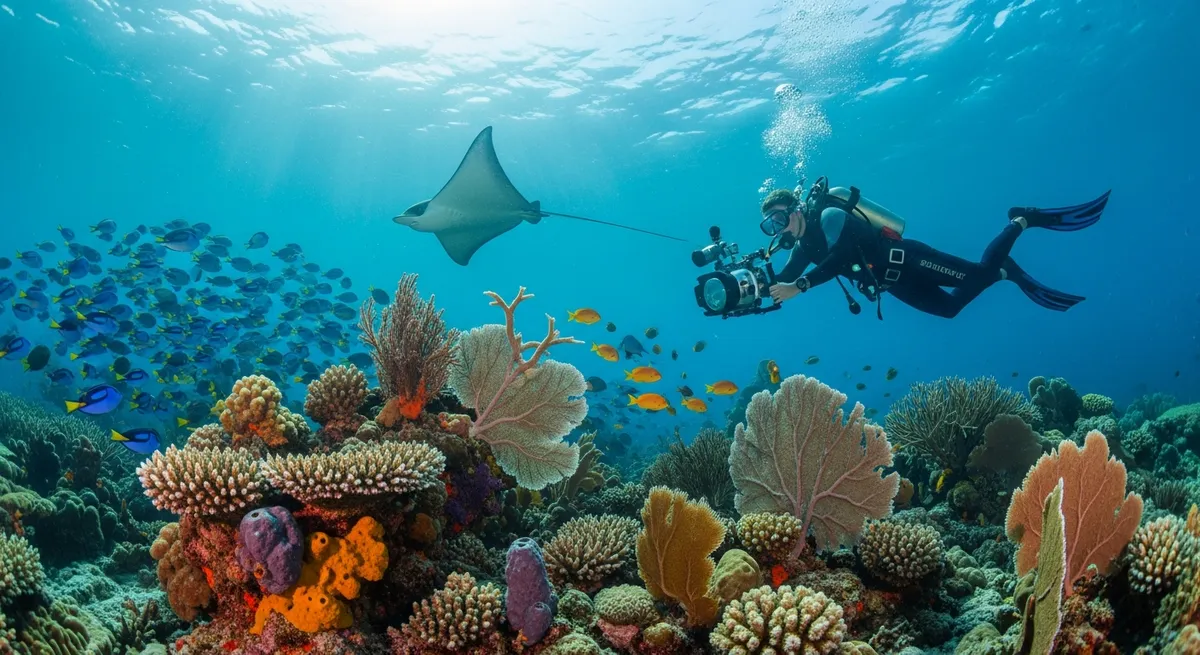
Honduras, with its 199 dive sites spread across five diverse regions, presents an excellent opportunity for beginner divers. While it has some advanced sites, two regions are specifically noted for their beginner-friendly conditions. The Bay Islands-Roatán, Utila, and Guanaja-are particularly renowned for their calm, warm waters and excellent visibility, making them ideal for learning. Water temperatures typically hover around 26-29°C (79-84°F) year-round, eliminating the need for thick wetsuits and making longer dives more comfortable for new divers.
Visibility in these areas is consistently good, often exceeding 20 meters (65 feet), which significantly reduces apprehension for those still getting accustomed to the underwater environment. This clarity allows new divers to easily observe the vibrant coral reefs and diverse marine life, including colorful reef fish, turtles, and rays, without the added challenge of murky conditions. The relatively gentle currents common in many Bay Islands dive sites also contribute to a relaxed first-time diving experience, allowing instructors to focus on skill development rather than managing strong drifts.
Best Beginner-Friendly Regions
Roatán: As the largest of the Bay Islands, Roatán offers numerous sheltered bays and shallow reefs perfect for initial dives. Sites like Mandy's Eel Garden and Half Moon Bay Wall feature gentle slopes, abundant reef fish, and healthy coral formations in depths suitable for Open Water training. Many dive centers here have easy access to these sites via short boat rides, minimizing travel time and maximizing underwater exploration for beginners.
Utila: Known for its laid-back atmosphere and competitive pricing, Utila is a popular choice for divers seeking certification. Its surrounding waters offer a variety of shallow, calm sites such as The Aquarium and Chepes Beach, which are ideal for practicing skills and getting comfortable underwater. Utila's focus on dive education means experienced instructors are readily available to guide beginners through their first underwater experiences.
Cayos Cochinos: This marine protected area offers pristine diving conditions with minimal current and healthy reefs. While less developed than Roatán or Utila, its protected status ensures an untouched environment. Beginner-friendly sites here are characterized by vibrant coral gardens and a high density of small reef fish, providing a serene and visually rewarding introduction to diving away from busier areas. Access often involves day trips from La Ceiba or Roatán.
What Certification Do You Need?
To participate in guided fun dives in Honduras, you will generally need a PADI Open Water Diver certification or an equivalent certification from another recognized agency, such as SSI, NAUI, or CMAS. Most dive centers in Honduras, particularly in Roatán and Utila, are PADI or SSI affiliated and offer courses ranging from Discover Scuba Diving experiences (which do not require certification) to advanced specialty courses. If you are new to diving, the Discover Scuba Diving program is an excellent way to try diving under direct supervision before committing to a full certification course. Local dive centers are plentiful and well-equipped to handle certifications, with experienced instructors often fluent in multiple languages.
Best Time to Visit
The best time to visit Honduras for diving is generally from February to September. During these months, the weather is typically drier with calmer seas, especially in the Bay Islands. Water temperatures consistently range from 27-29°C (81-84°F), providing comfortable diving conditions. While diving is possible year-round, the rainy season from October to January can bring stronger winds and rougher surface conditions, potentially impacting visibility and limiting access to certain dive sites. However, even during the rainy season, underwater visibility often remains good, particularly on leeward sides of the islands.
What to Expect on Your First Dive
Your first dive in Honduras, especially if it's a Discover Scuba Diving experience or part of an Open Water course, will typically begin at a dive center with a check-in process and paperwork. This will be followed by a comprehensive briefing from your instructor, covering safety procedures, equipment use, communication signals, and an overview of what you will see underwater. You will then be fitted with your gear-mask, fins, BCD, regulator, and wetsuit (if needed). Most first dives in the Bay Islands are boat dives, with a short ride to a shallow, calm reef. Entry is usually a controlled giant stride or back roll from the boat. Once in the water, your instructor will guide you through some basic skills in shallow water before slowly descending to explore the reef at a maximum depth of 12 meters (40 feet) for Discover Scuba or up to 18 meters (60 feet) for Open Water certified divers. Expect calm conditions and ample time to observe marine life under close supervision.
Budget Guide
Diving in Honduras offers a range of price points. A Discover Scuba Diving experience typically costs between $90-120 USD. A full PADI Open Water Diver course can range from $350-500 USD, often including equipment rental and certification fees. Fun dives for certified divers are generally $35-50 USD per dive, with discounts often offered for multi-dive packages (e.g., 10-dive package for $300-400 USD). Equipment rental, if not included in a package, is usually an additional $10-15 USD per day. Accommodation varies widely: budget hostels can be found for $15-30 USD per night, mid-range hotels for $50-100 USD, and resorts starting from $150 USD. Meals can cost $10-25 USD per day depending on local eateries versus tourist-oriented restaurants. Local currency is the Honduran Lempira (HNL), but USD is widely accepted in tourist areas.
Essential Tips
- Book your dive courses or packages in advance, especially during peak season (February-September), to secure your spot and potentially better rates.
- Carry insect repellent, particularly for evenings in jungle areas or on the islands, as mosquitoes and sand flies can be present.
- Stay hydrated, especially after dives, due to the warm climate. Drink plenty of water.
- Respect marine life and coral reefs; avoid touching or disturbing any underwater organisms.
- Learn a few basic Spanish phrases; while English is common in tourist areas, knowing some Spanish can enhance interactions with locals.
- Be mindful of local customs and dress codes, especially when visiting towns or non-beach areas.
- Consider travel insurance that covers diving activities and potential medical emergencies.
At a Glance
| Destination | Difficulty | Best Months |
|---|---|---|
| RoatánHonduras | Beginner | Jan-Dec |
| UtilaHonduras | Beginner | Jan-Dec |
| GuanajaHonduras | Beginner | - |
| Cayos CochinosHonduras | Beginner | - |
| Tela & North CoastHonduras | Beginner | - |
Roatán
Honduras
Difficulty
Beginner
Best Months
Jan-Dec
Water Temp
27-30C
Dive Centres
40
Practical Info
- dive Sites:
- 171
- dive Centres:
- 40
Utila
Honduras
Difficulty
Beginner
Best Months
Jan-Dec
Water Temp
27-30C
Dive Centres
35
Practical Info
- dive Sites:
- 28
- dive Centres:
- 35
Frequently Asked Questions
Do I need a certification to dive in Honduras?
For guided fun dives, you need a PADI Open Water Diver or equivalent certification. However, you can try diving without certification via a Discover Scuba Diving program, supervised by an instructor.
How much does diving cost in Honduras?
A Discover Scuba Diving experience costs $90-120 USD. A full Open Water course is $350-500 USD. Fun dives for certified divers are $35-50 USD per dive, with discounts for packages.
What is the best time to dive in Honduras?
The best time to dive in Honduras is from February to September, offering drier weather, calmer seas, and water temperatures of 27-29°C (81-84°F). Diving is possible year-round, but October-January can bring rougher conditions.
Is Honduras safe for beginner divers?
Yes, Honduras is suitable for beginner divers, especially in regions like Roatán and Utila. These areas offer calm, warm waters, good visibility, and numerous dive centers with experienced instructors focused on safety and training.
What marine life will I see in Honduras?
In Honduras, particularly in the Bay Islands, you can expect to see diverse marine life including colorful reef fish, sea turtles, stingrays, moray eels, and healthy coral formations on the reefs.
Related Guides
Planning when to go?
See the month-by-month conditions guide