First Time Diving in Vietnam - A Beginner's Complete Guide
Everything you need to know before your first dive in Vietnam
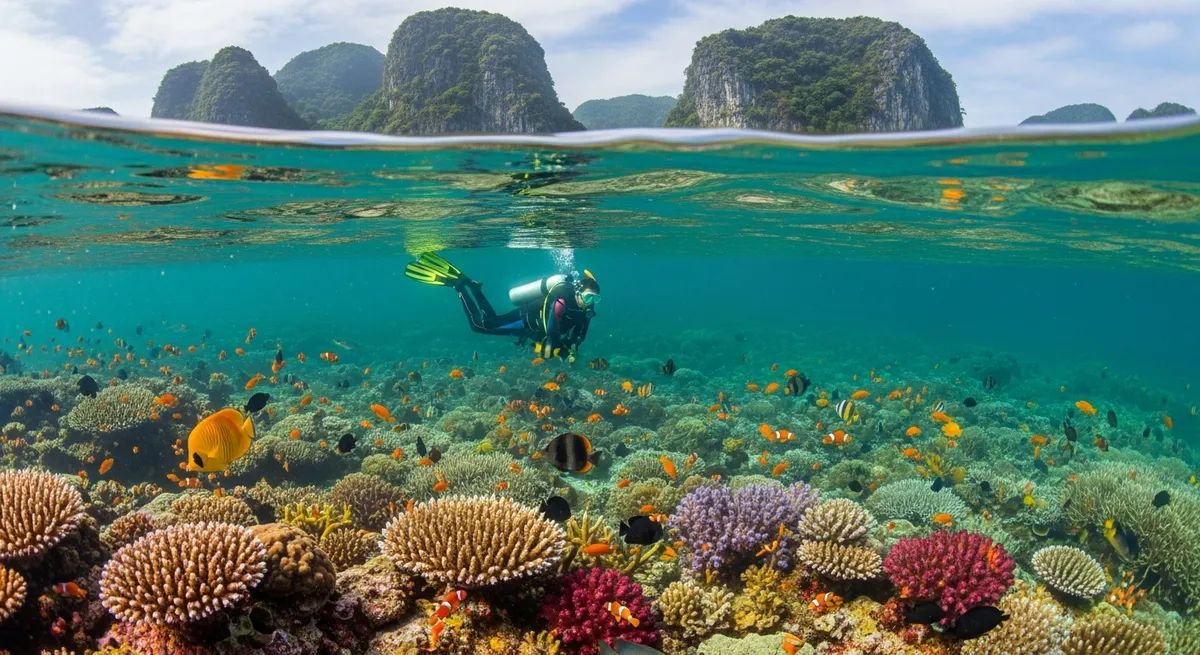
Why Vietnam for Your First Dives?
Vietnam offers a welcoming environment for first-time divers, making it an excellent choice for earning your initial certification or experiencing a Discover Scuba Dive. The country boasts generally calm conditions in its key dive regions, with many sites protected from strong currents. Water temperatures are consistently warm, typically ranging from 25°C to 30°C (77°F to 86°F) year-round, which means less bulky wetsuits and a more comfortable experience for beginners.
Visibility can vary but often sits in the 5-15 meter range, providing enough clarity to enjoy the underwater scenery without being overwhelming. While not known for large pelagic encounters, Vietnam's reefs are home to a good variety of smaller reef fish, colorful corals, and macro life. Expect to see clownfish, angelfish, butterflyfish, various nudibranchs, and sometimes small reef sharks or rays. The relaxed pace and accessible dive sites contribute to a stress-free learning environment.
Best Beginner-Friendly Regions
Nha Trang
Nha Trang is perhaps the most established dive hub in Vietnam and is highly recommended for beginners. Its numerous dive sites, particularly around Hon Mun Marine Protected Area, feature gentle slopes and minimal currents, making them ideal for initial training. Sites like Madonna Rock and Coral Garden offer vibrant soft and hard corals and plenty of small reef fish, providing an engaging experience without demanding advanced skills. The infrastructure for dive centers here is well-developed, offering a range of options for courses and guided dives.
Hoi An & Cu Lao Cham
The Cu Lao Cham Marine Park, accessible from Hoi An, is another excellent choice for beginners. This protected area focuses on conservation, leading to relatively healthy reefs. Dive sites here are generally shallow and sheltered, with calm conditions that are perfect for learning and gaining confidence underwater. Expect to see colorful anemones, clownfish, and various reef inhabitants. The combination of cultural immersion in Hoi An with accessible diving makes this a unique beginner destination.
Phu Quoc
Located in the south, Phu Quoc offers calm, clear waters, especially on its north and south coasts, which are suitable for beginner divers. Sites like Turtle Island (Mong Tay Island) and Finger Island (Doi Moi Island) feature gentle currents and good visibility during peak season, allowing new divers to focus on buoyancy and enjoying the marine life. The island's relaxed atmosphere complements a beginner's diving experience, providing a peaceful introduction to the underwater world.
What Certification Do You Need?
To participate in guided fun dives in Vietnam, you will need an Open Water Diver certification from a recognized agency such as PADI, SSI, NAUI, or CMAS. The PADI Open Water Diver course is the most widely offered and recognized certification globally, including in Vietnam. If you are a complete beginner, you can enroll in a Discover Scuba Diving experience, which allows you to dive under direct instructor supervision without prior certification. Many local dive centers in Vietnam are PADI or SSI certified and offer courses in English and other languages.
Best Time to Visit
The best time to dive in Vietnam varies by region due to the country's long, narrow shape and diverse climate. Generally, for Nha Trang and Con Dao, the dry season from February to October offers the calmest seas and best visibility, with water temperatures consistently between 26°C-30°C (79°F-86°F). For Hoi An and Cu Lao Cham, the ideal diving season is from May to September, with warm waters around 28°C-30°C (82°F-86°F) and typically calm conditions. Phu Quoc is best visited from October to May, where water temperatures average 27°C-29°C (81°F-84°F) and visibility is at its peak. Always check specific regional forecasts closer to your travel dates.
What to Expect on Your First Dive
Your first dive in Vietnam, especially if it's a Discover Scuba Dive or part of an Open Water course, will typically begin at a dive center with a check-in and paperwork. You'll then receive a comprehensive briefing covering dive theory, safety procedures, hand signals, and equipment use. After being fitted with your gear (mask, fins, wetsuit, BCD, regulator), you'll usually travel by boat to a nearby dive site. Most beginner dives in Vietnam are boat dives, often anchoring in sheltered bays.
Upon arrival at the site, your instructor will guide you through a controlled entry into the water, usually a giant stride or back roll. You'll then practice some basic skills at the surface before descending slowly with your instructor. The underwater experience will focus on controlled breathing, maintaining buoyancy, and observing marine life at a shallow depth, typically no deeper than 12 meters for Discover Scuba Diving. Expect a calm, guided exploration of the reef, with your instructor always close by to assist and ensure your comfort and safety.
Budget Guide
Diving in Vietnam is generally more affordable than many other popular dive destinations. A Discover Scuba Diving experience typically costs around 1,500,000-2,000,000 VND (approx. $60-$80 USD) for a half-day trip including two dives. A PADI Open Water Diver course usually ranges from 7,000,000-10,000,000 VND (approx. $280-$400 USD), including equipment rental, instruction, and certification fees. Fun dives for certified divers are often priced at 1,000,000-1,500,000 VND (approx. $40-$60 USD) per two-dive trip. Equipment rental is almost always included in course and fun dive prices. Accommodation varies widely, from budget hostels at 200,000 VND ($8 USD) per night to mid-range hotels at 700,000-1,500,000 VND ($28-$60 USD) per night.
Essential Tips
- Book your dive trip or course in advance, especially during peak season (e.g., Lunar New Year, summer holidays) to ensure availability with reputable centers.
- Carry a small amount of local currency (VND) for small purchases or tips, although major dive centers accept cards.
- Be mindful of sun protection both on the boat and in the water; the tropical sun can be intense.
- Respect local customs and marine life; avoid touching corals or disturbing animals.
- Confirm the dive center's safety record and instructor-to-student ratios, particularly for beginner courses.
- Consider travel insurance that specifically covers scuba diving activities.
- While English is spoken at most dive centers, learning a few basic Vietnamese phrases can be appreciated by locals.
At a Glance
| Destination | Difficulty | Best Months |
|---|---|---|
| Nha TrangVietnam | Beginner | Jan-Dec |
| Hoi An & Cu Lao ChamVietnam | Beginner | Jan-Dec |
| Phu QuocVietnam | Beginner | - |
| Whale Island & Van Phong BayVietnam | Beginner | - |
| Con Dao IslandsVietnam | Beginner | - |
Nha Trang
Vietnam
Difficulty
Beginner
Best Months
Jan-Dec
Water Temp
25-30C
Dive Centres
7
Practical Info
- dive Sites:
- 51
- dive Centres:
- 7
Hoi An & Cu Lao Cham
Vietnam
Difficulty
Beginner
Best Months
Jan-Dec
Water Temp
24-31C
Dive Centres
9
Practical Info
- dive Sites:
- 19
- dive Centres:
- 9
Frequently Asked Questions
Do I need a certification to dive in Vietnam?
To go on guided fun dives, you need an Open Water Diver certification (PADI, SSI, etc.). If you're a complete beginner, you can do a Discover Scuba Diving experience under direct instructor supervision, which does not require prior certification.
How much does diving cost in Vietnam?
A Discover Scuba Diving experience typically costs 1,500,000-2,000,000 VND ($60-$80 USD). A PADI Open Water course is usually 7,000,000-10,000,000 VND ($280-$400 USD). Fun dives for certified divers are 1,000,000-1,500,000 VND ($40-$60 USD) for a two-dive trip. Equipment rental is generally included.
What is the best time to dive in Vietnam?
The best time varies by region. For Nha Trang and Con Dao, February to October is ideal. For Hoi An & Cu Lao Cham, May to September offers calm conditions. Phu Quoc is best from October to May. Water temperatures are consistently warm, 25°C-30°C (77°F-86°F).
Is Vietnam safe for beginner divers?
Yes, Vietnam is generally safe for beginner divers. Many dive sites feature calm, shallow waters with minimal currents, making them suitable for learning. Reputable dive centers adhere to international safety standards, and instructors are trained to prioritize diver safety.
What marine life will I see in Vietnam?
You can expect to see a good variety of reef fish such as clownfish, angelfish, and butterflyfish. There are also many colorful corals, nudibranchs, and sometimes small reef sharks or rays, especially in protected marine areas.
Related Guides
Planning when to go?
See the month-by-month conditions guide