Cave Diving: Training, Risks & What It Takes
By DivePlnr Editorial Team | Published April 2026 | Updated April 2026
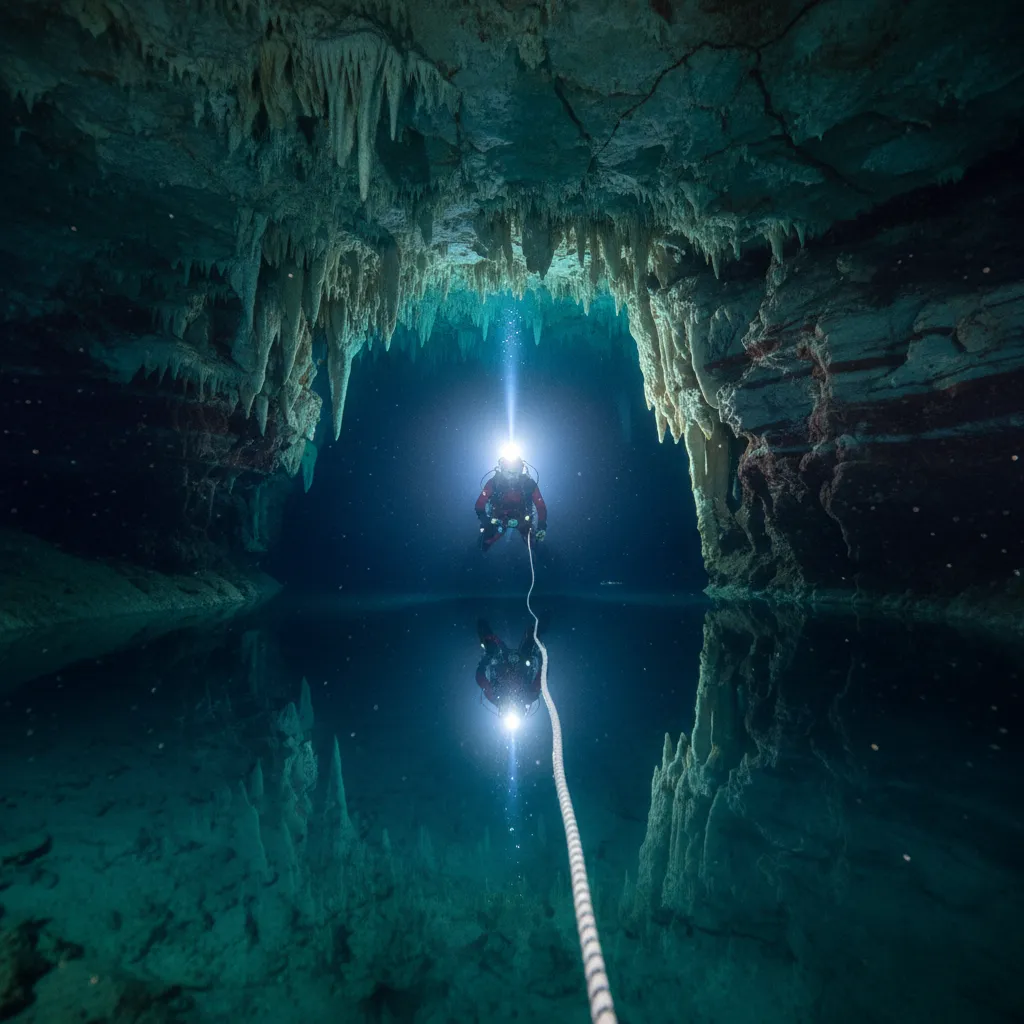
Cave diving is the exploration of underwater caves - and it is one of the most demanding, dangerous, and rewarding forms of diving on the planet. It is an overhead environment: there is no direct access to the surface. If something goes wrong at the back of a cave passage 400 metres from the entrance, you cannot simply swim up. You must navigate back through potentially complex passages, manage your gas supply precisely, maintain equipment redundancy, and stay calm under pressure that would overwhelm most divers. The statistics are sobering: cave diving has historically accounted for a disproportionate number of scuba fatalities relative to participants. However, the vast majority of cave diving deaths involve untrained divers who enter caves with open-water equipment and skills. Trained cave divers following established protocols have an excellent safety record. The cave diving community has developed rigorous training standards, equipment configurations, and procedural rules over decades - written, quite literally, in the blood of pioneers who died learning what works and what does not. If you are drawn to cave diving, respect the process. The training progression exists for a reason, and every shortcut you take is a risk paid for with your life, not your money.
Why Cave Diving Requires Specialised Training
Open-water diving skills are insufficient for overhead environments. In open water, most problems can be solved by ascending to the surface. In a cave, the surface does not exist - your exit is horizontal, potentially hundreds of metres away through passages that may be narrow, silted, or disorienting. Loss of visibility is the most common emergency in cave diving: a misplaced fin kick can reduce visibility from 30 metres to zero in seconds, turning a familiar passage into a featureless white-out where even finding the direction back to the entrance becomes a challenge. Cave diving training teaches you to navigate by touch using a continuous guideline, manage gas reserves for the worst-case scenario, handle equipment failures with redundant systems, and maintain the psychological composure needed to solve problems in an environment that offers no second chances.
The Training Progression
Cavern Diver
The cavern zone is the area of a cave within natural daylight penetration - typically no more than 60 metres from the entrance with visible natural light at all times. Cavern diver training introduces overhead environment procedures: guideline use, gas management (rule of thirds), light protocols, communication, and team procedures. Maximum depth is 40 metres and maximum penetration is limited to daylight visibility. This course is where you discover whether cave diving is for you - and where instructors assess whether you are ready to progress. Prerequisites typically include Advanced Open Water certification and at least 25-50 logged dives.
Intro to Cave (Apprentice Cave Diver)
Intro to cave training takes you beyond daylight into the dark zone. You learn complex navigation with guideline techniques including jumps, gaps, and T-intersections where passages branch. Gas management becomes more sophisticated - planning for both normal and emergency scenarios at greater penetration distances. You practise zero-visibility navigation, lost-line drills, and lost-diver protocols. Single guideline restriction applies: you follow one continuous line and do not make complex multi-line navigational decisions. Maximum penetration varies by agency but is typically limited to a single primary guideline.
Full Cave Diver
Full cave certification is the complete qualification. You learn to navigate complex cave systems with multiple guidelines, traverse (entering one entrance and exiting another), stage bottles, plan multi-stage dives, handle complex emergencies, and make independent navigational decisions in systems with dozens of passages. Full cave training is demanding - expect 8-12 dives over 4-6 days, with significant academic work and scenario-based problem solving. After certification, you are qualified to dive within the limits of your training, but you are not an expert - that takes years of experience and hundreds of cave dives.
The Rule of Thirds
Gas management in cave diving follows the rule of thirds: one third of your starting gas supply is allocated for penetration (going in), one third for exit (coming out), and one third is held in reserve for emergencies. In practice, this means you turn the dive when your first diver reaches one third of their starting pressure. If you start with 200 bar in each of two back-mounted doubles, that is 400 bar total - you turn at 267 bar remaining (133 bar used). The reserve third accounts for the worst-case scenario: sharing gas with a teammate who has lost their supply, while navigating out at increased breathing rate due to stress. Some experienced cave divers use more conservative planning - "thirds and a bit" or even quarters for extreme penetrations.
Line Protocols
The continuous guideline is your lifeline - literally. A primary reel is used to run a line from open water to the permanent cave line. This line must be tied off securely and maintained under slight tension throughout the dive. In zero visibility, the line is your only means of navigation - you follow it by touch, maintaining contact at all times. Directional markers (line arrows) are placed on the guideline pointing toward the exit. At every junction or T-intersection, cookies (personal markers) or directional markers are placed so that any diver, including a rescue diver, can determine which way is out. Never, under any circumstances, leave the guideline. Most cave diving fatalities in trained divers involve voluntarily leaving the line.
Equipment Configuration
Cave diving uses a standardised equipment configuration for good reason: in an emergency, your teammate needs to know exactly where every piece of equipment is, by touch, in zero visibility. The Hogarthian or DIR (Doing It Right) configuration is nearly universal: back-mounted twin cylinders with isolation manifold, long-hose primary regulator (typically 2.1 metres), short-hose secondary on a necklace bungee, backplate and wing BCD, primary light (canister or large handheld), two backup lights, reel and spool, line arrows and cookies, and a wet-notes slate. Everything is clipped, bungeed, or routed to eliminate entanglement and ensure instant access.
Famous Cave Systems
Mexico's Yucatan Peninsula contains the world's longest underwater cave systems. Sistema Sac Actun, at over 376 kilometres of surveyed passage, is the longest underwater cave on Earth. The cenotes - natural sinkholes that provide access to the cave systems - offer crystal-clear water, stunning formations, and accessible cavern diving for trained divers. Florida's spring systems (Ginnie Springs, Jackson Blue, Peacock Springs) are the historical birthplace of modern cave diving training and home to some of the most technically demanding cave dives in the world. Australia's Nullarbor Plain contains dramatic flooded sinkholes and caves in extremely remote locations. France's Fontaine de Vaucluse and the Dordogne caves offer deep, cold, and challenging European cave diving. The Bahamas' blue holes present vertical cave environments with unique geochemistry and biology.
Key Takeaways
- 1Cave diving is an overhead environment with no direct surface access - problems must be solved in place using redundant equipment and rigorous protocols
- 2Training follows a strict progression: Cavern → Intro to Cave → Full Cave - each level builds critical skills before allowing deeper penetration
- 3The rule of thirds is absolute: one third of gas for penetration, one third for exit, one third as emergency reserve for gas sharing
- 4The continuous guideline is your lifeline - maintain contact at all times, place directional markers at every junction, and never voluntarily leave the line
- 5Most cave diving fatalities involve untrained divers - trained divers following protocols have an excellent safety record
- 6Standard cave equipment (backmount doubles, long hose, primary light, two backups) is configured for team accessibility in zero visibility
Frequently Asked Questions
How many dives do I need before cave training?
Most agencies require Advanced Open Water certification and recommend 50-100 logged dives before cavern training. More important than the number is the quality: you should have excellent buoyancy, be comfortable with task loading, and have experience in limited visibility. Some instructors will assess your skills before accepting you into a course.
Is cave diving really that dangerous?
For untrained divers, yes - cave diving is extremely dangerous. For trained divers following established protocols with proper equipment, the risk is manageable. The cave diving community has spent decades developing safety standards. The majority of cave diving fatalities involve divers who lacked proper training, equipment, or both. Respect the training progression and the cave will reward you with extraordinary experiences.
How much does cave diving training cost?
Cavern: $400-800, Intro to Cave: $800-1,200, Full Cave: $1,200-2,000. Add equipment: backmount doubles with manifold, regulators, lights, and accessories can run $3,000-8,000 if purchased new. Many students rent equipment during training. The real cost is time - expect to invest 2-4 weeks total across all three levels, plus hundreds of dives building experience between courses.
Can I do a cavern dive without cave certification?
Yes - cavern dives within the daylight zone are offered as guided experiences at many cenotes in Mexico and springs in Florida. These typically require Advanced Open Water certification and are supervised by a cave-certified guide. However, a proper cavern diver course gives you skills and understanding that make these dives far safer and more enjoyable.