Decompression Sickness (The Bends): Causes, Symptoms & Prevention
By DivePlnr Editorial Team | Published April 2026 | Updated April 2026
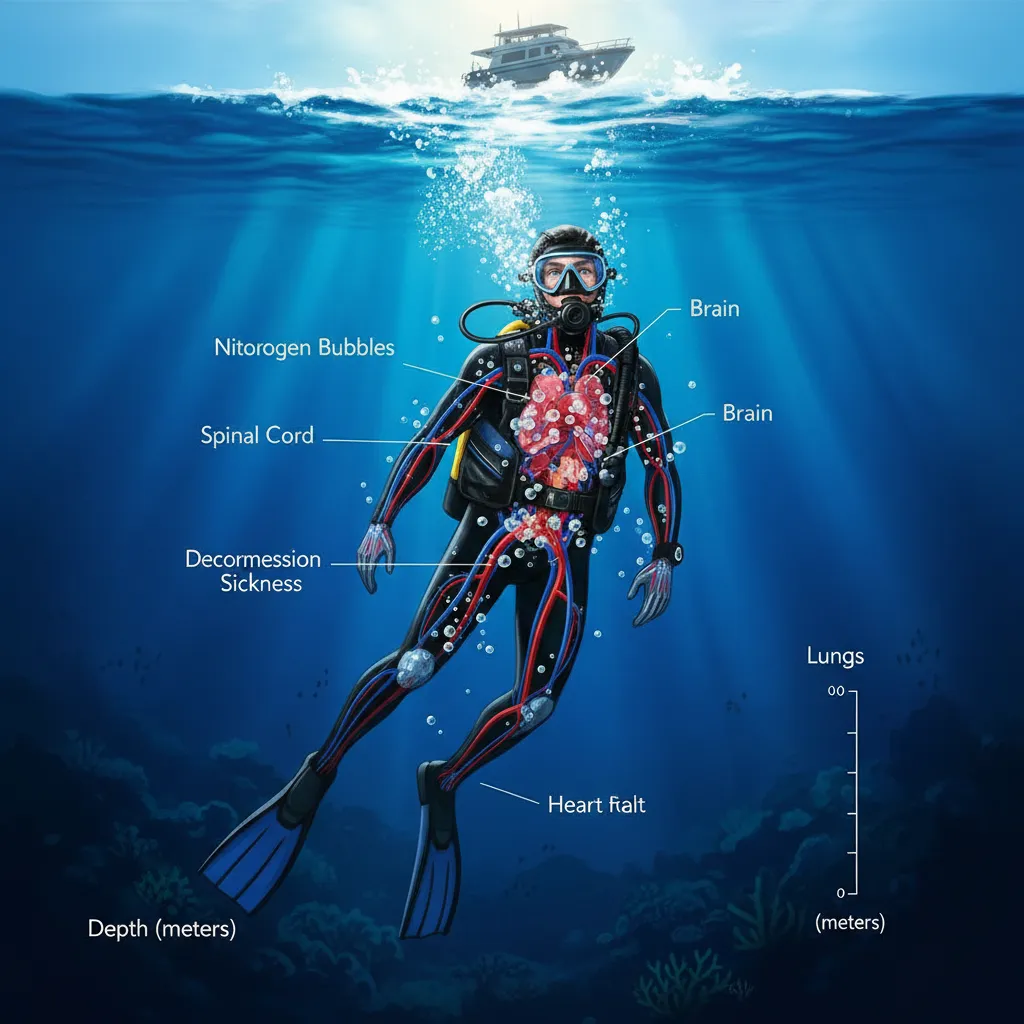
Decompression sickness - commonly called "the bends" - is the condition divers fear most, yet with proper training and conservative dive practices, it is almost entirely preventable. Understanding the mechanics behind DCS is essential for every diver, regardless of experience level. When you descend underwater, increasing ambient pressure causes nitrogen from your breathing gas to dissolve into your blood and tissues at a rate proportional to depth and time. This is Henry's Law in action: the solubility of a gas in a liquid is directly proportional to the partial pressure of that gas above the liquid. At depth, your body absorbs nitrogen steadily. The longer and deeper you dive, the more nitrogen saturates your tissues. The problem arises during ascent. As pressure decreases, dissolved nitrogen must come back out of solution. If you ascend slowly enough, nitrogen is carried by the blood to your lungs and exhaled harmlessly. But if pressure drops too quickly - ascending too fast, skipping safety stops, or making multiple deep dives without adequate surface intervals - nitrogen can form bubbles within your tissues and bloodstream, much like opening a shaken bottle of fizzy water. These bubbles can cause a range of symptoms from mild joint pain to life-threatening neurological damage.
How Decompression Sickness Occurs
Every tissue in your body absorbs and releases nitrogen at different rates. Fast tissues (blood, brain, spinal cord) saturate quickly during a dive but also off-gas rapidly during ascent. Slow tissues (cartilage, bone, fat) absorb nitrogen gradually and take hours to release it. Dive computers and tables model these tissue compartments - typically 16 in the Bühlmann algorithm - to calculate how long you can stay at a given depth before requiring staged decompression stops.
Bubble formation is the critical event. Microbubbles form on virtually every dive, but your body can handle small quantities - the lungs filter them out efficiently. Problems begin when bubble volume exceeds your body's capacity to manage them, or when bubbles form in sensitive locations like the spinal cord or inner ear.
Types of Decompression Sickness
Type I - Musculoskeletal and Skin
Type I DCS primarily affects joints, muscles, and skin. Joint pain - especially in shoulders, elbows, and knees - is the most common symptom, reported in roughly 70% of DCS cases. The pain is often described as a deep, dull ache that worsens with movement. Skin symptoms include mottled rash (cutis marmorata), itching, and localised swelling. Type I is considered less severe but still requires treatment, as it can progress to Type II.
Type II - Neurological and Cardiopulmonary
Type II DCS is a medical emergency. Neurological DCS occurs when bubbles affect the brain or spinal cord, producing symptoms such as numbness, tingling, weakness or paralysis in limbs, difficulty walking, confusion, visual disturbances, vertigo, or loss of bladder control. Spinal cord DCS is particularly concerning because delayed treatment can result in permanent damage. Pulmonary DCS ("the chokes") involves bubbles in the lung vasculature, causing chest pain, coughing, and breathing difficulty. Cardiopulmonary DCS is rare but life-threatening.
Risk Factors
Several factors increase your susceptibility to DCS beyond the obvious depth and time variables. Dehydration reduces blood volume and slows nitrogen elimination - always hydrate well before and between dives. Fatigue, poor fitness, and excess body fat (nitrogen is five times more soluble in fat than in water) increase risk. Older divers tend to have slower circulation, reducing off-gassing efficiency. A patent foramen ovale (PFO), a small hole between the heart's upper chambers present in roughly 25% of the population, allows venous bubbles to bypass the lung filter and enter arterial circulation, significantly increasing DCS risk. Cold water exposure causes peripheral vasoconstriction during a dive, trapping nitrogen in tissues, followed by vasodilation on surfacing in warm conditions - releasing bubbles suddenly. Flying after diving before adequate off-gassing (minimum 12 hours after a single no-deco dive, 18-24 hours after repetitive or deco dives) exposes you to further pressure reduction at altitude.
First Aid and Treatment
If you suspect DCS, act immediately. Administer 100% oxygen via a non-rebreather mask - this accelerates nitrogen elimination by creating a steep concentration gradient. Keep the diver lying flat in a horizontal position (the Trendelenburg position is no longer recommended). Encourage oral fluid intake if the diver is conscious and not vomiting - isotonic sports drinks or water, not alcohol. Contact emergency services and DAN (Divers Alert Network) emergency hotline (+1-919-684-9111 internationally). Do not delay evacuation. Definitive treatment is hyperbaric oxygen therapy (recompression) in a chamber, which mechanically shrinks bubbles and drives nitrogen out of tissues. Treatment is most effective within the first 6 hours but can still provide benefit days later - never assume it is "too late" to seek treatment.
Prevention
Ascend slowly - no faster than 9 metres (30 feet) per minute, with many experts recommending 6 metres per minute for the final 10 metres. Always perform a safety stop at 5 metres for 3-5 minutes on every dive. Plan conservative profiles: stay well within your computer's no-decompression limits rather than pushing to the edge. Maintain good hydration - drink 500ml of water in the hour before diving. Avoid strenuous exercise for 4 hours after diving. Build up gradually at the start of a dive trip rather than doing your deepest, longest dive first. Use nitrox (enriched air) when available - the lower nitrogen percentage provides a meaningful safety margin when diving within air-depth limits. Keep your dive computer's conservatism setting at a moderate or high level, especially if you have any risk factors.
Key Takeaways
- 1DCS occurs when dissolved nitrogen forms bubbles in tissues during ascent - caused by ascending too fast or exceeding no-decompression limits
- 2Type I affects joints and skin (painful but treatable); Type II affects the nervous system and lungs (medical emergency requiring recompression)
- 3Key risk factors include dehydration, fatigue, excess body fat, cold water, PFO, and flying too soon after diving
- 4First aid: 100% oxygen, horizontal position, fluids, and immediate evacuation to a hyperbaric chamber
- 5Prevention: ascend at 9m/min or slower, always do a 3-5 minute safety stop at 5m, stay well within no-deco limits, and hydrate thoroughly
- 6Nitrox provides an extra safety margin by reducing the nitrogen fraction in your breathing gas
Frequently Asked Questions
How quickly do DCS symptoms appear?
Most DCS symptoms appear within 1-6 hours of surfacing, with roughly 50% manifesting within the first hour. However, symptoms can appear up to 48 hours after a dive. Any unusual symptoms following a dive - even mild joint pain or tingling - should be treated as potential DCS until proven otherwise.
Can you get the bends from shallow dives?
While rare, DCS can occur after dives as shallow as 6 metres (20 feet) if the diver has made many repetitive dives over several days, is significantly dehydrated, or has a PFO. Shallow but long dives (over 60 minutes) can produce surprisingly high nitrogen loading.
Is DCS the same as an arterial gas embolism?
No. DCS is caused by dissolved gas coming out of solution as bubbles in tissues. An arterial gas embolism (AGE) is caused by gas entering the bloodstream through ruptured lung tissue, typically from breath-holding or a rapid uncontrolled ascent. AGE symptoms tend to be immediate and severe (stroke-like). Both are treated with hyperbaric oxygen therapy.
Does a dive computer prevent DCS?
A dive computer significantly reduces your risk by calculating real-time nitrogen loading and providing no-decompression limits, ascent rate warnings, and safety stop reminders. However, no computer can guarantee you won't get DCS - algorithms are mathematical models, not biological certainties. Individual variation means some divers are more susceptible than the model predicts.