Nitrox (Enriched Air) Diving: Benefits & Considerations
By DivePlnr Editorial Team | Published March 2026 | Updated March 2026
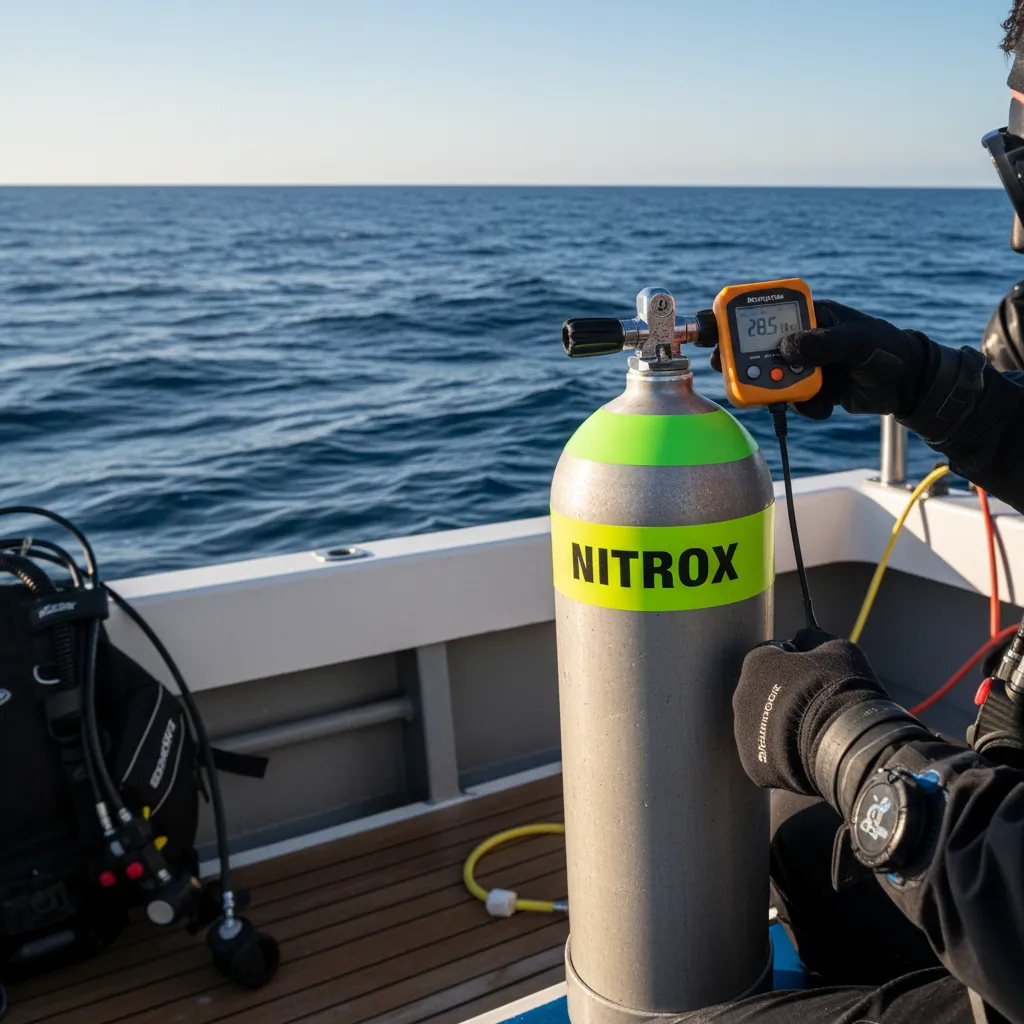
Nitrox, also known as Enriched Air Nitrox (EANx), is a breathing gas mixture containing a higher percentage of oxygen than normal air. Standard air contains approximately 21% oxygen and 79% nitrogen. The most common nitrox mixture used in recreational diving is EAN32 (32% oxygen, 68% nitrogen) or EAN36 (36% oxygen, 64% nitrogen). By reducing the proportion of nitrogen in the breathing gas, nitrox offers significant advantages for recreational divers: extended no-decompression limits, reduced nitrogen loading, shorter surface intervals between repetitive dives, and reduced post-dive fatigue. These benefits make nitrox particularly valuable for divers doing multiple dives per day, diving at moderate depths of 18-30 metres where the NDL extension is most meaningful, and on dive holidays where maximising underwater time is a priority. The Nitrox certification is the most popular specialty course in recreational diving and for good reason - it is immediately practical, relatively simple to learn, and provides tangible benefits on every subsequent dive. However, nitrox also introduces an important consideration that air divers do not face: oxygen toxicity. Higher oxygen concentrations limit the maximum depth to which a mixture can be safely breathed, and exceeding this limit can cause a life-threatening seizure underwater. Understanding and managing this oxygen exposure limit is the primary focus of nitrox training.
How Nitrox Extends Bottom Time
No-decompression limits are determined by nitrogen absorption. Since nitrox contains less nitrogen than air, a diver breathing nitrox absorbs nitrogen more slowly at any given depth. The practical result is significantly extended NDLs at recreational depths. For example, at 30 metres, the NDL on air is approximately 20 minutes. On EAN32, it extends to approximately 30 minutes - a 50% increase. At 24 metres, the difference is even more dramatic: 30 minutes on air versus 45+ minutes on EAN32.
This extension is most valuable at moderate depths (18-30 metres) where recreational divers spend most of their time. At very shallow depths (less than 15 metres), NDLs on air are already so generous that nitrox provides minimal additional benefit. At depths approaching the maximum operating depth for a given nitrox mix, other limitations apply.
Maximum Operating Depth (MOD)
The maximum operating depth is the deepest you can safely breathe a particular nitrox mixture without exceeding a safe partial pressure of oxygen (ppO2). For recreational nitrox diving, the maximum ppO2 is 1.4 bar (with 1.6 bar as an absolute contingency limit).
For EAN32 at ppO2 1.4: MOD = (1.4 / 0.32 - 1) x 10 = 33.75 metres. For EAN36 at ppO2 1.4: MOD = (1.4 / 0.36 - 1) x 10 = 28.9 metres. These are firm limits - exceeding the MOD risks CNS (central nervous system) oxygen toxicity, which can cause seizures underwater. A seizure underwater is almost always fatal because the regulator falls from the mouth.
Oxygen Toxicity
CNS Oxygen Toxicity
Central nervous system oxygen toxicity occurs when the partial pressure of oxygen exceeds safe limits. Symptoms can include visual disturbances (tunnel vision), ear ringing, nausea, twitching (particularly facial muscles), irritability, and dizziness. These symptoms are remembered by the acronym VENTID-C (Vision, Ears, Nausea, Twitching, Irritability, Dizziness, Convulsions). However, seizures can occur without warning symptoms. The only reliable prevention is staying within your MOD.
Pulmonary Oxygen Toxicity
Long-duration exposure to elevated ppO2 (typically above 0.5 bar for many hours) can cause lung inflammation. This is generally only a concern for technical divers on extended decompression dives or in hyperbaric medicine, not for typical recreational nitrox diving.
Analysing Your Mix
Before every nitrox dive, you must personally analyse the gas in your tank using an oxygen analyser. Verify the oxygen percentage matches the intended mix within 1%. Calculate and record the MOD. Never accept a nitrox fill without analysing it yourself - mislabelled or incorrectly mixed fills, while rare, do occur. Label your tank with the analysed oxygen percentage and MOD.
Using Nitrox Conservatively
Many experienced divers breathe nitrox but set their dive computer to the air algorithm. This provides the extended safety margin of reduced nitrogen loading without the temptation to push NDLs to their nitrox-calculated maximum. This approach does not eliminate the need to respect MOD limits - oxygen toxicity is a physical limit unaffected by computer settings.
Key Takeaways
- 1Nitrox (EAN32/36) reduces nitrogen in breathing gas, extending no-decompression limits by 30-50% at moderate depths
- 2Maximum Operating Depth for EAN32 is approximately 34 metres - exceeding this risks fatal oxygen toxicity seizures
- 3Always personally analyse your nitrox fill before diving and verify the oxygen percentage
- 4Nitrox is most beneficial for repetitive diving at 18-30 metres and multi-day dive holidays
- 5Nitrox certification is the most popular and immediately practical specialty course
- 6Many experienced divers breathe nitrox but plan conservatively on air tables for extra safety margin
Frequently Asked Questions
Is nitrox certification worth it?
Absolutely - the Enriched Air Nitrox specialty is widely considered the most valuable certification after Open Water. It extends your bottom time significantly, reduces nitrogen loading, and allows shorter surface intervals on multi-dive days. The course is straightforward (typically half a day), and once certified, you can use nitrox anywhere in the world. Most dive operations charge a small premium ($5-15) for nitrox fills.
Can nitrox prevent decompression sickness?
Nitrox reduces the risk of DCS by lowering nitrogen absorption, but it does not eliminate the risk entirely. Diving within nitrox NDLs still requires proper ascent rates, safety stops, and conservative planning. Some divers breathe nitrox but set their computers to air mode, using the reduced nitrogen loading as an additional safety buffer rather than extending bottom time.
Can I use nitrox in any scuba tank?
Nitrox up to 40% oxygen can be used in standard scuba tanks in most countries. Mixes above 40% require oxygen-cleaned (O2-clean) tanks and dedicated regulators to prevent the risk of oxygen-fuelled fire or explosion. Always ensure your equipment is rated for the mix you intend to use. Some dive operations require dedicated nitrox regulators even for standard recreational mixes.
Does nitrox make you feel less tired after diving?
Many divers report reduced fatigue after nitrox dives compared to air dives, though scientific evidence is mixed. The reduced nitrogen loading may play a role, or the effect could be psychological. Regardless, thousands of experienced divers consider reduced fatigue one of the practical benefits, particularly on multi-dive days or week-long dive holidays.