Rebreather Diving: How CCR Works
By DivePlnr Editorial Team | Published March 2026 | Updated March 2026
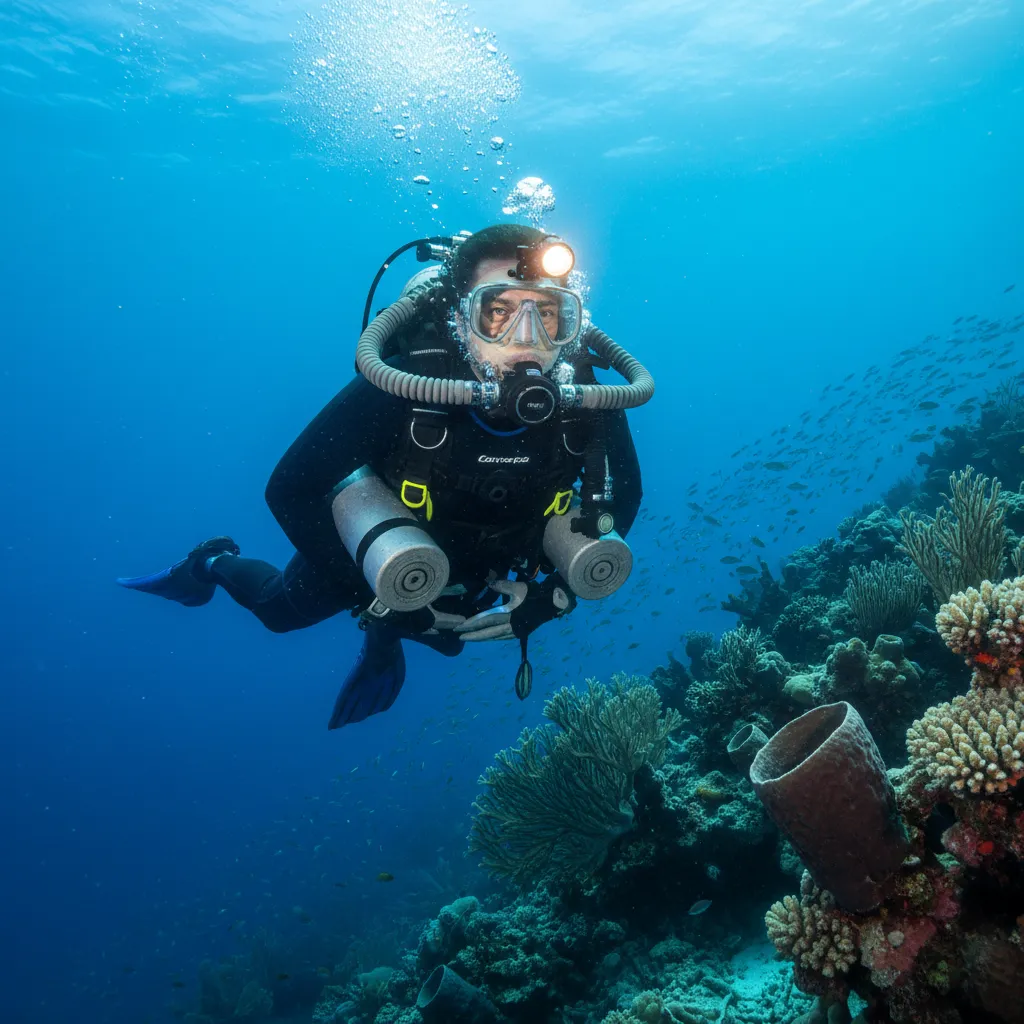
Rebreather diving represents the cutting edge of underwater exploration technology. Unlike open-circuit scuba, where every exhaled breath is vented as bubbles, a rebreather recirculates exhaled gas - scrubbing the carbon dioxide, replacing the consumed oxygen, and returning the gas for the diver to breathe again. The result is dramatically extended dive times, near-silent operation that does not disturb marine life, warm moist breathing gas, and optimised decompression at every depth. A Closed Circuit Rebreather (CCR) maintains a constant partial pressure of oxygen (setpoint) regardless of depth by injecting oxygen as needed from a small cylinder, while an absorbent canister (scrubber) removes CO2 from the exhaled gas. The loop - the breathing circuit - recirculates gas with minimal waste. Where an open-circuit deep diver might consume a twinset of gas in 30 minutes, a CCR diver at the same depth uses only the small amount of oxygen actually metabolised by the body - roughly 0.5-1 litre per minute regardless of depth. The technology is mature and reliable in experienced hands, but demands a fundamentally different skill set, mindset, and maintenance discipline compared to open-circuit diving. Rebreather diving is not for everyone, but for those who embrace it, it opens doors to underwater experiences that open-circuit cannot match.
How a CCR Works
A Closed Circuit Rebreather consists of several key components: a breathing loop (mouthpiece, counterlungs, and hoses), a CO2 scrubber canister filled with absorbent material (typically sofnolime or similar), oxygen and diluent cylinders with solenoid-controlled injection, oxygen sensors (typically three, for redundancy), and a controller (computer) that manages the setpoint. The diver breathes from the loop: exhaled gas passes through the scrubber where CO2 is chemically absorbed, oxygen is injected to maintain the desired partial pressure (setpoint), and the clean, oxygen-replenished gas returns to the diver. Diluent gas (air or trimix) is added as needed to maintain loop volume during descent.
Advantages of Rebreather Diving
Gas efficiency is the primary advantage - a CCR uses only the oxygen metabolised by the body, independent of depth. This means a small 2-3 litre oxygen cylinder can support hours of diving. Silent operation (no bubbles) allows closer approaches to marine life - photographers and researchers prize this capability. The breathing gas is warm and moist (heated by the CO2 absorption reaction), reducing dehydration and heat loss. The constant optimal oxygen fraction at every depth provides the best possible decompression - equivalent to breathing the ideal nitrox mix at every depth change, which no open-circuit configuration can achieve.
Risks and Failure Modes
Rebreather diving has specific risks not present in open-circuit: hypoxia (if oxygen injection fails and PO2 drops), hyperoxia (if oxygen over-injection raises PO2 above safe limits), hypercapnia (if the scrubber is exhausted or bypassed and CO2 builds up in the loop), and caustic cocktail (if water contacts the scrubber material, creating a caustic alkaline solution). Each failure mode can be fatal. Oxygen sensor failure is the most insidious risk - sensors degrade over time and can fail without warning, giving false readings. This is why CCRs use three independent sensors and voting logic.
Training Requirements
CCR training is unit-specific - you must train on the exact rebreather model you will dive. Courses cover: unit assembly and pre-dive checks, loop and scrubber management, bailout to open circuit, oxygen sensor calibration and monitoring, failure recognition and response, and decompression planning. Minimum prerequisites typically include Advanced Nitrox and Decompression Procedures certification, plus significant open-circuit experience (100-200+ dives). Training is intensive and ongoing - rebreather diving demands regular practice and currency.
Key Takeaways
- 1CCR recirculates exhaled gas: scrubs CO2, replaces O2, dramatically extending dive times
- 2Gas consumption is independent of depth - a small O2 cylinder supports hours of diving
- 3Silent operation allows unprecedented close approaches to marine life
- 4Specific risks include hypoxia, hyperoxia, hypercapnia, and scrubber failure - each potentially fatal
- 5Training is unit-specific and requires significant open-circuit experience as a prerequisite
- 6Pre-dive checks and equipment maintenance discipline are critical - complacency kills on rebreathers
Frequently Asked Questions
How much does a rebreather cost?
A quality CCR unit costs $5,000-15,000+ USD depending on the model. Popular units include the rEvo, AP Inspiration, JJ-CCR, and Liberty. Add training costs ($2,000-4,000+), scrubber material (ongoing consumable), oxygen sensors (replaced every 12-18 months, $100-150 each), and servicing. The total investment is significant but justified by the capabilities it provides.
How long can you dive on a rebreather?
Scrubber duration (typically 2-4 hours depending on depth, temperature, and workload) is usually the limiting factor, not gas supply. A CCR can support dives of 3+ hours on a single scrubber fill. Practical dive times are often limited by cold, decompression obligation, or physiological fatigue rather than equipment capacity.
Are rebreathers safe?
In the hands of properly trained, current, and disciplined divers, modern CCRs are reliable. However, rebreather diving has a higher fatality rate per dive than open-circuit - largely due to human factors: inadequate pre-dive checks, complacency, failure to monitor sensors, diving beyond training, and poor maintenance. The technology is sound; the human interface is where risk concentrates.
Can I learn to dive a rebreather as a recreational diver?
Some agencies offer recreational CCR courses that keep you within no-decompression limits. However, most CCR training assumes significant open-circuit experience (100+ dives minimum) and at least Advanced Nitrox certification. The unit-specific training is intensive, and maintaining rebreather skills requires regular practice. It is not a shortcut to longer dives - it is an entirely different diving discipline.