Underwater Navigation: Compass & Natural Methods
By DivePlnr Editorial Team | Published March 2026 | Updated March 2026
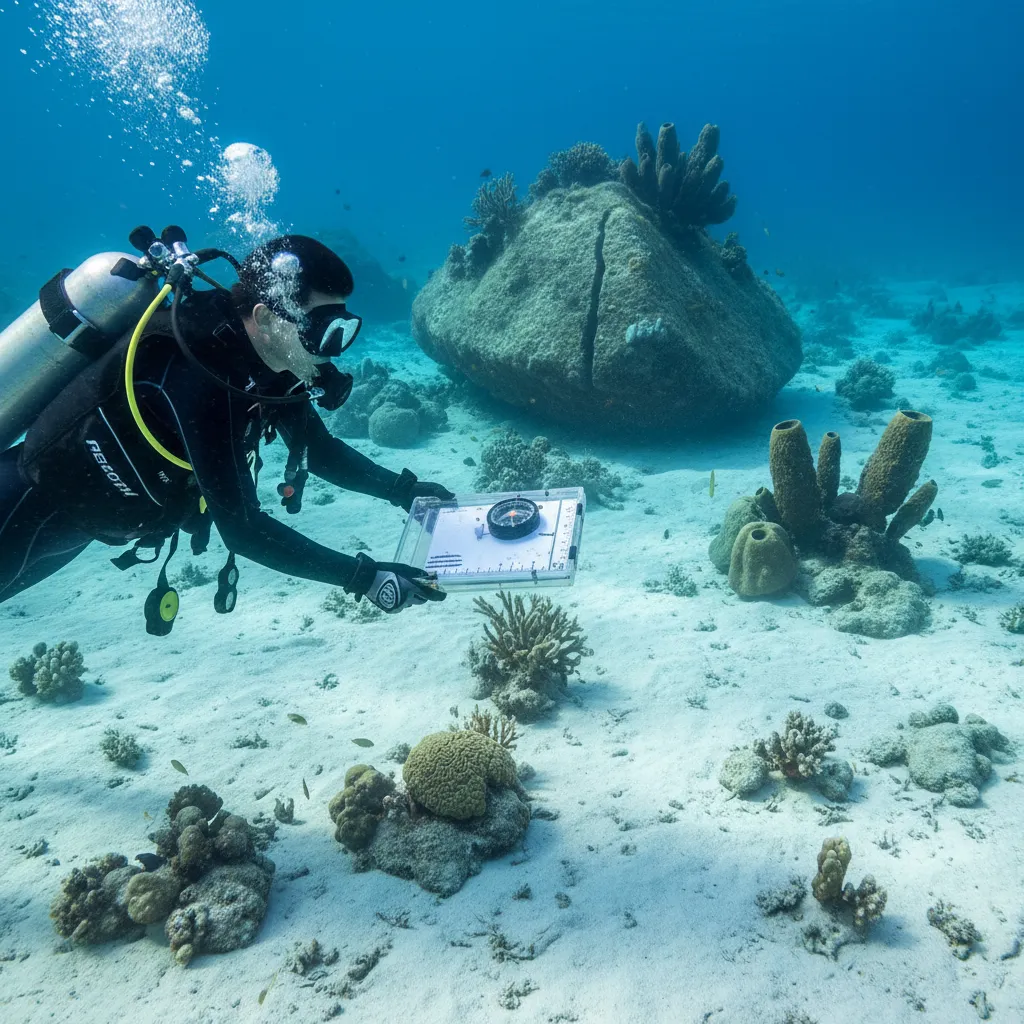
Underwater navigation is one of the most practical and rewarding skills a diver can develop. The ability to find your way to a specific site, navigate around a reef system, and return to your exit point or anchor line without surfacing transforms you from a follower into an independent, self-reliant diver. Navigation underwater is challenging because the lack of distant landmarks, altered perception of distance and direction, and the three-dimensional nature of the underwater environment all conspire against natural orientation. Fortunately, two complementary approaches - compass navigation and natural navigation - provide reliable methods for maintaining direction and position awareness. Compass navigation uses a magnetic compass to establish and follow headings, providing precision regardless of visibility or familiarity with a site. Natural navigation uses environmental cues - sunlight direction, sand ripple patterns, reef contours, current direction, depth contours, and bottom composition changes - to maintain orientation intuitively. The best navigators use both methods simultaneously, with the compass providing a reliable reference and natural cues providing context and confirmation. Strong navigation skills reduce stress, extend exploration range, conserve air (no surface swims back to the boat), and significantly improve safety by ensuring you can always find your way back.
Compass Navigation Fundamentals
An underwater compass works exactly like a land compass - a magnetic needle aligns with Earth's magnetic field, pointing to magnetic north. The compass housing rotates to set a lubber line (reference mark) to your desired heading. To follow a heading, align the magnetic needle with the north index mark and swim in the direction of the lubber line.
Setting and Following a Heading
Point your body (and the compass lubber line) toward your destination. Rotate the compass bezel until the north-seeking needle aligns with the north index mark. Your heading is now set. To follow it, swim while keeping the needle aligned with the index mark. Check the compass frequently - every 10-15 seconds - and correct small deviations immediately before they compound.
Reciprocal Headings
To return the way you came, swim a reciprocal heading - 180 degrees opposite your outbound heading. On most dive compasses, the reciprocal is indicated by a south index mark or second lubber line opposite the primary one. Simply rotate until the needle aligns with this opposite mark. Practice setting and following reciprocal headings until it becomes automatic.
Square and Triangle Patterns
A square navigation pattern involves four 90-degree turns, each swum for the same number of kick cycles. If executed correctly, you return to your starting point. Turn right for a clockwise square (add 90 degrees to your heading at each corner) or left for counter-clockwise. Triangle patterns use three 120-degree turns. These patterns are taught in navigation courses and are excellent practice exercises.
Natural Navigation Techniques
Sunlight and Shadows
In clear water, sunlight direction provides a reliable east-west reference, particularly in the morning and afternoon when the sun is lower. Shadows cast by reef structures indicate the sun's direction. This works best in tropical waters with good visibility and is less reliable in overcast conditions or murky water.
Sand Ripples
Wave action creates parallel ripple patterns in sand that run perpendicular to the prevailing wave direction (and therefore parallel to the shoreline). Swimming along the ripples keeps you parallel to shore; swimming across them takes you toward or away from shore. This is particularly useful for shore diving.
Depth Contours
Most reef systems slope from shallow near-shore areas to deeper water offshore. Maintaining awareness of your depth and the bottom slope provides constant directional reference. A reef wall to your right on the outbound leg should be to your left on the return.
Current
Note the current direction at the start of the dive. Current against your face on the way out means current at your back on the way home - and vice versa. When possible, swim into the current at the start of the dive (when you have full air) and return with it (when you are lower on air and energy).
Practical Tips
Count kick cycles to estimate distance - a consistent flutter kick covers roughly 1 metre per cycle. Use landmarks: a distinctive coral head, an unusual rock formation, or a piece of debris can serve as waypoints. On unfamiliar sites, look behind you regularly to see what the return path will look like. Practice navigation on every dive, even guided ones - try to predict where the divemaster will turn, and compare your compass heading to the actual route.
Key Takeaways
- 1Combine compass navigation with natural cues for the most reliable underwater orientation
- 2Reciprocal headings (180 degrees opposite) are the simplest way to return to your starting point
- 3Sand ripple patterns run parallel to shore - use them for directional reference on shore dives
- 4Count kick cycles to estimate distance - roughly 1 metre per consistent kick cycle
- 5Always note current direction at dive start - swim into it first, return with it
- 6Practice square and triangle navigation patterns to build compass confidence
Frequently Asked Questions
What type of compass is best for scuba diving?
A wrist-mounted compass with a large, easy-to-read dial and clear lubber line is most practical. Look for a compass with a side window for reading headings while swimming horizontally and a top window for reading while hovering. Many dive computers include a digital compass, which is convenient but often less intuitive than an analogue compass for navigation training.
How do I navigate in poor visibility?
In low visibility, compass navigation becomes essential as natural cues are limited. Maintain close buddy contact, reduce pace, and check your compass more frequently. Use a reference line (such as the anchor line for departure and return) when possible. Bottom composition changes - sand to rock, mud to rubble - provide navigation cues even when you cannot see far.
How can I practice underwater navigation?
Start with simple out-and-back compass courses on familiar sites. Progress to square and triangle patterns. Practice estimating distance by counting kick cycles. On guided dives, maintain your own compass awareness and try to predict the route. Many dive shops offer navigation specialty courses with structured exercises.