Underwater Scooters (DPVs): How They Work & Are They Worth It?
By DivePlnr Editorial Team | Published April 2026 | Updated April 2026
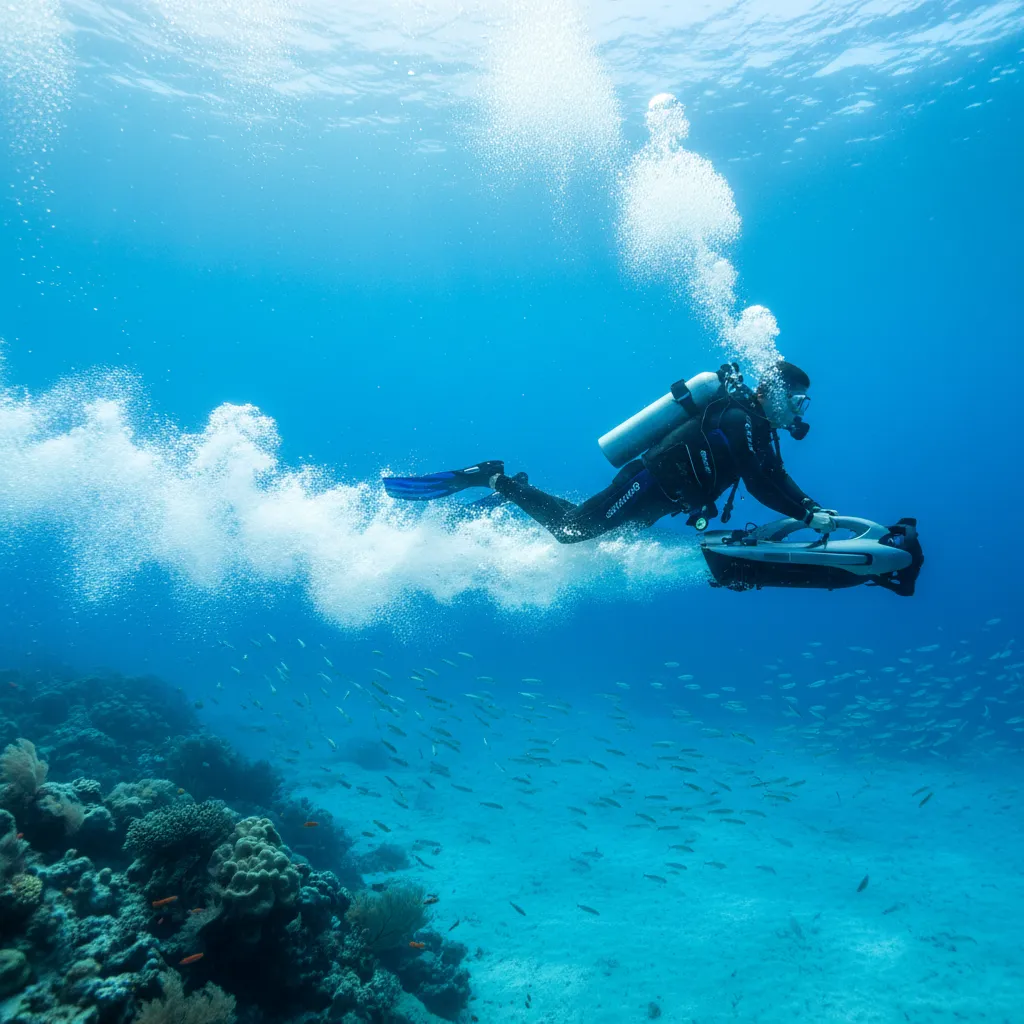
Diver propulsion vehicles (DPVs) - commonly called underwater scooters - are battery-powered devices that pull divers through the water at speeds far exceeding what fins alone can achieve. A typical recreational DPV moves at 1.5-3 knots (roughly 2-5 km/h), while high-end technical and military models can exceed 5 knots. To put that in perspective, an average scuba diver kicks at roughly 0.5-0.7 knots - so even a basic scooter triples your speed and dramatically extends your range. DPVs were originally developed for military and commercial diving operations where covering large distances efficiently was essential. Cave divers adopted them in the 1980s and 1990s to access remote passages in Florida's vast spring systems and Mexico's cenotes, where the distance to explore from a single entry point can exceed 2 kilometres. Today, DPVs have become increasingly accessible to recreational divers, with entry-level models available from around $500 and premium units ranging from $2,000 to $15,000+. They are transformative tools - imagine covering an entire reef system in a single dive instead of seeing just one small section - but they introduce unique safety considerations that every user must understand.
How DPVs Work
A DPV consists of a sealed, pressure-rated housing containing a rechargeable battery (typically lithium-ion in modern units), an electric motor, and a propeller or impeller protected by a shroud or nozzle. The diver grips handles on the rear of the housing and controls speed with a trigger, thumb lever, or twist grip. Most units offer variable speed settings - slower for fine manoeuvring in confined spaces, faster for open-water transits. The propulsion force is directed rearward, pulling the diver forward. Buoyancy characteristics vary: some DPVs are slightly negative in water and sink if released, while others can be trimmed to near-neutral.
Battery technology has transformed DPVs over the past decade. Modern lithium-ion cells offer 60-120 minutes of run time at cruising speed, compared to 20-40 minutes from older NiMH or lead-acid batteries, in packages that are significantly lighter and more compact. Depth ratings range from 40 metres for recreational models to 100+ metres for technical units. Charging time is typically 3-6 hours from depleted.
When DPVs Are Useful
Covering Distance
DPVs excel when the dive plan involves covering a large area - long reef walls, extensive wreck fields, or transiting between widely spaced points of interest. A DPV turns a dive where you would see 200 metres of reef into one where you cover a kilometre or more. This is particularly valuable on drift dives where you want to move faster than the current, or on sites where the best features are spread far apart.
Cave and Technical Diving
Cave divers were early DPV adopters for good reason: cave penetration distances can be enormous, and finning generates silt that destroys visibility. A DPV allows cave divers to reach remote passages with minimal exertion and silt disturbance. In cave diving, DPVs also reduce gas consumption - less physical effort means lower breathing rates. Technical divers use DPVs for similar reasons: covering distance to reach deep sites, reducing exertion (and therefore gas consumption) during long deco dives, and towing stages and equipment.
Underwater Photography and Videography
Photographers use DPVs to quickly reposition between subjects, reach shy pelagic animals before they disappear, and reduce air consumption so they can spend longer at a site. The ability to approach subjects effortlessly from optimal angles - without the bubble-producing exertion of heavy finning - is a genuine advantage for wildlife photography.
Safety Considerations
Buoyancy Control
DPVs move you vertically as well as horizontally. Pointing the scooter slightly upward or downward while at speed can cause rapid depth changes. In cave diving, hitting the ceiling at 3 knots can cause serious injury. Maintain disciplined body position, keep the DPV pointed parallel to your intended path, and make deliberate depth changes - do not let the scooter dictate your depth.
Entanglement
The spinning propeller creates a genuine entanglement risk with fishing line, kelp, guide lines, or loose equipment. Always ensure your gear is streamlined with nothing dangling. In cave environments, maintain awareness of the guideline's position relative to your scooter. Most modern DPVs have propeller guards, but they do not eliminate entanglement risk entirely.
Runaway Scooter
A DPV that activates unexpectedly or cannot be turned off is a runaway scooter - a serious emergency. At depth, a runaway can drag you rapidly toward the surface, risking DCS and lung over-expansion. If you cannot turn off a runaway scooter: release it immediately. Let it go. Your life is worth more than the equipment. Point yourself downward and fin against the buoyancy change while you regain controlled buoyancy. Quality DPVs have magnetic safety switches (lanyards) that kill the motor if the unit separates from the diver.
Gas Management
A DPV extends your range dramatically, which means you can be a long way from your exit point. Apply the rule of thirds rigorously: one third of your gas to go out, one third to come back, one third as reserve. Remember that your return journey without the scooter (if it fails) will take much longer and consume much more gas than the outbound trip. Plan your turn pressure based on finning back, not riding back.
Choosing a DPV
For recreational divers exploring reefs and wrecks in warm water, an entry-level scooter ($500-1,000) with 40-60 minutes run time and 1.5-2 knot speed is a fun addition that opens up new dive possibilities. For serious recreational and light technical use, mid-range units ($1,000-3,000) offer longer battery life, better speed, deeper ratings, and more robust construction. For cave diving and heavy technical use, expect to spend $3,000-10,000 on units with 90+ minute run time, 3+ knot speed, tool-less battery swaps, and proven reliability. Brands to research include Suex, Bonex, DiveX, Sublue, and Lefeet for recreational models.
Key Takeaways
- 1A DPV triples your swimming speed (1.5-3 knots vs 0.5-0.7 knots finning), dramatically extending range and reducing gas consumption
- 2Modern lithium-ion batteries provide 60-120 minutes of run time - a massive improvement over older battery technologies
- 3DPVs are transformative for cave diving, covering large reef systems, and underwater photography where repositioning speed matters
- 4Critical safety rule: if a DPV activates uncontrollably (runaway), release it immediately - your life is worth more than the equipment
- 5Always plan gas management for a fin-back return - if the scooter fails far from your exit, you need enough gas to swim back
- 6Entry-level recreational scooters start around $500; serious technical DPVs run $3,000-10,000+
Frequently Asked Questions
Do I need special training to use a DPV?
While not legally required for recreational use, a DPV specialty course is strongly recommended. It covers handling techniques, emergency procedures (runaway scooter, towing a buddy), buoyancy management at speed, and gas planning with extended range. Cave and technical DPV use absolutely requires specific training.
Can I take a DPV on a liveaboard or dive boat?
Some operators welcome DPVs; others prohibit them due to space, charging logistics, or liability concerns. Always check with the operator before booking. Lithium-ion battery regulations also affect air travel with DPVs - many airlines restrict large lithium batteries in checked luggage, though batteries under 160Wh are typically allowed in carry-on.
How deep can underwater scooters go?
Recreational DPVs are typically rated to 30-40 metres - matching recreational diving limits. Technical models are rated to 80-150+ metres. The depth rating reflects the housing's pressure resistance. Never exceed the manufacturer's stated depth limit.
Are DPVs bad for marine life?
Used responsibly, DPVs cause minimal disturbance. They are quieter than a diver's bubbles and create less water turbulence than aggressive finning. However, speeding through a reef at close range is harmful and irresponsible - maintain the same safe distance from marine life that you would while finning, and never use a DPV to chase animals.