Flying After Diving: Rules, Risks & Safe Wait Times
By DivePlnr Editorial Team | Published April 2026 | Updated April 2026
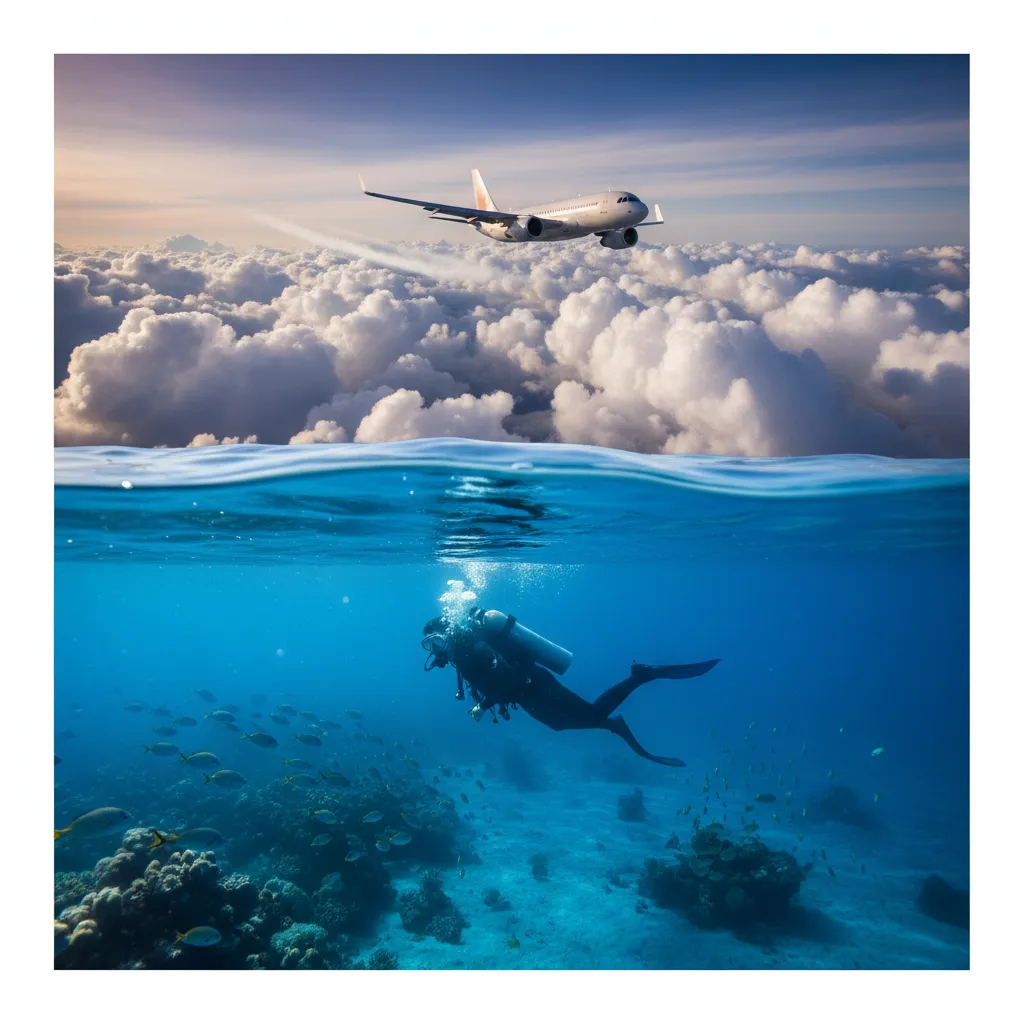
Flying too soon after scuba diving is one of the most common ways divers put themselves at risk of decompression sickness. Aircraft cabins are pressurised to an equivalent altitude of 1,800-2,400 metres (6,000-8,000 feet), which is enough to cause residual nitrogen in your tissues to form dangerous bubbles. Understanding the recommended wait times and the science behind them is essential for any diver planning a trip that ends with a flight home.
Why Flying After Diving Is Dangerous
During every scuba dive, your body absorbs nitrogen from your breathing gas. The deeper and longer you dive, the more nitrogen dissolves into your blood and tissues. After surfacing, your body gradually eliminates this excess nitrogen through normal breathing - a process called off-gassing that can take 12-48 hours depending on your dive profile. When you board an aircraft, the reduced cabin pressure (equivalent to being at 1,800-2,400 metres altitude) causes any remaining dissolved nitrogen to expand and potentially form bubbles in your tissues and bloodstream. This is the same mechanism that causes decompression sickness during an overly fast ascent, but triggered by the altitude change instead. Even a modest amount of residual nitrogen that your body would have safely eliminated at sea level can become problematic at cabin altitude.
Recommended Wait Times
The Divers Alert Network (DAN) and most certification agencies recommend the following minimum surface intervals before flying:
Single No-Decompression Dive
Wait a minimum of 12 hours before flying. This applies if you made one dive within no-decompression limits and have no plans to dive again before your flight. DAN's research suggests that 12 hours is sufficient for most divers after a single conservative dive, though longer is always better.
Multiple Dives or Multi-Day Diving
Wait a minimum of 18 hours before flying. If you have been diving over several days (the typical holiday pattern of 2-4 dives per day), your tissues accumulate significantly more nitrogen than a single dive produces. The 18-hour minimum accounts for this higher nitrogen loading. Many experienced divers and dive professionals recommend 24 hours as a more conservative and safer guideline for multi-day diving.
Decompression Dives
Wait a minimum of 24 hours, and ideally longer. If you performed dives requiring mandatory decompression stops, your nitrogen loading was substantial. Some dive physicians recommend 48 hours after heavy decompression diving. This is non-negotiable - decompression dives push your body's nitrogen tolerance to its limits, and the additional altitude exposure of flying creates genuine danger.
Practical Planning Tips
Schedule Your Last Dive Wisely
The simplest approach: make your last dive on the penultimate day of your trip, not the final day. If your flight departs at 2pm on Saturday, your last dive should be no later than Saturday morning - but ideally, dive your last dive on Friday. This gives you a comfortable 24+ hour buffer without any anxious clock-watching. Many dive resorts and liveaboards build this into their schedules automatically, with the last day reserved for packing and relaxation.
Make Your Last Dive Shallow and Short
If you do dive on your second-to-last day, make the final dive a shallow one - 12 metres (40 feet) or less. Shallow dives produce significantly less nitrogen loading than deep dives, reducing the time your body needs to off-gas. Avoid deep dives (below 30 metres) in the last 24-36 hours before flying.
Use Your Dive Computer's Fly Time
Modern dive computers display a "no-fly" countdown based on your actual dive profile and calculated nitrogen loading. This is more accurate than generic guidelines because it accounts for your specific depth, time, number of dives, and surface intervals. Do not fly until your computer's no-fly timer has reached zero. If your computer says 16 hours but DAN guidelines say 18 hours, follow the longer recommendation.
What About Altitude Without Flying?
The same principles apply to any altitude gain after diving. Driving over a mountain pass, taking a cable car to a high viewpoint, or even driving to a hotel at significant elevation can pose similar risks. In many dive destinations this is relevant - in Bali, the drive from the coast to Ubud gains meaningful altitude. In Egypt, excursions to high desert locations after diving in Dahab or Sharm el-Sheikh should be considered. The general rule: avoid going above 300 metres (1,000 feet) elevation gain for the same time periods recommended for flying.
What If You Must Fly Sooner?
If circumstances force you to fly before the recommended wait time - a medical emergency, for example - inform the flight crew that you have been scuba diving recently and when your last dive was. Request supplemental oxygen if available. Stay well hydrated before and during the flight, avoid alcohol (which impairs off-gassing), and do not sleep during the flight so you can monitor yourself for symptoms. If you develop any symptoms of decompression sickness during or after the flight - joint pain, tingling, numbness, dizziness, rash, difficulty breathing - seek medical attention immediately and mention your recent diving history. Contact DAN's emergency hotline for guidance.
Symptoms to Watch For
DCS symptoms can appear during a flight or up to 24 hours after landing. Be alert for: deep joint pain (especially shoulders, elbows, knees), skin rash or mottling, unusual fatigue, tingling or numbness in extremities, dizziness or vertigo, visual disturbances, difficulty thinking clearly, or chest pain. Do not dismiss symptoms as "jet lag" or "travel fatigue" - if you have been diving in the past 48 hours and feel unwell, treat it as potential DCS until proven otherwise. Early treatment with hyperbaric oxygen therapy dramatically improves outcomes.
Key Takeaways
- 1Wait at least 12 hours after a single no-decompression dive, 18 hours after multiple dives, and 24+ hours after decompression dives before flying
- 2Aircraft cabin pressure is equivalent to 1,800-2,400 metres altitude - enough to cause residual nitrogen to form dangerous bubbles
- 3Plan your last dive for the penultimate day of your trip to build in a comfortable safety buffer
- 4Make your final dive shallow (12m or less) to minimise nitrogen loading before travel
- 5The same wait times apply to any significant altitude gain, not just flying - mountain passes, cable cars, and high-altitude drives count
- 6If DCS symptoms appear during or after a flight, seek immediate medical attention and contact DAN's emergency hotline
Frequently Asked Questions
Can I fly 12 hours after diving?
Only if you made a single no-decompression dive. After multiple dives or multi-day diving, the minimum recommended wait is 18 hours, with 24 hours being a safer guideline. After decompression dives, wait at least 24 hours. When in doubt, wait longer - there is no risk from waiting too long, but significant risk from flying too soon.
What happens if I fly too soon after diving?
The reduced cabin pressure at altitude can cause residual dissolved nitrogen in your tissues to form bubbles, resulting in decompression sickness (DCS). Symptoms range from joint pain and skin rash to serious neurological problems including paralysis. The risk is proportional to how much residual nitrogen remains and how soon after diving you fly.
Does my dive computer's no-fly time replace DAN guidelines?
Your dive computer provides a personalised no-fly countdown based on your actual dive profiles, which is more precise than generic guidelines. However, if your computer shows a shorter wait time than DAN recommends, follow the longer DAN guideline. Computers use mathematical models that may not account for individual risk factors like dehydration, age, or body composition.
Can I take a helicopter or small plane after diving?
Small aircraft and helicopters often fly unpressurised at altitudes of 1,500-3,000 metres, making them potentially more dangerous than commercial flights after diving. The same wait-time guidelines apply. If taking a seaplane transfer (common in the Maldives), confirm the flying altitude with the operator - seaplanes typically fly at only 300-500 metres, but even this modest altitude can be problematic with high nitrogen loading.
Is it safe to snorkel before flying?
Yes. Snorkelling on the surface does not cause nitrogen absorption because you are breathing at atmospheric pressure. You can snorkel right up until your departure day with no concerns. This makes snorkelling an excellent last-day activity when you can no longer dive.
What about hyperbaric chamber availability at my destination?
Before any dive trip, note the location of the nearest hyperbaric chamber. DAN maintains a worldwide database of chambers. Popular dive destinations typically have facilities nearby, but remote locations may require evacuation. Having DAN dive insurance ensures coverage for chamber treatment and medical evacuation regardless of location.