How Much Does Scuba Certification Cost? (Complete Guide)
By DivePlnr Editorial Team | Published April 2026 | Updated April 2026
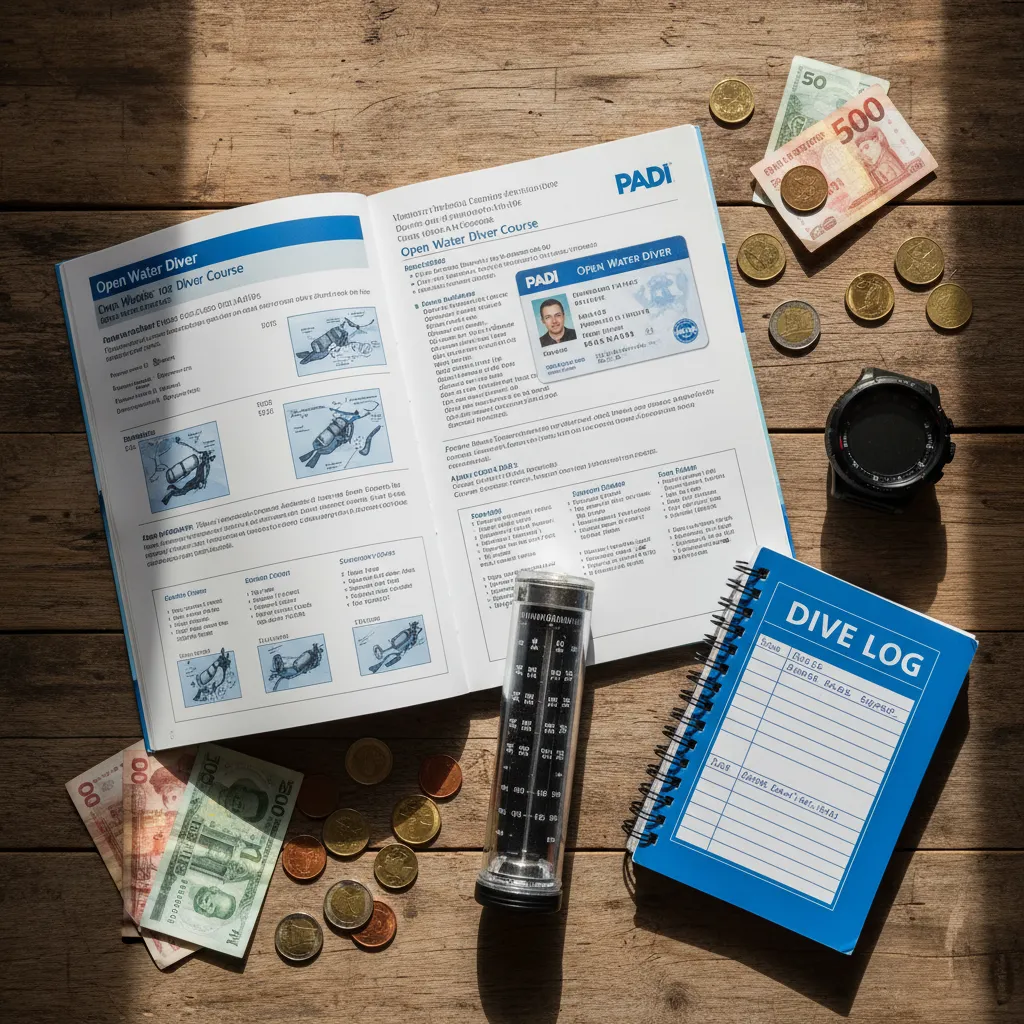
Scuba certification costs vary dramatically depending on where you learn, which agency you choose, and what is included in the price. An Open Water course can range from $250 in Southeast Asia to $800+ in major Western cities. This guide breaks down every cost involved - course fees, equipment rental, materials, hidden extras - so you can budget accurately and find the best value for your money.
Open Water Certification Costs by Region
The Open Water Diver course is the entry-level certification that allows you to dive independently to 18 metres (60 feet). Pricing varies enormously by location, driven by local cost of living, competition between dive shops, and what is bundled into the price.
Budget Destinations ($250-$400)
Thailand (Koh Tao), Honduras (Utila and Roatan), Egypt (Dahab and Sharm el-Sheikh), Indonesia (Gili Islands), and the Philippines (Moalboal) consistently offer the lowest certification prices globally. Koh Tao is arguably the world capital of budget diving education - intense competition among dozens of dive schools keeps prices low while maintaining quality. At these prices, courses typically include all equipment rental, learning materials, boat fees, and 4 open water dives. Some shops include free or discounted accommodation as an incentive.
Mid-Range Destinations ($400-$600)
Australia (Great Barrier Reef), Mexico (Cozumel and Playa del Carmen), Costa Rica, Croatia, Greece, and mainland Spain fall into this bracket. You will get professional instruction in well-maintained facilities, though equipment rental and materials may be charged separately. Courses in popular tourist areas often include extras like underwater photos or additional fun dives.
Premium Destinations ($600-$900+)
The UK, mainland Europe (France, Switzerland, Germany), the US (Hawaii, California, Florida), Japan, and the Maldives command the highest prices. In the UK, pool sessions often take place in heated pools with open water dives in quarries or the coast, adding facility rental costs. In the Maldives, the resort setting and pristine conditions justify premium pricing. US prices vary widely - Florida and Hawaii hover around $500-$700, while courses in New York or San Francisco can exceed $800.
What is Included (and What is Not)
Typically Included
A standard Open Water course fee should cover: instructor fees for all classroom, pool, and open water sessions; pool or confined water facility access; a minimum of 4 open water dives; and your certification card processing fee. With SSI, digital learning materials are always free. With PADI, eLearning is sometimes bundled, sometimes charged separately ($50-$180).
Common Extras to Budget For
Equipment rental is the biggest variable. Some courses include full equipment; others charge $15-$40 per day for a full kit (BCD, regulator, wetsuit, mask, fins, computer). Learning materials - if taking PADI and eLearning is not bundled - add $50-$180. Boat fees for open water dives may be separate in some locations ($10-$30 per dive). Medical clearance, if required, costs $30-$80 depending on your country. Passport-sized photos for the certification card are occasionally needed ($5-$10). Some dive shops charge for insurance ($5-$15 per day) if you do not have your own dive insurance.
Continuing Education Costs
Advanced Open Water ($250-$450)
The next step after Open Water, this course extends your depth limit to 30 metres and introduces specialties like navigation, deep diving, and buoyancy. It typically involves 5 adventure dives over 2 days. Prices are lower than Open Water because there is less classroom time.
Rescue Diver ($300-$500)
A more intensive course covering emergency management, diver rescue techniques, and first aid. Requires Emergency First Response (EFR) or equivalent first aid certification, which adds $100-$200 if you do not already have one. Many divers consider this the most valuable course they ever take.
Specialty Courses ($150-$350 each)
Nitrox, wreck diving, underwater photography, night diving, drift diving - the list is long. Each specialty typically involves 2-4 dives and a brief theory component. Nitrox is the most popular and arguably the best value, as it improves safety margins on every subsequent dive.
Divemaster ($1,500-$3,000)
The first professional-level rating. Divemaster training is extensive - typically 4-8 weeks of full-time training covering dive theory, rescue skills, dive management, and supervised guiding. Budget destinations (Koh Tao, Utila) offer the most competitive pricing, often with accommodation included. This is a significant investment but opens the door to working in the dive industry worldwide.
Hidden Costs to Watch For
Travel and accommodation are often the largest expense, particularly if you travel specifically to get certified. Factor in flights, transfers, and 3-5 nights of accommodation minimum. Travel insurance with diving cover is essential - standard travel policies often exclude scuba diving. Dedicated dive insurance from providers like DAN (Divers Alert Network) costs $35-$75 per year and covers hyperbaric treatment, which can cost $10,000+ without insurance. Tip culture varies by region - in the Caribbean and Americas, tipping your instructor $20-$50 for a course is customary.
Money-Saving Tips
Book your course directly with the dive shop rather than through a third-party booking platform - you will often get a better price or bundled extras. Ask about package deals if you plan to do Open Water and Advanced back-to-back; most shops offer a discount of 10-20% for combined courses. Get certified at home if you live near suitable open water - this avoids spending precious holiday days in a classroom. Alternatively, do the theory and pool sessions at home (referral course) and complete open water dives on holiday. Buy your own mask and snorkel before the course ($40-$80) - rental masks rarely fit well, and a leaking mask is the number one source of frustration for new divers. Consider SSI over PADI if cost is a primary concern, as SSI's free digital materials save $50-$180 per course.
Key Takeaways
- 1Open Water certification costs $250-$900+ depending on location - Southeast Asia and Central America offer the best value
- 2Always clarify what is included: equipment rental, learning materials, boat fees, and certification card processing can add $100-$300 to the base price
- 3SSI courses are typically cheaper than PADI because all digital learning materials are free
- 4Budget for hidden costs: travel, accommodation, dive insurance ($35-$75/year), medical clearance, and tips
- 5Package deals for Open Water + Advanced back-to-back typically save 10-20%
- 6The Divemaster professional certification costs $1,500-$3,000 and takes 4-8 weeks of full-time training
Frequently Asked Questions
What is the cheapest place to get scuba certified?
Koh Tao (Thailand) and Utila (Honduras) are consistently the cheapest places to get scuba certified, with Open Water courses starting around $250-$300 including all equipment, materials, and dives. Dahab (Egypt) and the Gili Islands (Indonesia) are similarly affordable. At these prices, you still receive quality instruction from certified professionals.
Is it cheaper to get certified at home or on holiday?
It depends on where you live and where you holiday. If you live in the UK or US, getting certified in Southeast Asia or Central America is almost always cheaper, even factoring in flights. However, if you would be spending holiday time in classroom sessions, a referral course (theory at home, dives on holiday) gives you the best of both worlds.
Do I need to buy my own equipment to get certified?
No. All dive schools provide rental equipment for courses. However, buying your own mask ($40-$80) is highly recommended - a well-fitting mask makes a huge difference to comfort. Everything else (BCD, regulator, wetsuit, fins, computer) can be rented until you know you want to continue diving.
Are online scuba courses cheaper?
The eLearning (theory) portion can save time but rarely saves money on its own. With PADI, eLearning costs $50-$180 and may or may not be included in the course price. With SSI, eLearning is always free. Either way, you still need in-water training with a certified instructor, which is where the bulk of the cost lies.
How much should I budget for a dive trip including certification?
For a budget certification trip to Southeast Asia, budget $800-$1,200 total including flights from Europe, 5-7 nights accommodation, the course, food, and insurance. For a mid-range destination like Mexico or Egypt, budget $1,500-$2,500. For premium destinations like the Maldives or Australia, expect $3,000-$5,000+.
Is dive insurance worth the cost?
Absolutely. Dive insurance from DAN or similar providers costs $35-$75 per year and covers hyperbaric chamber treatment, which can cost $10,000-$50,000 without insurance. It also covers dive-related medical evacuations. Standard travel insurance typically excludes scuba diving or limits coverage to shallow depths. Every diver should have dedicated dive insurance.