PADI vs SSI: Which Scuba Certification Is Right for You?
By DivePlnr Editorial Team | Published April 2026 | Updated April 2026
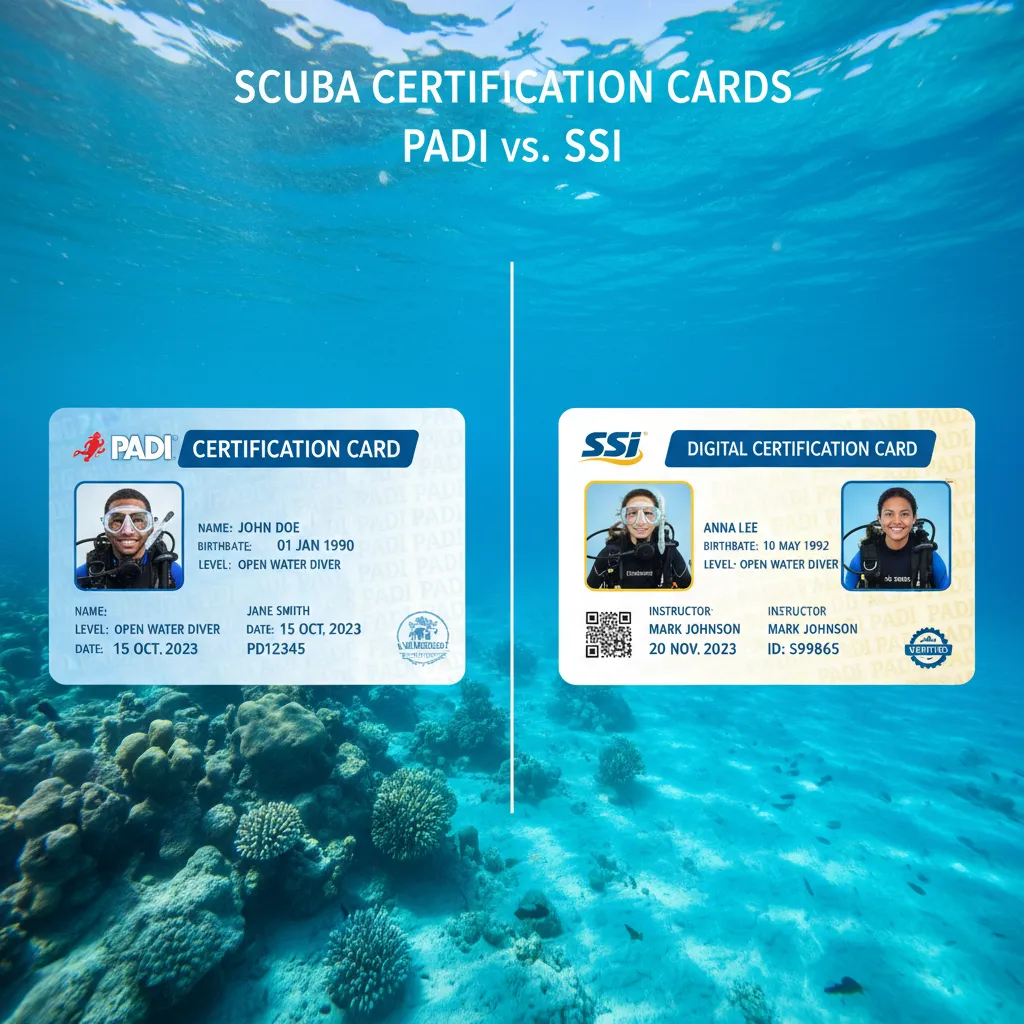
Choosing between PADI and SSI is one of the first decisions new divers face, and it can feel overwhelming. The good news is that both agencies are internationally recognised, produce competent divers, and will open the same doors at dive centres worldwide. The differences lie in their teaching philosophy, pricing structure, and how they deliver learning materials. This guide breaks down exactly what sets them apart so you can make a confident choice.
Overview: Two Giants of Dive Training
PADI (Professional Association of Diving Instructors) and SSI (Scuba Schools International) are the two largest scuba certification agencies in the world, together training the vast majority of new divers annually. PADI was founded in 1966 and operates as an independent certification body - dive shops pay for affiliation but operate independently. SSI was founded in 1970 and uses a retailer-based model where dive centres are more tightly integrated into the SSI network. Both agencies are members of the World Recreational Scuba Training Council (WRSTC), which sets minimum training standards that both exceed.
Head-to-Head Comparison
| Feature | PADI | SSI |
|---|---|---|
| Founded | 1966 | 1970 |
| Learning materials | Paid (digital or physical) | Free digital materials |
| eLearning platform | PADI App / eLearning | SSI App (MySSI) |
| Teaching approach | Structured, prescriptive | Flexible, concept-based |
| Dive centres worldwide | 6,600+ | 3,500+ |
| Certification card | Physical + digital (paid) | Digital free, physical optional |
| Recognition | Universal | Universal |
| Crossover ease | Accepts SSI certs | Accepts PADI certs |
Learning Approach and Materials
PADI: Structured and Standardised
PADI courses follow a highly structured curriculum. Every PADI Open Water student around the world covers the same material in the same sequence. The knowledge development portion is divided into five sections, each paired with a corresponding confined water (pool) session and open water dive. This predictability is a strength - if you start a course in London and finish it in Thailand, the second instructor knows exactly where you left off. PADI materials must be purchased separately, typically costing $50-$180 depending on format. The PADI eLearning platform is polished and well-designed, with video content, knowledge reviews, and quizzes.
SSI: Flexible and Digital-First
SSI takes a more concept-based approach, giving instructors greater flexibility in how they teach the material. The core knowledge is the same - both agencies exceed WRSTC minimums - but an SSI instructor can adapt the sequence and emphasis to suit their students. SSI's biggest differentiator is that all digital learning materials are free through the MySSI app. You register, enrol in a course, and access everything at no cost. This can meaningfully reduce the total cost of getting certified. The SSI app also functions as a digital logbook and training record, tracking your entire dive career in one place.
Cost Comparison
The total cost of an Open Water course depends far more on location than on agency. However, SSI courses tend to be slightly cheaper because the learning materials are free. A PADI Open Water course typically runs $350-$600 globally, while an equivalent SSI course might be $300-$550. In budget destinations like Thailand or Honduras, the difference narrows considerably. For continuing education, the savings with SSI accumulate - every specialty course includes free digital materials, whereas PADI charges for each course's materials separately. Read our full breakdown of scuba certification costs for detailed regional pricing.
Certification Levels and Progression
Both agencies offer equivalent certification tracks. PADI's Open Water Diver maps to SSI's Open Water Diver. PADI Advanced Open Water corresponds to SSI Advanced Adventurer. PADI Rescue Diver equals SSI Diver Stress & Rescue. At the professional level, PADI Divemaster is equivalent to SSI Dive Guide, and both offer instructor-level training. Specialty courses are broadly similar too - both offer nitrox, deep diving, wreck diving, underwater photography, and dozens more. SSI has a unique recognition system that awards ratings (Specialty Diver, Advanced Open Water Diver, Master Diver) automatically based on the number of specialties and logged dives you accumulate.
Worldwide Recognition and Transferability
Here is the most important point: a certification from either agency is recognised at virtually every dive centre and liveaboard on the planet. No reputable dive operation will turn you away because you have an SSI card instead of PADI, or vice versa. If you hold a PADI Open Water certification and want to take an SSI Advanced course, you can - the SSI instructor will accept your PADI credential. The same applies in reverse. You are not locked into one agency for life. Choose whichever works best for your circumstances right now, and switch freely for future courses if a different instructor or shop appeals to you.
Which Should You Choose?
Choose PADI if you value a highly structured learning experience, want the widest possible choice of dive centres (particularly in remote locations), or prefer physical textbooks alongside digital materials. Choose SSI if you want to minimise costs through free digital materials, prefer a flexible learning approach, or like the idea of a single app that tracks your training, certifications, and dive log. If you are taking your first course, the instructor matters far more than the agency - a great SSI instructor will produce a better diver than a mediocre PADI instructor, and vice versa. Ask to meet the instructor beforehand, read reviews, and choose the person who makes you feel confident and comfortable.
Key Takeaways
- 1Both PADI and SSI are internationally recognised - no dive centre will reject either certification
- 2SSI offers free digital learning materials, making courses typically $50-$100 cheaper than PADI equivalents
- 3PADI follows a more structured, prescriptive teaching method; SSI gives instructors more flexibility
- 4Certifications are fully transferable - you can start with one agency and continue education with the other
- 5PADI has more affiliated dive centres worldwide (6,600+), but SSI's network (3,500+) covers all major destinations
- 6The quality of your instructor matters far more than which agency logo is on the card
Frequently Asked Questions
Can I use a PADI certification at an SSI dive centre?
Yes, absolutely. Both PADI and SSI certifications are universally accepted at dive centres worldwide, regardless of their affiliation. An SSI dive centre will recognise your PADI card, and a PADI centre will recognise your SSI card. This applies to all certification levels from Open Water through to professional ratings.
Is PADI harder than SSI?
No. Both agencies meet or exceed the same World Recreational Scuba Training Council (WRSTC) minimum standards. The knowledge and skills you must demonstrate are equivalent. PADI's approach is more structured and standardised, which some students find more rigorous, but the actual difficulty and competency requirements are comparable.
Can I switch from SSI to PADI mid-certification?
Yes, through a referral process. If you complete the theory and pool sessions with an SSI instructor, you can do your open water dives with a PADI instructor (and receive a PADI certification) via a referral. Some additional paperwork or a brief skills review may be required, but it is straightforward.
Which certification is better for professional diving careers?
Neither has a clear advantage. PADI has a larger network, which means slightly more job listings mention PADI by name. However, most dive operations accept instructors from either agency. SSI's professional track (Dive Guide through Instructor) is equally respected. Choose based on the professional training programme that best suits your learning style and budget.
Do PADI and SSI certifications expire?
No. Both PADI and SSI certifications are valid for life and never expire. However, if you have not dived for an extended period (12+ months), most dive centres will require or strongly recommend a Scuba Review or ReActivate refresher course before taking you diving. This is a safety measure, not a recertification requirement.
Are there other certification agencies worth considering?
Yes. SDI/TDI, NAUI, BSAC, CMAS, and RAID are all reputable agencies with globally recognised certifications. BSAC is particularly popular in the UK with a strong club-based model. CMAS is the international federation that many national agencies fall under. For most beginners, PADI or SSI are the practical choice simply because of instructor availability.