Diving in Curaçao Southeast
Why dive here
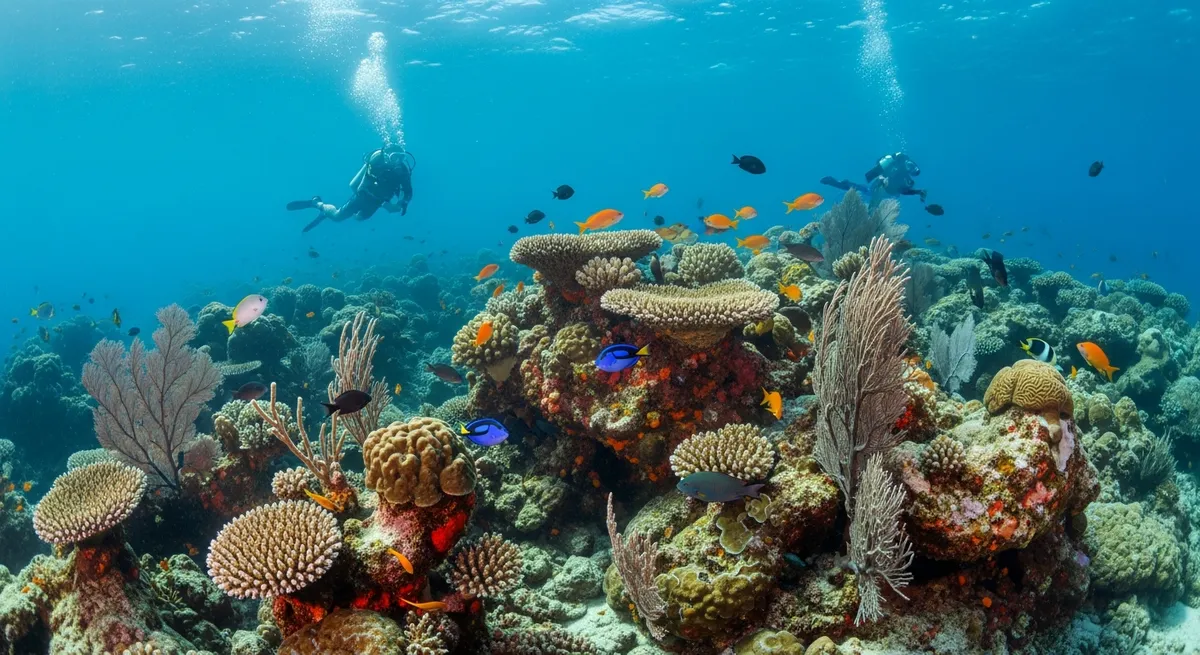
Curaçao Southeast offers some of Curaçao's richest diving, with 310+ marine species recorded in the area - including barracuda, octopuses, orcas, sea turtles and sperm whales. Water ranges 27-30°C, warmest September, October, November.
The southeast coast of Curaçao is where we send new divers, or anyone who just wants easy, relaxing dives. Think calm, warm water and minimal current. It’s ideal for getting comfortable again if you haven't been in the water for a while. We love the easy shore entries and how the reef slopes gently, perfect for finding your buoyancy. You’re pretty much guaranteed a good time at Director’s Bay, with its quiet vibe and the old pier pilings making a great habitat for juvenile fish. Keep an eye out for the Bluewing Searobin; they're always a delight to watch "walking" on their fins. Our favourite, though, has to be the Blue Room. It’s a truly special experience watching the light filter in, making the water glow a vivid blue. Time your visit around midday for the best light show. The Superior Producer wreck is another standout, particularly for photography. It’s upright and largely intact, attracting schools of Schoolmaster snappers and the occasional patrolling Gag grouper. Visibility is generally excellent year-round, making it easy to spot creatures like the Redlip Blenny peeking out from their holes. If you're looking for stress-free diving with plenty to see without battling conditions, this is your spot.
Curaçao Southeast Dive Site Map
Dive sites and dive centres in Curaçao Southeast
Curaçao Southeast Dive Sites
87 dive sites in Curaçao Southeast
Airplane Wreck (Santa Martha)
Okay, so the Airplane Wreck near Santa Martha, it’s not exactly a massive shipwreck, but it’s got a real charm. It’s a Cessna, pretty broken up, lying in about 21 metres of water. We love a site with a story, and you can still imagine the impact here, the way the fuselage bent. There’s something a bit eerie about it, but also fascinating. We always approach from the shore, finning out from the old Sunset Waters Resort. It's a bit of a swim, so conserve air. The wreck itself is home to some fantastic creatures. Look for those Atlantic Yellow Cowries tucked away, they’re beautiful. We’ve seen Great Barracuda cruising nearby, and the blennies are everywhere, popping their heads out of tiny holes. The coral has really started to reclaim parts of the plane, especially the wings, turning it into an artificial reef. It’s a great spot for anyone who enjoys exploring a wreck without needing deep certs, and the photographic opportunities with the light filtering through the broken fuselage are excellent. Just keep an eye out for boat traffic, a surface marker buoy is a must.
Airplane Wreck (Santa Martha)
Okay, so the Airplane Wreck near Santa Martha, it’s not exactly a massive shipwreck, but it’s got a real charm. It’s a Cessna, pretty broken up, lying in about 21 metres of water. We love a site with a story, and you can still imagine the impact here, the way the fuselage bent. There’s something a bit eerie about it, but also fascinating. We always approach from the shore, finning out from the old Sunset Waters Resort. It's a bit of a swim, so conserve air. The wreck itself is home to some fantastic creatures. Look for those Atlantic Yellow Cowries tucked away, they’re beautiful. We’ve seen Great Barracuda cruising nearby, and the blennies are everywhere, popping their heads out of tiny holes. The coral has really started to reclaim parts of the plane, especially the wings, turning it into an artificial reef. It’s a great spot for anyone who enjoys exploring a wreck without needing deep certs, and the photographic opportunities with the light filtering through the broken fuselage are excellent. Just keep an eye out for boat traffic, a surface marker buoy is a must.
Airplane Wreck (Sunset Waters)
The Airplane Wreck at Sunset Waters isn't just a plane in the ocean, it's a genuine slice of history. It was deliberately sunk back in the 70s, a small commuter craft, and now it sits at a very manageable depth, maybe 15 metres, making it super accessible for most divers. We love poking around the fuselage. You can actually swim through the cockpit, which feels a bit surreal, imagining the pilots. What makes it a standout for us isn't just the plane itself, but how nature has completely taken over. Big schools of French grunt shelter under the wings, their silver scales glinting in the light that filters through. Look closely and you’ll find Mushroom Scorpionfish, masters of camouflage, tucked into crevices, almost invisible against the coral growth. We’ve seen Great Barracuda cruising past, keeping a watchful eye on everything. The corals, especially the Lettuce Coral and robust star corals, have really encrusted the wreck. It's an ideal spot for macro enthusiasts, but equally engaging for those who just want to explore a cool wreck without going too deep. Our tip: go early to avoid any crowds.
Alice in Wonderland
Alice in Wonderland delivers a gentle wall dive, accessible to most experience levels. The main draw here is the extensive coral formations, particularly the plate corals, which create a layered, almost tiered landscape. We've often found small morays tucked away in the crevices and a good number of grunt and snapper schooling around the larger bommies. It's a relaxed dive, good for photographers or those looking for an easy second tank.
Alice in Wonderland
Alice in Wonderland delivers a gentle wall dive, accessible to most experience levels. The main draw here is the extensive coral formations, particularly the plate corals, which create a layered, almost tiered landscape. We've often found small morays tucked away in the crevices and a good number of grunt and snapper schooling around the larger bommies. It's a relaxed dive, good for photographers or those looking for an easy second tank.
Barbara Beach
Barbara Beach is one of those sites we always recommend to newer divers in Curaçao, or anyone who just wants an easy, pleasant shore dive. It’s accessible right from the old Santa Barbara Resort, which means no boat faff. The reef here, topping out at about 16m, isn't dramatic, but it’s healthy, with some really nice boulder and brain corals in the shallows. What we really enjoy about Barbara Beach is its chill vibe. You'll glide past parrotfish munching on the coral, and we often spot green moray eels tucked into crevices. Keep an eye out for the smaller stuff too; we've seen everything from tiny blennies peeking out of holes to a curious Spotfin Dragonet scooting along the sand. It’s a gentle drift, but do pay attention to boat traffic if you're venturing further out towards the Spanish Waters channel. It’s an ideal spot for a relaxed second dive of the day, or for photographers who want to take their time finding subjects without current pushing them along.
Barbara Beach
Barbara Beach is one of those sites we always recommend to newer divers in Curaçao, or anyone who just wants an easy, pleasant shore dive. It’s accessible right from the old Santa Barbara Resort, which means no boat faff. The reef here, topping out at about 16m, isn't dramatic, but it’s healthy, with some really nice boulder and brain corals in the shallows. What we really enjoy about Barbara Beach is its chill vibe. You'll glide past parrotfish munching on the coral, and we often spot green moray eels tucked into crevices. Keep an eye out for the smaller stuff too; we've seen everything from tiny blennies peeking out of holes to a curious Spotfin Dragonet scooting along the sand. It’s a gentle drift, but do pay attention to boat traffic if you're venturing further out towards the Spanish Waters channel. It’s an ideal spot for a relaxed second dive of the day, or for photographers who want to take their time finding subjects without current pushing them along.
Barracuda Point
Barracuda Point, just across the channel from Barbara Beach, is a prime example of why we love a good boat dive. Sure, you *could* try the shore entry, but trust us, the effort isn't quite worth the scraped knees when the boat ride is so quick. Drop in, and you're immediately greeted by vast fields of purple sea fans swaying in the gentle surge, interspersed with some truly impressive hard coral structures. We’ve spent whole safety stops just watching the light play through them. The maximum depth here is 19m, making it a comfortable dive for nearly everyone. Our favourite part? The sheer density of reef fish, often schooling so tightly you feel enveloped. Look for the bold yellowtail parrotfish nibbling away, and keep an eye out for the smaller, more cryptic residents like spotfin dragonets near the sand patches. Turtles, both green and hawksbill, are regular visitors, often just cruising past, unbothered. It's a relaxed, vibrant dive, best suited for those who appreciate healthy coral and abundant fish life without the need for extreme depths or strong currents.
Barracuda Point
Barracuda Point, just across the channel from Barbara Beach, is a prime example of why we love a good boat dive. Sure, you *could* try the shore entry, but trust us, the effort isn't quite worth the scraped knees when the boat ride is so quick. Drop in, and you're immediately greeted by vast fields of purple sea fans swaying in the gentle surge, interspersed with some truly impressive hard coral structures. We’ve spent whole safety stops just watching the light play through them. The maximum depth here is 19m, making it a comfortable dive for nearly everyone. Our favourite part? The sheer density of reef fish, often schooling so tightly you feel enveloped. Look for the bold yellowtail parrotfish nibbling away, and keep an eye out for the smaller, more cryptic residents like spotfin dragonets near the sand patches. Turtles, both green and hawksbill, are regular visitors, often just cruising past, unbothered. It's a relaxed, vibrant dive, best suited for those who appreciate healthy coral and abundant fish life without the need for extreme depths or strong currents.
Beacon Point
Beacon Point, tucked away at the western edge of Caracas Bay, is definitely one of our favourite boat dives when we’re in Curaçao. It’s a classic Caribbean wall, but it’s the drift that makes it special. We’ve had some cracking rides here, just floating along, watching the Donkey Dung sea cucumbers waving from the reef and those vibrant Candy Basslets darting in and out of the crevices. The current, when it’s running, pushes you gently past some truly impressive pillar corals in the shallows, then along the deeper wall. We always keep an eye out for larger pelagics in the blue – we’ve seen jacks and barracuda cruise by more than once. The maximum depth of 20m means you get plenty of bottom time, which is great for hunting out the smaller stuff like those tiny Notchtongue Gobies or the flash of a Harlequin Brittle Star peeking from under a coral head. If you’re a fan of a relaxed drift with the chance of some bigger visitors, this is a solid pick. We usually find the visibility around 24m, making it easy to spot a Green Turtle munching on sponges or a Chain Moray snaking through the coral.
Beacon Point
Beacon Point, tucked away at the western edge of Caracas Bay, is definitely one of our favourite boat dives when we’re in Curaçao. It’s a classic Caribbean wall, but it’s the drift that makes it special. We’ve had some cracking rides here, just floating along, watching the Donkey Dung sea cucumbers waving from the reef and those vibrant Candy Basslets darting in and out of the crevices. The current, when it’s running, pushes you gently past some truly impressive pillar corals in the shallows, then along the deeper wall. We always keep an eye out for larger pelagics in the blue – we’ve seen jacks and barracuda cruise by more than once. The maximum depth of 20m means you get plenty of bottom time, which is great for hunting out the smaller stuff like those tiny Notchtongue Gobies or the flash of a Harlequin Brittle Star peeking from under a coral head. If you’re a fan of a relaxed drift with the chance of some bigger visitors, this is a solid pick. We usually find the visibility around 24m, making it easy to spot a Green Turtle munching on sponges or a Chain Moray snaking through the coral.
Blue Bay Garden
Blue Bay Garden feels like a secret, tucked away just enough to keep the crowds thin. We usually drop in near the buoys and head out over the sand patch, scanning for movement. It’s here we’ve consistently spotted seahorses, tucked into the sparse seagrass or clinging to a sponge – keep your eyes peeled for their tiny, bobbing heads. The real show starts when the reef wall drops off. It's not a dramatic sheer face, more of a gentle slope with plenty of nooks. We love the Blushing Star Coral here, a soft, velvety texture under the dappled light. You’ll see plenty of Brown Chromis, a constant flutter against the blue, and the occasional Nassau Grouper eyeing you from a distance. For macro fans, look for the Reticulated Brittle Stars tucked into crevices or the vibrant Spotfin Dragonets scuttling across the sand. The maximum depth of 19m makes it a relaxed dive, good for taking your time. We'd suggest an early morning entry for the calmest conditions and best light on the wall. This site is perfect for photographers or anyone who enjoys a peaceful, unhurried exploration.
Show all 87 dive sites in Curaçao Southeast
- Blue Bay Garden
- Blue Bay the Wall
- Blue Bay the Wall
- Boca Sami
- Boca Sami
- Boka Sami
- Booby trap
- Booby trap
- Caracasbaai
- Car Wrecks (Kokomo Beach)
- Cas Abao
- Central Dive Curacao
- Cornelius Bay
- Daaibooi Baai
- Director's Bay
- Divers Leap
- Double Reef
- Eel Valley
- Fuikbaai / Newport
- Fuikbai Anchorage
- Golf Course East End
- Go West Diving
- Grote Knip
- Habitat
- Jan Thiel baai
- Klein Curaçao
- Kleine Knip
- Long Beach
- Lost Anchor
- Marie Pampoen
- Moomba Beach
- Mushroom Forest
- Mushroom Forest & Blue Room
- North Point of Klein Curacao
- Old Quarry Golf Course
- Oswaldo's Drop Off
- Parasasa Beach / Crash Site
- Piscadera Bay
- Playa Daaibooi
- Playa Forti
- Playa Grandi / Playa Piscado
- Playa Hundu
- Playa Jeremi
- Playa Kalki
- Playa Lagun
- Playa Largu
- Playa Manzalina
- Playa Piskado
- Playa Piskado
- Playa Shon Mosa
- Porto Mari
- Punt Canon
- Rancho El Sobrino
- Rif Sint Marie
- Royal Reef
- Saba
- Sandy’s Plateau
- Ship wreck
- Ship Wreck Point
- Ship Wreck Tugboat
- Small Wall
- Snake Bay
- South Point of Klein Curacao
- Stella Maris / Ocean Encounters
- St. Marie Reef
- Sun Reef
- Superior Producer
- SUPERIOR PRODUCER (POSSIBLY)
- Tarpon Bridge
- Tee Box
- The Valley
- Vaersenbaai (Kokomo)
- Watamula
- Water Factory / Fisherman’s Wharf
- Witches Kitchen
Curaçao Southeast Dive Centres
39 dive shops and operators in Curaçao Southeast
All About Scuba Curacao
Atlantis Diving
Blue Bay Dive
Blue Bay Dive and Watersports
BLVD Divers
Central Dive Curacao
Coral Divers Curacao
Curaçao Divers
Show all 39 dive centres in Curaçao Southeast
- Curious 2 Dive N.V.
- Dive Center Pietermaai
- Dive Center Scuba Do
- Dive City Curaçao
- Dive Nas
- Divers Republic
- Duikcentrum van de Ven
- Duikschool Fred
- Duikstudio Leon
- ELITE DIVING CURACAO
- Epsilon Curacao
- Fundiving Curacao
- Go West Diving
- Groove Diving
- Jan Thiel Diving
- Ocean Encounters
- Ocean Encounters (Lions Dive & Sunscape Resort)
- PADI Diving School
- Palm Trading NV Groothandel
- Papagayo Beach
- Porto Mari Dive Center
- Rebel Diving Cucaçao
- Relaxed Guided Dives
- ResQpro
- Scubacao Diving Adventures
- Scuba Store and More
- Sublime Diving
- The Dive Bus
- THE DIVESHOP
- The Little Green Boat
- Unique Diving
Ocean Wildlife in Curaçao Southeast
310 species recorded in Curaçao Southeast
Curaçao Southeast Daylight & Sunrise/Sunset
Sunrise and sunset times for Curaçao Southeast, calculated from coordinates
Today - Sunday 11 October
Sunrise
05:26
Sunset
17:21
Daylight
11h 55m
Golden Hour
16:53
First light (dawn) at 05:05 · Last light (dusk) at 17:43
Monthly Averages
| Month | Sunrise | Sunset | Daylight |
|---|---|---|---|
| Jan | 06:01 | 17:30 | 11h 29m |
| Feb | 05:59 | 17:43 | 11h 44m |
| Mar | 05:45 | 17:47 | 12h 2m |
| Apr | 05:25 | 17:48 | 12h 23m |
| May | 05:13 | 17:53 | 12h 41m |
| JunLongest | 05:12 | 18:02 | 12h 50m |
| Jul | 05:19 | 18:06 | 12h 47m |
| Aug | 05:25 | 17:58 | 12h 32m |
| Sep | 05:26 | 17:39 | 12h 13m |
| OctNow | 05:26 | 17:19 | 11h 53m |
| Nov | 05:34 | 17:09 | 11h 35m |
| DecShortest | 05:49 | 17:14 | 11h 25m |
Times are approximate local times based on longitude. Actual times may vary slightly depending on the exact timezone observed in Curaçao Southeast.
Where to Stay near Curaçao Southeast
Prices from Booking.com. We may earn a commission at no extra cost to you.
Marine Protected Areas near Curaçao Southeast
4 protected areas near Curaçao Southeast - please respect local regulations when diving
Shete Boka Park
Oostpunt
Spanish Water Inner Bay Park
Klein Kòrsou
Getting to Curaçao Southeast
Willemstad
Kralendijk
Oranjestad
Plan & book
Ways to dive Curaçao Southeast, from day trips to liveaboards.
Day trips & courses
via GetYourGuideGuided dives, courses and snorkel trips with instant booking.
Find dive trips in Curaçao SoutheastPlaces to stay
via Booking.comHotels and dive resorts near Curaçao Southeast.
Search stays in Curaçao SoutheastDive insurance
Most travel insurance excludes or limits scuba. Check what you need before you go.
Dive insurance explainedPartner links: we may earn a commission if you book, at no extra cost to you. How we make money