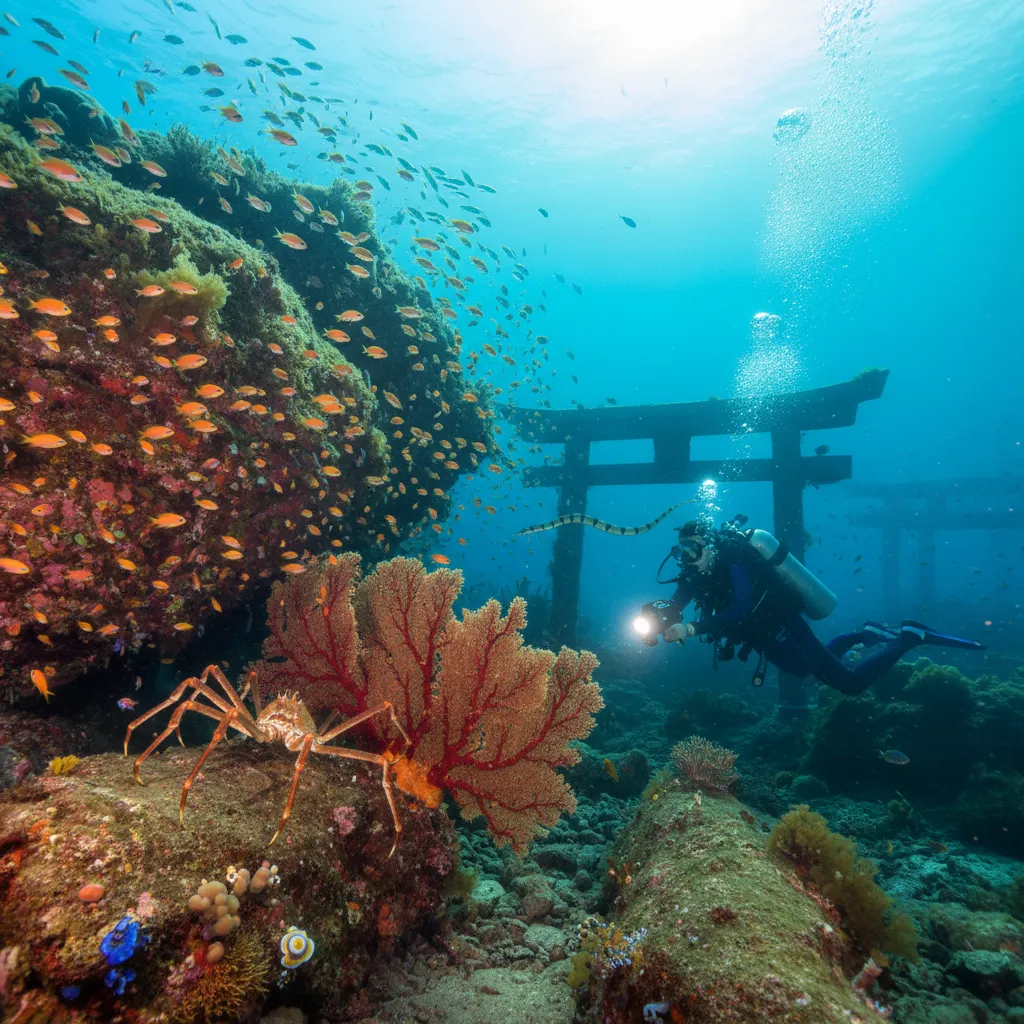
Diving in Izu Peninsula
Why dive here
Izu Peninsula offers 61 dive sites in Japan.
Izu Peninsula. Japan’s most accessible diving from Tokyo, and we love it for its wild diversity. Think dramatic volcanic seascapes, an astonishing variety of macro critters, and, if you hit it right, some serious pelagic action. The local dive scene here is robust, with over 100 dive centres spread across the peninsula, so finding a guide is never an issue. What we genuinely appreciate about Izu is its commitment to the small stuff. The muck diving rivals Southeast Asia for sheer strangeness, with bizarre bellows fish and bristlemouths hiding in the sandy bottoms. Our favourite sites often involve poking around rocky overhangs, spotting frogfish perfectly camouflaged against the volcanic rock. We’ve spent whole dives mesmerized by the frantic displays of a short-head sabretooth blenny. But don’t pigeonhole Izu as just a macro spot. Mikomoto Island, a bit of a boat ride from Shimoda, offers a completely different vibe. Strong currents here sweep in hammerhead aggregations seasonally, usually from late summer into autumn. It’s an exhilarating drift, not for the faint of heart, but the reward of seeing dozens of sharks materialise from the blue is something else. You can practically feel the current pushing you along, the water roaring in your ears. For a different thrill, some of the deeper sites can reveal rarer finds like halosaurs or snipe eels, if you have the patience and the gas. Overall, Izu is a fantastic option for anyone looking for something beyond the typical coral reef.
Izu Peninsula Dive Site Map
Dive sites and dive centres in Izu Peninsula
Izu Peninsula Dive Sites
61 dive sites in Izu Peninsula
Aki no Hama
Aki no Hama in Izu Peninsula is a solid choice for newer divers. The site drops to a comfortable 22 meters, making it an easy drift or out-and-back. You'll often find nudibranchs crawling the rocks and schools of small fish hovering over the seafloor. It's not a dramatic wall dive, but it’s a calm introduction to Japanese diving.
AQUA MATE
Aqua Mate in Izu Peninsula is a solid Japanese dive for divers looking for a relaxed experience. We usually spot darkie charlies flitting around, and porcupinefish are quite common here. If you’re lucky, a loggerhead turtle might cruise past. It’s a good spot for a couple of easy dives, especially if you appreciate the local species.
Arari
Arari offers a gentle introduction to Izu diving, topping out at 22 metres. We typically find schooling damselfish and occasional nudibranchs along the sandy bottom, which is good for those honing buoyancy. It’s a straightforward dive, very suitable for beginners or a relaxed afternoon with your camera.
Beach Bum
Beach Bum is a shallow, easy dive, perfect for new divers or those getting back in the water. Maximum depth is six meters, so you'll have plenty of bottom time to practice skills or just get comfortable. Expect to see smaller reef fish and some interesting macro life if you look closely amongst the rocks. It’s a good spot for a relaxed afternoon.
be dive
Be Dive, located on Japan's Izu Peninsula, offers a straightforward shore dive that works well for those looking for an easy entry. The site often features blackfinned triplespine among the rocky seabed. We’ve also spotted loggerhead turtles here occasionally. It’s a good choice for newer divers or for a relaxed day out.
Bitagane
Bitagane, on Japan’s Izu Peninsula, is a mellow dive to 24m. It’s ideal for newer divers or those looking for a relaxed exploration. We’ve found decent macro opportunities here, with nudibranchs often spotted on the rocky substrate. Visibility can vary, but on a good day, it offers a pleasant, easy dive.
Budaine
Budaine offers intermediate divers a good look at Izu's rocky reef structures. We've seen some interesting nudibranchs here, tucked into the crevices, and it's a reliable spot for macro photography. Depths generally max out around 24 meters, making it a solid choice for those looking for a relaxed dive without strong currents.
Bumb Tokyo Sports Culture Center
The Bumb Tokyo Sports Culture Center is more of a training pool than a dive site, really. It’s an indoor facility, purpose-built for learning the basics. We’re talking about a very controlled environment, perfect for your first fin kicks or gear practice. It’s certainly not a place to spot marine life, but it’s excellent for open water course confined sessions or just getting comfortable in the water before heading to the coast.
Chinsen Point
Chinsen Point on the Izu Peninsula offers a straightforward shore dive. We usually find smaller marine life here, nudibranchs are a common sight along the rocky slopes, and sometimes a few octopuses peek out from crevices. It's a good spot for a relaxed dive, especially if you're keen on macro photography or just getting comfortable with the local conditions. Currents are generally manageable, making it suitable for newer divers.
Dougashima
Dougashima offers an easy entry point, perfect for newer divers exploring the Izu Peninsula. The site’s maximum depth of 21m keeps things relaxed, and while we haven't noted specific species here yet, the area generally provides a mix of smaller reef fish and crustaceans amongst the rock formations. It’s a comfortable spot to get your fins wet.
Enoura
Enoura is a beginner-friendly shore dive on the Izu Peninsula, reaching a maximum depth of 14m. It's a gentle introduction to Japanese temperate diving, with a sloping sandy bottom and scattered rock formations. You'll often find small schools of damselfish and wrasse darting around, along with the occasional moray eel peeking from crevices. It's a good spot for dive centers to run training dives or for newer divers to build confidence.
Fukuura
Fukuura is a straightforward shore dive on the Izu Peninsula, ideal for those new to temperate diving. At a maximum depth of 12m, it’s a good spot to practice buoyancy and get comfortable in cooler waters. You'll often find small schooling fish around the rocky outcrops, and we've spotted nudibranchs tucked into crevices. It's a reliable choice for training dives or an easy afternoon splash.
Show all 61 dive sites in Izu Peninsula
- Futou
- Futo Yokobama
- Hatsushima Futatsune
- Haunted Mansion
- Hayakawa Beach
- Hazama Takane
- Hirasawa
- Hokkawa Kajikaki
- Inatori Port
- Ishibashi
- Ita
- Ito Shark City
- Iwa Triangle
- Izu Oceanic Park
- Izusan Port Side
- Jabune
- Kanaya Sunset Beach
- Kawana
- Koganezaki
- Kosoga Cave
- Kumomi Ushitsuki Rock
- Miho
- Mikura Island
- Mitsune
- Nebukawa
- Nishikawana One
- OK Marine Pro
- Okubo Hama
- Otaka Rock
- Outer bay
- Sanbondake
- Sentan
- Shimura Beach
- Shishihama
- Shobusawa Beach
- Sodaine
- Tago
- TEARS BLUE DIVING
- Toi Beach
- Toujima
- Usami Beach
- Wannai
- Yugawara Aqua Park
- Zamrud
- Zenisu
- サマータイム
- ティモンオーシャンファンタジー
- ハスチョルダイビング
- 伊豆大島ダイビング Beach Line
Izu Peninsula Dive Centres
155 dive shops and operators in Izu Peninsula
Akazawa Diving Center
Amuse Marine Club
AQCIA DIVE HOUSE
AQUAutopia
Ark Dive
Athlie Diving Club
Blue Labo
Blue Sub
Show all 155 dive centres in Izu Peninsula
- Buddy Dive shop
- Celsius Club
- Club Kids Sapporo
- COCOMO OSEZAKI
- Coconut Tokyo
- Collins' D.C.
- Colors Diving Proshop
- Craft Dive
- Cupid Akabane
- CURRENT BLUE
- Daichi Freediving Club
- Deos Sensuido
- DIVE/CODE
- Dive Craps
- Dive Esuch
- Dive Healing
- Dive KO*BE
- Diver's 7
- Divers Cafe
- Dive!SCOOP
- Dive Terry's
- Diving College Tartaruga
- Diving Lounge aqua QUEST
- DIVING PLACE OSAKAHONMACHI
- Diving Project Jic
- Diving School Cocomo
- Diving School Io Esaka
- Diving School Io Ikeda
- Diving School Kanau
- Diving School Marea Fukuokahakata
- Diving School Marea Ikebukuro
- Diving School Marea Ishigakijima
- Diving School Marea Okinawa
- Diving School Marea Shinjuku
- Diving School Marea Shinsaibashi
- Diving School Marea Tokyo
- Diving School Marea Yokohama
- Diving School Noris Kobe maiko
- Diving School Noris Osaka
- Diving School TOP-J
- DivingService Kawanabiyori
- DivingShop BlueBase
- Diving Shop LEO
- Diving shop Namidea Yokohama
- Diving Shop NANA
- Divingshop Quartet
- Diving Shop UMITOMO
- Diving Shop UMIYA
- Diving Supplyer Smile
- Dolphin Eyes
- D-Poc
- D.S ATAMI
- Earth Sound
- Eastdive
- Energy
- FAMILY OF THE SEA FUCHU DIVING CENTER
- Fish Island Crew
- Flipper Dive Center
- Frontier Diving School
- GO!GO! SCUBA Diving
- Grampus
- Hirasawa Marine Center
- Hokule'a Shonan
- Inatori Marinesports Centre
- isLIFE DIVING
- ITA DIVING CENTER
- IZUKKO DIVING
- IZUMI DIVING RESORT
- Jah Diving Club Mito
- JAH scubadiving club
- Jogasaki Indies
- Jogashima Diving Center
- Kaila Mermaid Team
- Laut
- MARINE HOUSE Lei Aloha Higashiizu
- Marine Pocket
- Marine Studio Dragonlady
- MARIN HOUSE LEI ALOHA
- mic21 Umeda
- mic21 Yokohama
- MIKOMOTO HAMMERS
- Miss Ocean Diving Service
- MIURA UMINO GAKKO
- MOTOSUKO DIVE RESORT
- M's Diving Adventure
- M's Diving Adventure Nishifunabashi
- Namiyoikujira
- NEODIVING
- NIIJIMA OKESHOU
- Nishikawana Diving Service
- Nobeoka Marine Service
- Ocean Dream
- Ocean Studio
- OCEAN TATEYAMA
- Ocean Tribe
- Odawara Diving School
- Ohana With
- Ok Marine Club
- Osper
- Pacifica Diving School
- PAPALAGI Diving School Fujisawa
- PAPALAGI Diving School Ikebukuro
- Papalagi Diving School Shinjuku
- Papalagi Diving School Tachikawa
- PAPALAGI Diving School Tokyo
- Papalagi Diving School Yokohama
- Peace Dolphin
- Peaceful
- PLATYPUS
- pole pole at sea
- PONTA DIVING SCHOOL
- Pro Scuba Team SEARays
- PURELY
- RAGNA
- SAIL AWAY TACHIKAWA
- Scuba Diving Air
- Scuba Pro Shop Oimachi
- Seads Kasukabe
- Sea Loop
- Sea Magic
- Sea Point Mie
- Season
- SHARK EYE
- Shishihama Diving Service
- SHONANDIVE HAYAMA TANK SERVICE
- Sotto Marino
- STINGRAY JAPAN
- SUN La IZU DIVING
- SUNNY RULE
- TEARS BLUE DIVING
- THE DIVE FACTORY MITAKA
- THE DIVE FACTORY TOKYO
- THE DIVES
- THE WIND DROPS
- TIARA
- Toi Diving Service
- TOKYO KOKUSAI SENSUI CLUB
- True North
- uminoGAKKO
- WAILANI Inc.
- Wasshoi Divers
- WITH 新宿
- ダイビング Blue Cube
- フィズ
- ボイジャーダイビング PADI
- 伊豆大島ダイビング Beach Line
- 伊豆海洋公園ダイビングshop
Izu Peninsula Daylight & Sunrise/Sunset
Sunrise and sunset times for Izu Peninsula, calculated from coordinates
Today - Sunday 11 October
Sunrise
05:46
Sunset
17:16
Daylight
11h 30m
Golden Hour
16:42
First light (dawn) at 05:21 · Last light (dusk) at 17:41
Monthly Averages
| Month | Sunrise | Sunset | Daylight |
|---|---|---|---|
| Jan | 06:52 | 16:55 | 10h 3m |
| Feb | 06:31 | 17:26 | 10h 55m |
| Mar | 05:56 | 17:51 | 11h 55m |
| Apr | 05:13 | 18:15 | 13h 2m |
| May | 04:41 | 18:40 | 13h 59m |
| JunLongest | 04:30 | 18:59 | 14h 29m |
| Jul | 04:41 | 18:59 | 14h 18m |
| Aug | 05:04 | 18:34 | 13h 30m |
| Sep | 05:27 | 17:53 | 12h 26m |
| OctNow | 05:49 | 17:11 | 11h 21m |
| Nov | 06:18 | 16:40 | 10h 22m |
| DecShortest | 06:44 | 16:34 | 9h 50m |
Times are approximate local times based on longitude. Actual times may vary slightly depending on the exact timezone observed in Izu Peninsula.
Where to Stay near Izu Peninsula
Prices from Booking.com. We may earn a commission at no extra cost to you.
Marine Protected Areas near Izu Peninsula
49 protected areas near Izu Peninsula - please respect local regulations when diving
銭洲・伊豆諸島周辺海域
房総沖・相模湾海域
駿河湾・金洲ノ瀬海域
遠州灘・志摩沖海域
共同漁業権区域(千葉県)
富士箱根伊豆
共同漁業権区域(静岡県)
共同漁業権区域(愛知県)
水郷筑波
南房総
共同漁業権区域(神奈川県)
三河湾
Showing 12 largest of 49
Getting to Izu Peninsula
Izu Oshima
Tokyo
Makinohara / Shimada
Plan & book
Ways to dive Izu Peninsula, from day trips to liveaboards.
Day trips & courses
via GetYourGuideGuided dives, courses and snorkel trips with instant booking.
Find dive trips in Izu PeninsulaPlaces to stay
via Booking.comHotels and dive resorts near Izu Peninsula.
Search stays in Izu PeninsulaDive insurance
Most travel insurance excludes or limits scuba. Check what you need before you go.
Dive insurance explainedPartner links: we may earn a commission if you book, at no extra cost to you. How we make money