Diving in Saint-Gilles & West Coast
Why dive here
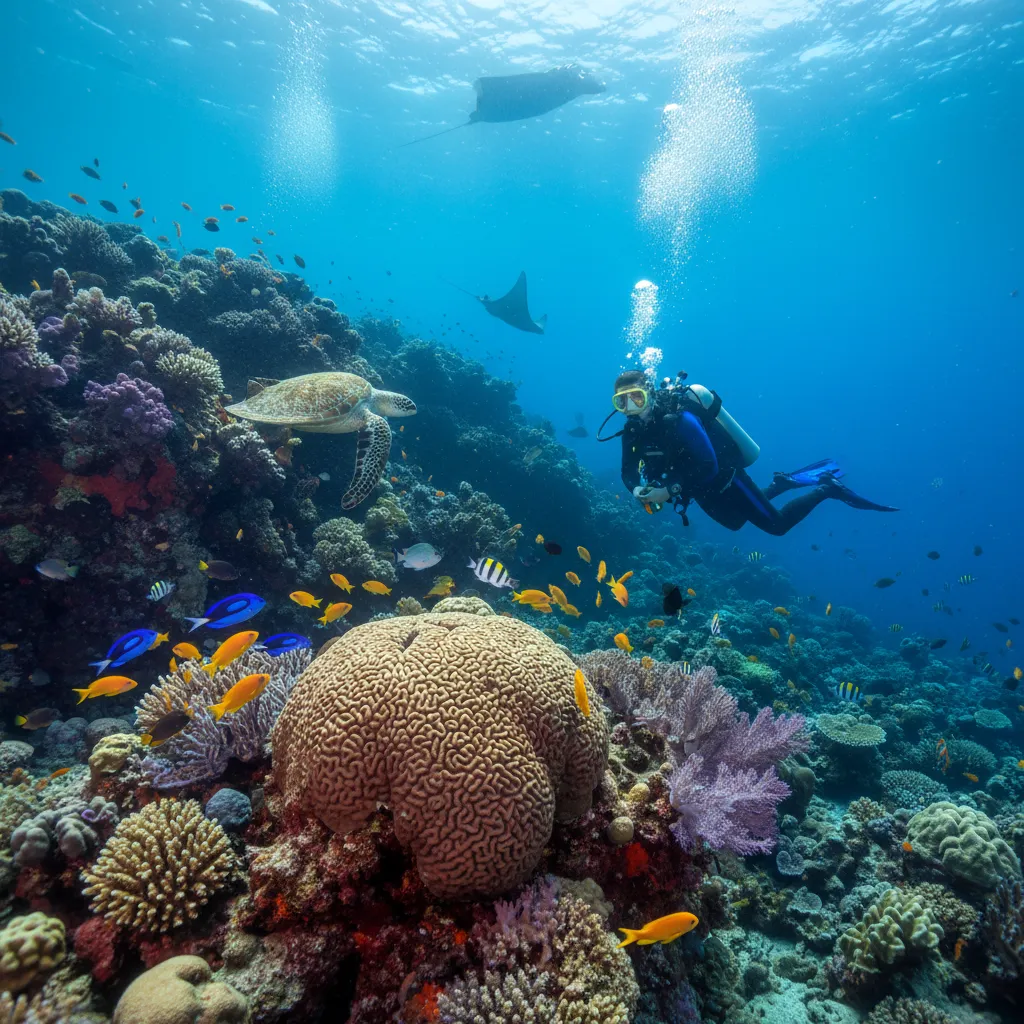
Saint-Gilles & West Coast offers some of Réunion's richest diving, with 511+ marine species recorded in the area - including barracuda, blacktip reef sharks, blue sharks, dolphins and eagle rays. Water sits around 28°C.
Saint-Gilles and Réunion's west coast give us plenty to talk about. We love the variety here, from the sheltered lagoon dives perfect for shaking off rust, to the exhilarating outer wall drifts. Our favourite sites often involve a gentle push along a reef peppered with yellow scroll coral and large star corals, where you'll spot Blackburn's butterflyfish flitting past. It’s not uncommon to see humphead wrasse cruising by, their sheer size always a pleasure. This area truly shines when you hit the outer walls. The reef drops away, revealing healthy hard corals and stony corals, often with schools of threadfin and fusiliers thick enough to dim the light for a moment. Keep an eye out for the Rufous lanternfish in deeper sections, a real treat to encounter. Visibility usually holds up well, but we'd suggest hitting the deeper wall dives in the morning before any afternoon thermoclines kick in. If you're lucky enough to be here between October and December, whale sharks are a genuine possibility, though never a guarantee. The wreck dives are a fun alternative, attracting blackbar filefish and hooded oysters clinging to the metal. It’s a great mix of accessible and adventurous.
Saint-Gilles & West Coast Dive Site Map
Dive sites and dive centres in Saint-Gilles & West Coast
Saint-Gilles & West Coast Dive Sites
47 dive sites in Saint-Gilles & West Coast
Abyss Plongée
Abyss Plongée might be a wreck, but it’s definitely not one of those ghostly, intact vessels. Think more scattered debris, a collection of objects that were once a fishing boat, now resting on a sandy bottom. We’d suggest you go in the late morning, after the initial rush, when the sun is high and cuts through the water, making the metal gleam. What makes it special for us is the way marine life has completely taken over. You’ll spot charming hermit crabs scuttling amongst the plates, and often see humphead unicornfish grazing nearby. Look closely, and you might find a loggerhead turtle resting on a larger piece of hull. It’s less about penetration, more about observing the ecosystem that’s repurposed this man-made structure. We love it for its easygoing vibe and the sheer density of smaller critters, perfect for a relaxed dive where you can truly slow down and explore.
Ali Baba
Ali Baba, off Saint-Gilles, offers a solid intermediate dive down to 28 meters. It’s a good spot for a relaxed drift, often with pelagic action further out, though the current can pick up. You’ll typically see schooling fusiliers, bannerfish, and sometimes barracuda hanging in the blue. Keep an eye on the sand patches for stingrays and garden eels. We find it’s a site that consistently delivers decent encounters without being overly challenging.
Antonio Lorenzo
Antonio Lorenzo is a solid choice when you’re diving out of Saint-Gilles, especially if you’re looking for something a bit deeper. Dropping to 37 metres, it’s an intermediate dive that takes you down to a deep reef structure. We usually see a decent variety of fish life down there, often some larger pelagics cruising past in the blue. Keep an eye out for triggerfish and parrotfish along the coral, and sometimes a white tip reef shark makes an appearance. It’s a good spot for divers comfortable with depth and who appreciate a deeper exploration.
Bleu Marine Réunion
Bleu Marine Réunion is one of those spots we keep coming back to when we’re on the west coast, particularly if we’re looking for a relaxed dive that still delivers. It’s right off Saint-Gilles, so access is generally pretty straightforward. We love it for the sheer consistency of the sightings, especially the turtles. On a good day, you’ll likely spot a few green or hawksbill turtles just cruising past, sometimes stopping for a clean. The reef here isn't the most dramatic drop-off, but it's got plenty of nooks and crannies that attract some interesting characters. We often find immaculate squirrelfish tucked away, their big eyes reflecting our torch beams. Keep an eye out for the charming hermit crabs scuttling across the sand patches between the coral heads, they’re always busy. While the Jordan's blue dogshark and false killer whales are rarer visitors, the everyday reef life makes this site special. It’s a great pick for photographers who want to take their time, or anyone who just wants a pleasant dive without battling currents.
Bossy’s Canyon
Bossy’s Canyon is a solid choice for a mellow dive off Saint-Gilles. At a comfortable 19 metres, it’s a good spot to ease back into things or for newer divers getting their fins wet. You’ll find yourself drifting along a sandy bottom, broken up by interesting rock formations and small coral heads where angelfish and parrotfish often graze. It's an easy-going dive, perfect for just cruising and spotting whatever decides to swim by.
Bouée rouge
Bouée rouge is a good easy dive, perfect for getting back into the swing of things or for newer divers. It’s a gentle slope down to about 18 meters, mostly sandy patches with some interesting coral bommies scattered around. We usually spot moray eels tucked into crevices, and often see stingrays gliding over the sand. It’s a calm site, rarely hit by strong currents, so you can really take your time exploring without feeling rushed.
Bouée verte
Bouée verte, just off Saint-Gilles, is exactly what it sounds like – a green buoy marking a nice, shallow dive. At 11 metres, it's perfect for a relaxed swim-through or a refresher dive. You’ll often find us taking new divers here to get comfortable, spotting plenty of damselfish darting between the rocks, and the occasional turtle gliding past. It's not a deep thrill-seeker's spot, but it’s reliably calm, offering a gentle introduction to Réunion’s coastal critters.
Canyon
The Canyon dive site off Saint-Gilles is a solid choice for an easy afternoon dip, especially if you’re new to the local waters. It’s pretty shallow, topping out around 15 metres, which means plenty of light filters down, even on an overcast day. We’ve found it's a calm spot, protected from most of the stronger currents, making it ideal for beginners or those just wanting a relaxed dive to get their fins wet. You’ll weave through some interesting rock formations that give the site its name, often spotting small reef fish tucked into crevices. It’s not going to blow your mind with massive pelagics, but it's a pleasant, accessible dive for a gentle introduction to Réunion's underwater world.
Cap la Houssaye
Cap la Houssaye is a solid choice for a relaxed dive along Réunion's west coast, particularly if you’re new to the local waters or want a chill afternoon. At a consistent 13 metres, it’s an easy depth for beginners to get comfortable, with plenty of time to explore the volcanic rock formations. We often spot moray eels tucked into crevices, and the small schools of damselfish always make for a nice backdrop. The site typically has calm conditions, making it an unfussy spot to log some bottom time and shake off any pre-dive jitters.
Corail Noir
Corail Noir is a deep one, dropping down to a maximum of 44 metres, so it’s definitely one for the expert divers among us. The reef itself feels ancient, with some substantial coral structures that have clearly been around for a long time. You’ll spend most of your time exploring crevices and overhangs, keeping an eye out for larger pelagics cruising by in the blue. It’s a site that rewards patience and a good eye, not a kaleidoscope of colour, but more about the quiet grandeur of the deep reef.
Deux Arches
Down on Réunion's west coast, Deux Arches makes for a pleasant, straightforward dive, especially if you're just starting out with cavern diving. It's a shallow spot, topping out at 18 metres, making it a good choice for newer divers to practice their buoyancy control in an overhead environment. You'll find yourself drifting through a couple of natural arches, sculpted by the ocean over time. Light filters in beautifully, illuminating the rock formations and any small critters tucked into the crevices. We often spot schooling fusiliers near the entrances, and sometimes a passing snapper or two. It’s a gentle introduction to Réunion's underwater topography without any strong currents to worry about.
FONG KUO
Alright, let’s talk about the Fong Kuo. This isn’t a deep dive, not by a long shot. At a maximum of two metres, it’s practically a snorkel, but don’t let that fool you into thinking it’s not worth your time. This factory ship went down in 1973, splitting neatly in two right on the reef. What you get now is a really accessible wreck, perfect for those days when you just want to potter around without the pressure of depth. We love the way the sunlight slices through the water here, illuminating every angle of the ship’s skeleton. You’ll find the two main sections are still pretty distinct. The bow and stern sections are separated by a short swim, and they’ve both become fantastic little artificial reefs. Look closely in the nooks and crannies for moray eels – they’re everywhere – and parrotfish chomp away at the corals growing on the metal. Our favourite part has to be the play of light and shadow, particularly mid-morning, as it dances over the twisted metal. It’s a great spot for photographers keen on natural light and close-ups of the small stuff. Just be mindful of the occasional surge, which can make things a bit bouncy around the shallower parts of the wreck.
Show all 47 dive sites in Saint-Gilles & West Coast
- Grotte aux Dentelles
- Haï Siang, wreck
- Kary's smiles
- L'Arche de Noël
- La Cheminée
- La Passe de l'Hermitage
- La Pointe au Sel
- Le Bowl
- Le jardin des kiosques
- Le Pain de Sucre
- Les Grottes du Portail
- Le Tombant
- Maharani
- Navarra
- Nez du Pharaon
- Passe de 3 Bassins
- Passe de l’Ermitage
- Petites Gorgones
- Petit Tombant
- Piège à Requins
- Pierre au préfet
- Pierre aux Platax
- Plongée Australe
- Plongée Salée
- Roches Merveilleuses
- Saliba
- sankuba
- Sea Venture
- SEA VENTURE
- Sec à Zitte
- THESEN
- Tombant des Grottes
- Tour de Boucan
- Vallée aux Mérous
- WARREN HASTINGS
Saint-Gilles & West Coast Dive Centres
7 dive shops and operators in Saint-Gilles & West Coast
Ocean Wildlife in Saint-Gilles & West Coast
511 species recorded in Saint-Gilles & West Coast
Saint-Gilles & West Coast Daylight & Sunrise/Sunset
Sunrise and sunset times for Saint-Gilles & West Coast, calculated from coordinates
Today - Sunday 11 October
Sunrise
05:52
Sunset
18:21
Daylight
12h 29m
Golden Hour
17:51
First light (dawn) at 05:30 · Last light (dusk) at 18:43
Monthly Averages
| Month | Sunrise | Sunset | Daylight |
|---|---|---|---|
| Jan | 05:50 | 19:07 | 13h 17m |
| Feb | 06:10 | 18:58 | 12h 48m |
| Mar | 06:22 | 18:36 | 12h 14m |
| Apr | 06:31 | 18:08 | 11h 37m |
| May | 06:43 | 17:50 | 11h 7m |
| JunShortest | 06:54 | 17:46 | 10h 51m |
| Jul | 06:57 | 17:54 | 10h 58m |
| Aug | 06:43 | 18:06 | 11h 23m |
| Sep | 06:16 | 18:14 | 11h 57m |
| OctNow | 05:49 | 18:22 | 12h 33m |
| Nov | 05:31 | 18:38 | 13h 7m |
| DecLongest | 05:33 | 18:57 | 13h 24m |
Times are approximate local times based on longitude. Actual times may vary slightly depending on the exact timezone observed in Saint-Gilles & West Coast.
Where to Stay near Saint-Gilles & West Coast
Prices from Booking.com. We may earn a commission at no extra cost to you.
Marine Protected Areas near Saint-Gilles & West Coast
10 protected areas near Saint-Gilles & West Coast - please respect local regulations when diving
Marine De La Réunion
Grande Anse
La Pointe Au Sel
Terre Rouge
Grande Ravine
Marine De Vincendo
Ravine Du Portail Aux Avirons
Rochers Des Colimacons
Rocher De Petite Ile
Ile De Petite-Ile
Getting to Saint-Gilles & West Coast
Saint-Pierre
Sainte-Marie
Plaine Magnien
Plan & book
Ways to dive Saint-Gilles & West Coast, from day trips to liveaboards.
Day trips & courses
via GetYourGuideGuided dives, courses and snorkel trips with instant booking.
Find dive trips in Saint-Gilles & West CoastPlaces to stay
via Booking.comHotels and dive resorts near Saint-Gilles & West Coast.
Search stays in Saint-Gilles & West CoastDive insurance
Most travel insurance excludes or limits scuba. Check what you need before you go.
Dive insurance explainedPartner links: we may earn a commission if you book, at no extra cost to you. How we make money