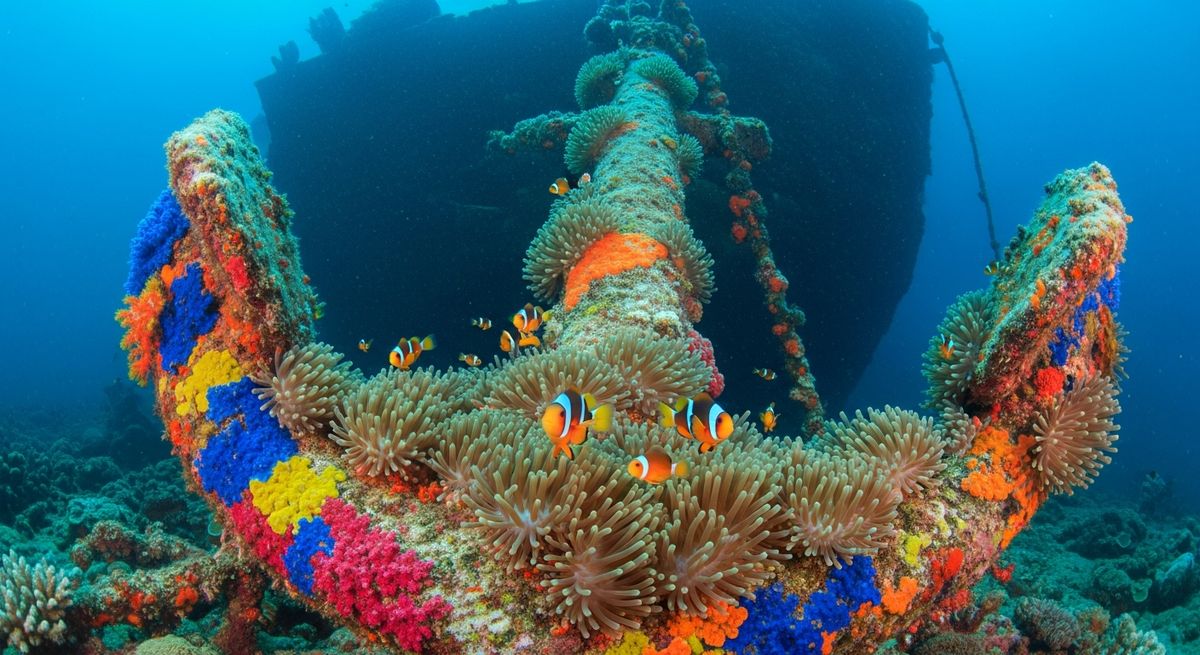
ASIA PACIFIC
Why dive here
ASIA PACIFIC is a wreck dive where divers can encounter sea turtles and sperm whales. Water ranges 27-30°C, warmest May, June, July.
The ASIA PACIFIC wreck is one of our favourites in Palawan, precisely because it’s a carrier, not a purpose-sunk warship. It ran aground in 1973, making for an accidental, fascinating dive. We love that the wreck starts right at the surface, its superstructure breaking the water, letting you snorkel around the upper sections before you even gear up. Below, the ASIA PACIFIC slopes down to about 25 metres. Because it wasn't scuttled, it rests at an interesting angle, creating all sorts of swim-throughs and pockets. You can spend an entire dive just exploring the bridge area and cargo holds, watching the light filter in through gaps. Look out for schools of snapper hanging in the shadows and the occasional turtle grazing on algae growing on the hull. The continuous swell that eventually claimed her still makes its presence felt; sometimes there’s a gentle surge, which adds to the atmosphere. We’d suggest hitting this site mid-morning; the sun angle really brings out the textures of the encrusting corals and creates some dramatic light shafts inside. This wreck is perfect for divers who enjoy exploration and appreciate a bit of history without needing deep depths or strong currents.
Safety Notes
Wreck site - avoid penetration without wreck diving certification. Watch for sharp metal and entanglement hazards.
ASIA PACIFIC Wreck History
Year Sunk
1973
Vessel Type
cargo ship
Cause
grounding
Built in 1967, the carrier vessel Asia Pacific had a short service life. In December 1973, while on a voyage from Hong Kong to Kota Kinabalu, the ship ran into serious trouble near Palawan Island. It ran hard aground on a reef, breaching the hull. The relentless pounding of the ocean swell flooded the vessel throughout, causing catastrophic damage. With no hope of salvage, the ship was abandoned by her crew and declared a constructive total loss.
Resting at a depth of 0 meters, the wreck of the Asia Pacific is a unique site, more of a shoreline feature than a dive location. It is likely partially visible above the water, with its rusting hull exposed to the elements. This makes it an intriguing target for snorkelers, kayakers, and photographers exploring the Palawan coastline, offering a stark and dramatic reminder of the power of the sea just a stone's throw from shore.
Reviews for ASIA PACIFIC
Conditions
Ocean conditions, forecast and tides for ASIA PACIFIC
ASIA PACIFIC Ocean Conditions
Monthly averages for ASIA PACIFIC, sourced from Open-Meteo marine data - nearest station: Open-Meteo marine grid (11.2, 119.35) (0km away)
October Averages
Sea Temperature
30°C
86°F · Range: 28.9–30.7°C
Air Temperature
28°C
82°F
Wind Speed
6.69 m/s
13.0 knots
Atmospheric Pressure
1008.9 hPa
Based on 4 years of monitoring data · Data sources: Open-Meteo marine data
Plan & book
Ways to dive Palawan, from day trips to liveaboards.
Day trips & courses
via GetYourGuideGuided dives, courses and snorkel trips with instant booking.
Find dive trips in PalawanPlaces to stay
via Booking.comHotels and dive resorts near Palawan.
Search stays in PalawanDive insurance
Most travel insurance excludes or limits scuba. Check what you need before you go.
Dive insurance explainedPartner links: we may earn a commission if you book, at no extra cost to you. How we make money
Where to Stay near ASIA PACIFIC
Prices from Booking.com. We may earn a commission at no extra cost to you.