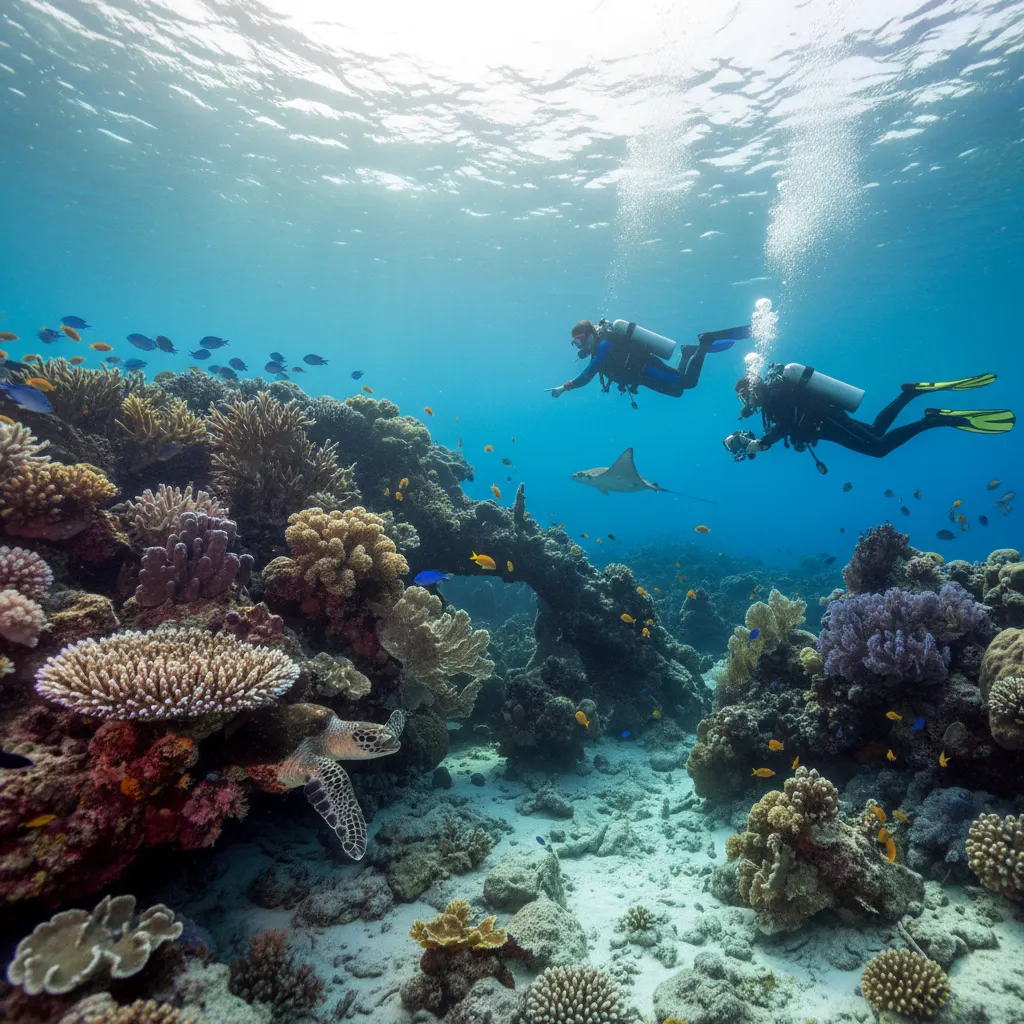
Diving in Aruba Leeward Coast
Why dive here
Aruba Leeward Coast offers some of Aruba's richest diving, with 82+ marine species recorded in the area - including orcas, sea turtles, whale sharks, frogfish and lionfish. Water ranges 27-30°C, warmest September, October, November.
The Leeward Coast of Aruba is where you’ll find some seriously easy diving, great for stretching out those bottom times. We love it because the west side generally keeps things calm, so you're not fighting a current and can really just drift along. Most of the famous wrecks live here, like the Antilla, which is huge and always has schools of jacks swirling around it, and the Pedernales, a shallower tanker worth exploring for its resident green morays. You’ll see plenty of bicolor damselfish flitting through the corals, and if you keep an eye on the sand flats, you might spot a bay whiff or a conchfish darting about. The reefs themselves are generally healthy, with large formations of elliptical star coral and blushing star coral. We’ve found that morning dives are usually the quietest, before the day boats really get going. It’s a great spot for beginners, but even experienced divers will appreciate the relaxed pace and sheer number of sites.
Aruba Leeward Coast Dive Site Map
Dive sites and dive centres in Aruba Leeward Coast
Aruba Leeward Coast Dive Sites
41 dive sites in Aruba Leeward Coast
Airplanes (Wreck)
Airplanes Wreck on Aruba’s Leeward Coast gives us a genuine thrill. It’s not just one plane, but two Convair 240s, both big birds, settled on the seabed. We really enjoy descending onto these artificial reefs; the way they’ve broken apart over time means there are cool nooks and crannies to poke into, and the light often catches the metal just right, giving the whole scene a ghostly glow. The deeper of the two planes sits at 22 metres, a solid dive for experienced wreck enthusiasts. Around the wings and fuselage, you’ll usually find clouds of snapper and grunt, often so dense they obscure parts of the wreck. We’ve had some fantastic encounters here – a curious nurse shark often pokes its head out from under a wing, and we’ve spotted eagle rays cruising by in the blue a few times. Visibility usually hovers around 18 metres, which is decent enough to appreciate the scale of these sunken giants. For us, this site is a standout for its unique character and the way marine life has truly embraced these old aircraft.
Airplanes (Wreck)
Airplanes Wreck on Aruba’s Leeward Coast gives us a genuine thrill. It’s not just one plane, but two Convair 240s, both big birds, settled on the seabed. We really enjoy descending onto these artificial reefs; the way they’ve broken apart over time means there are cool nooks and crannies to poke into, and the light often catches the metal just right, giving the whole scene a ghostly glow. The deeper of the two planes sits at 22 metres, a solid dive for experienced wreck enthusiasts. Around the wings and fuselage, you’ll usually find clouds of snapper and grunt, often so dense they obscure parts of the wreck. We’ve had some fantastic encounters here – a curious nurse shark often pokes its head out from under a wing, and we’ve spotted eagle rays cruising by in the blue a few times. Visibility usually hovers around 18 metres, which is decent enough to appreciate the scale of these sunken giants. For us, this site is a standout for its unique character and the way marine life has truly embraced these old aircraft.
Antilla (Wreck)
The Antilla is a grand dame of a wreck, a German freighter scuttled by her crew in 1940 and now resting on her port side in just 17 meters of water. She’s huge, over 120 metres long, which means you get a real sense of her scale as you descend. What we love about the Antilla isn't just her size, but how approachable she is for divers of all levels; no gnarly currents here, just a gentle sway. We’ve explored her many times, poking into cargo holds where barracuda often lurk, and swimming through the massive open areas that used to be her engine room. Sunlight streams through the openings, illuminating the clouds of silversides that flicker like disco balls. Look closely at the deck fittings and railings – they’re encrusted with orange anemones and tube sponges, a perfect home for lurking lobsters and shy garden eels. Keep an eye out for hawksbill turtles gliding past; we often spot them nosing around the growth. Dive her early in the morning before the crowds, or even better, catch her on a night dive when the real show begins.
Antilla (Wreck)
The Antilla is a grand dame of a wreck, a German freighter scuttled by her crew in 1940 and now resting on her port side in just 17 meters of water. She’s huge, over 120 metres long, which means you get a real sense of her scale as you descend. What we love about the Antilla isn't just her size, but how approachable she is for divers of all levels; no gnarly currents here, just a gentle sway. We’ve explored her many times, poking into cargo holds where barracuda often lurk, and swimming through the massive open areas that used to be her engine room. Sunlight streams through the openings, illuminating the clouds of silversides that flicker like disco balls. Look closely at the deck fittings and railings – they’re encrusted with orange anemones and tube sponges, a perfect home for lurking lobsters and shy garden eels. Keep an eye out for hawksbill turtles gliding past; we often spot them nosing around the growth. Dive her early in the morning before the crowds, or even better, catch her on a night dive when the real show begins.
Antilla Wreck
The Antilla is pure joy, a proper wreck dive that’s accessible to just about anyone. Dropping down onto that vast, dark hull, you really feel the scale of this thing – 400 feet of history sitting upright on the sand. It’s shallow enough, 18 metres at the deepest, that you get great light penetration, which makes exploring the open cargo holds a real treat. We love swimming through the massive internal spaces, seeing the schools of French grunts and squirrelfish that now call them home. Outside, the superstructure is draped in orange cup corals, and we’ve often spotted hawksbill turtles slowly grazing on the encrusting sponges. It’s also our favourite spot for macro photography, with colourful little tobacco basslets tucked into every crevice and cherub pygmy angelfish flitting around the railings. If you’re into wrecks, this is a fantastic introduction, offering plenty to see without any serious current or depth concerns. Get there early to beat the crowds; it makes a huge difference.
Arashi Reef
Arashi Reef is where we go when we want a proper chill dive, the kind where you barely need to kick. Maxing out at 15 metres, it’s a brilliant spot for beginners or anyone who just wants to soak it all in without worrying about deco. We especially love it for the gentle currents – sometimes almost nonexistent – which makes for fantastic long bottom times. The reef itself is a pretty classic Caribbean scene, lots of brain corals and big gorgonian sea fans swaying with the surge. You’ll spot plenty of spotted goatfish sifting through the sand, and we’ve had some cracking encounters with hawksbill turtles here, just gliding along, completely unfazed by divers. Keep an eye out for the smaller stuff too, like the cherub pygmy angelfish darting around the coral heads. If you catch it on a calm morning, the visibility is usually excellent, letting you see clear across the reef. It’s a gentle introduction to Aruba’s underwater world, and frankly, a lovely place to just potter about.
Arashi (Wreck)
The Arashi wreck is one of our favourite beginner-friendly dives in Aruba. It’s a Lockheed Lodestar, scattered across a 15-meter sandy bottom, and while it might not be a huge intact vessel, its broken sections offer plenty to poke around in. You’ll weave through metal ribs and plating, now encrusted with sponges and soft corals, feeling the gentle surge pull you along. We love seeing the way the reef has completely enveloped parts of the plane. Schools of snapper and grunts hover in the shade of the larger pieces, and we’ve often spotted hawksbill turtles slowly munching on algae near the landing gear. Keep an eye out for the cherub pygmy angelfish flitting in and out of the crevices. The visibility here is usually great, around 18 metres, making it perfect for photographers or anyone wanting a relaxed, shallow wreck dive without the need for advanced skills. It’s a great introduction to wreck diving, letting you get up close without any tight squeeze-throughs.
Arashi (Wreck)
The Arashi wreck is one of our favourite beginner-friendly dives in Aruba. It’s a Lockheed Lodestar, scattered across a 15-meter sandy bottom, and while it might not be a huge intact vessel, its broken sections offer plenty to poke around in. You’ll weave through metal ribs and plating, now encrusted with sponges and soft corals, feeling the gentle surge pull you along. We love seeing the way the reef has completely enveloped parts of the plane. Schools of snapper and grunts hover in the shade of the larger pieces, and we’ve often spotted hawksbill turtles slowly munching on algae near the landing gear. Keep an eye out for the cherub pygmy angelfish flitting in and out of the crevices. The visibility here is usually great, around 18 metres, making it perfect for photographers or anyone wanting a relaxed, shallow wreck dive without the need for advanced skills. It’s a great introduction to wreck diving, letting you get up close without any tight squeeze-throughs.
Aruba
Aruba, as a dive site, isn't just one spot, it's the whole leeward coast package, and we think it's often overlooked. Forget the usual Caribbean clichés; the wreck diving here is surprisingly good, especially for those who love poking around old metal. We’re talking proper shipwrecks and some interesting artificial reefs, like those sunken airplanes. The maximum depth of 17m keeps things relaxed, perfect for extending your bottom time and really getting to know the wrecks. Our pick for a truly engaging dive is often the Antilla, though the specific site you're asking about, "Aruba," usually refers to the general area's appeal. Imagine gliding over sand flats before a vast, ghostly shape emerges, its structure now softened by sponges and gorgonians. Schools of snapper often drift through the superstructure, and we’ve seen eagle rays cruise past on more than one occasion. You can spend a whole dive just exploring the cargo holds, imagining their past life, while tiny tobacco basslets dart among the coral growth. Visibility averages around 18m, which gives you plenty of scope to appreciate the scale of these wrecks. It’s a great choice if you enjoy exploring history underwater, with plenty of fish life making these wrecks their home.
Aruba
Aruba, as a dive site, isn't just one spot, it's the whole leeward coast package, and we think it's often overlooked. Forget the usual Caribbean clichés; the wreck diving here is surprisingly good, especially for those who love poking around old metal. We’re talking proper shipwrecks and some interesting artificial reefs, like those sunken airplanes. The maximum depth of 17m keeps things relaxed, perfect for extending your bottom time and really getting to know the wrecks. Our pick for a truly engaging dive is often the Antilla, though the specific site you're asking about, "Aruba," usually refers to the general area's appeal. Imagine gliding over sand flats before a vast, ghostly shape emerges, its structure now softened by sponges and gorgonians. Schools of snapper often drift through the superstructure, and we’ve seen eagle rays cruise past on more than one occasion. You can spend a whole dive just exploring the cargo holds, imagining their past life, while tiny tobacco basslets dart among the coral growth. Visibility averages around 18m, which gives you plenty of scope to appreciate the scale of these wrecks. It’s a great choice if you enjoy exploring history underwater, with plenty of fish life making these wrecks their home.
Barcadera Reef
Barcadera Reef on Aruba’s Leeward Coast is our pick for a really relaxed drift dive. At a maximum depth of 19m, it is super accessible, meaning you can really stretch out your bottom time and soak it all in. We love how the reef here is broken up; you'll drift over stretches of bright white sand, then suddenly find yourself gliding past big, healthy coral formations that rise up like miniature cities. Keep your eyes peeled in those sandy patches, we often spot Bigtooth Cardinalfish tucked away, and the occasional Eyed Flounder perfectly camouflaged. But it’s the drift itself that makes Barcadera special. The current usually pushes you gently along, giving you a smooth ride past schools of Herring and Atlantic Bumper, so dense they sometimes block out the light for a second. It is an ideal spot if you're keen on an easy dive with plenty to see without having to kick too hard. We’d suggest going in the morning before any wind picks up, the visibility is usually at its best then.
Barcadera Reef
Barcadera Reef on Aruba’s Leeward Coast is our pick for a really relaxed drift dive. At a maximum depth of 19m, it is super accessible, meaning you can really stretch out your bottom time and soak it all in. We love how the reef here is broken up; you'll drift over stretches of bright white sand, then suddenly find yourself gliding past big, healthy coral formations that rise up like miniature cities. Keep your eyes peeled in those sandy patches, we often spot Bigtooth Cardinalfish tucked away, and the occasional Eyed Flounder perfectly camouflaged. But it’s the drift itself that makes Barcadera special. The current usually pushes you gently along, giving you a smooth ride past schools of Herring and Atlantic Bumper, so dense they sometimes block out the light for a second. It is an ideal spot if you're keen on an easy dive with plenty to see without having to kick too hard. We’d suggest going in the morning before any wind picks up, the visibility is usually at its best then.
Show all 41 dive sites in Aruba Leeward Coast
- Blue Reef / Debbie II (Wreck)
- Blue Reef / Debbie II (Wreck)
- BORBURATA
- CASTORE
- CLAUDIA
- COLOMBO
- EL GUAIQUERI
- GABARRA TM-60
- Happy Divers Aruba
- Happy Divers Aruba boat
- Harbor Reef / Pilot Boat
- Hole in the Wall
- Jane Sea (Wreck)
- LADY PATRICIA
- MAFALCA V
- Mangel Halto
- MIRABELLE
- ORANJESTAD
- Palm Beach Divers
- Pedernales Wreck
- Pedernalis (Wreck)
- PORTO SALVO
- SANTO TOME
- Shipwreck
- SOFIA M
- Sponge Reef
- SS Antilla
- Star Gerren
- Wreck of MS Antilla
Aruba Leeward Coast Dive Centres
5 dive shops and operators in Aruba Leeward Coast
Ocean Wildlife in Aruba Leeward Coast
82 species recorded in Aruba Leeward Coast
Aruba Leeward Coast Daylight & Sunrise/Sunset
Sunrise and sunset times for Aruba Leeward Coast, calculated from coordinates
Today - Sunday 11 October
Sunrise
05:31
Sunset
17:26
Daylight
11h 55m
Golden Hour
16:58
First light (dawn) at 05:10 · Last light (dusk) at 17:47
Monthly Averages
| Month | Sunrise | Sunset | Daylight |
|---|---|---|---|
| Jan | 06:07 | 17:35 | 11h 28m |
| Feb | 06:04 | 17:48 | 11h 44m |
| Mar | 05:50 | 17:52 | 12h 2m |
| Apr | 05:30 | 17:54 | 12h 24m |
| May | 05:18 | 17:59 | 12h 41m |
| JunLongest | 05:17 | 18:08 | 12h 51m |
| Jul | 05:24 | 18:11 | 12h 48m |
| Aug | 05:30 | 18:03 | 12h 33m |
| Sep | 05:31 | 17:44 | 12h 13m |
| OctNow | 05:31 | 17:24 | 11h 52m |
| Nov | 05:39 | 17:13 | 11h 34m |
| DecShortest | 05:54 | 17:19 | 11h 24m |
Times are approximate local times based on longitude. Actual times may vary slightly depending on the exact timezone observed in Aruba Leeward Coast.
Where to Stay near Aruba Leeward Coast
Prices from Booking.com. We may earn a commission at no extra cost to you.
Marine Protected Areas near Aruba Leeward Coast
3 protected areas near Aruba Leeward Coast - please respect local regulations when diving
Oostpunt
Zuidkust
Westpunt
Getting to Aruba Leeward Coast
Oranjestad
Willemstad
Kralendijk
Plan & book
Ways to dive Aruba Leeward Coast, from day trips to liveaboards.
Day trips & courses
via GetYourGuideGuided dives, courses and snorkel trips with instant booking.
Find dive trips in Aruba Leeward CoastPlaces to stay
via Booking.comHotels and dive resorts near Aruba Leeward Coast.
Search stays in Aruba Leeward CoastDive insurance
Most travel insurance excludes or limits scuba. Check what you need before you go.
Dive insurance explainedPartner links: we may earn a commission if you book, at no extra cost to you. How we make money