APOSTOLOS ANDREAS
Why dive here
With 361+ marine species recorded in the area - including barracuda, bull sharks, eagle rays, nurse sharks and seahorses - APOSTOLOS ANDREAS offers some of Ocho Rios's richest wreck diving. Water ranges 27-31°C, warmest August, September, October.
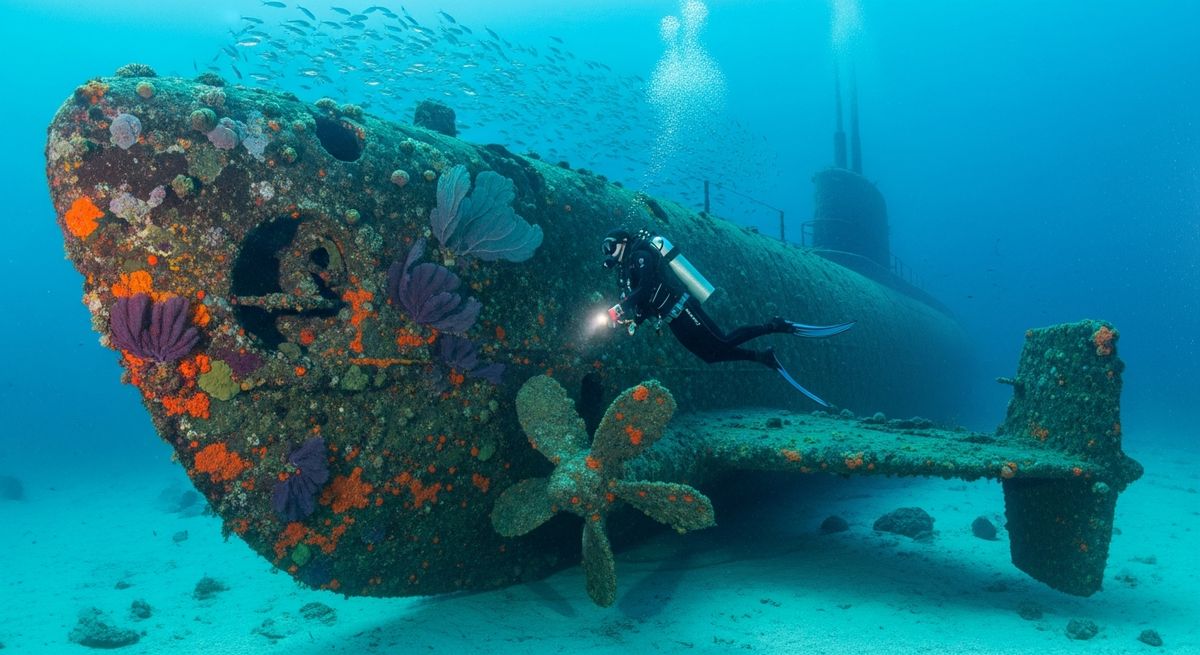
We love the Apostolos Andreas for its sheer scale, a truly massive wreck broken into pieces but still impressively large. This isn't your typical small Caribbean wreck; she’s an old motor vessel, built in 1937, and ran aground back in '67. You’ll spend most of your dive just taking in the sheer amount of crumpled steel, great sheets of it, twisted and contorted. It’s shallow, only 5 metres, which means you get fantastic light penetration, really highlighting the rust-coloured hull against the bright blue. Visibility is usually excellent here. Even with the historical context, what really gets us is how the reef has taken hold. Schools of snapper dart through the shadows beneath the larger sections, and you’ll spot parrotfish grazing on the coral growth. Our favourite part is navigating through the larger open areas where the hull has collapsed in on itself; it feels like exploring a submerged industrial playground. It’s an easy, relaxing dive, perfect for photographers or anyone who just wants to take their time soaking in the atmosphere of a grand old ship transformed into a vibrant artificial reef. You'll want to take a wide-angle lens for this one.
Typical APOSTOLOS ANDREAS Dive Profile
Illustrative profile based on site depth and type. Actual dive profiles vary - always follow your dive computer and training.
Safety Notes
Wreck site - avoid penetration without wreck diving certification. Watch for sharp metal and entanglement hazards.
APOSTOLOS ANDREAS Wreck History
Year Sunk
1967
Vessel Type
cargo ship
Cause
grounding
Tonnage
4,772 GRT
The Apostolos Andreas, a Panamanian-flagged freighter built in 1937, was on an epic journey from Guantanamo, Cuba, to China in July 1967. Its voyage was cut dramatically short when it ran hard aground on the treacherous Formigas Bank, a shallow reef off the easternmost tip of Jamaica. The impact caused extensive damage to the ship's bottom, leading to catastrophic flooding that sealed its fate. The crew was rescued, but the vessel was declared a total loss and abandoned to the sea.
Today, the wreck of the Apostolos Andreas is an incredible site for novice divers and snorkelers. Resting in just 5 metres of warm, clear Caribbean water, it is bathed in sunlight, which illuminates the entire structure and the abundant marine life that now calls it home. Divers can easily explore the ship's remains, which are scattered across the reef top. The shallow depth allows for long, relaxed bottom times, making it a perfect location for underwater photography and for those taking their first breaths exploring a real shipwreck.
Reviews for APOSTOLOS ANDREAS
Conditions
Ocean conditions, forecast and tides for APOSTOLOS ANDREAS
APOSTOLOS ANDREAS Ocean Conditions
Monthly averages for APOSTOLOS ANDREAS, sourced from Open-Meteo marine data - nearest station: Open-Meteo marine grid (17.95, -76.78) (14km away)
October Averages
Sea Temperature
31°C
87°F · Range: 28.7–31.9°C
Air Temperature
27°C
81°F
Wind Speed
3.66 m/s
7.1 knots
Atmospheric Pressure
1012.6 hPa
Based on 4 years of monitoring data · Data sources: Open-Meteo marine data
Plan & book
Ways to dive Ocho Rios, from day trips to liveaboards.
Day trips & courses
via GetYourGuideGuided dives, courses and snorkel trips with instant booking.
Find dive trips in Ocho RiosPlaces to stay
via Booking.comHotels and dive resorts near Ocho Rios.
Search stays in Ocho RiosDive insurance
Most travel insurance excludes or limits scuba. Check what you need before you go.
Dive insurance explainedPartner links: we may earn a commission if you book, at no extra cost to you. How we make money
Where to Stay near APOSTOLOS ANDREAS
Prices from Booking.com. We may earn a commission at no extra cost to you.