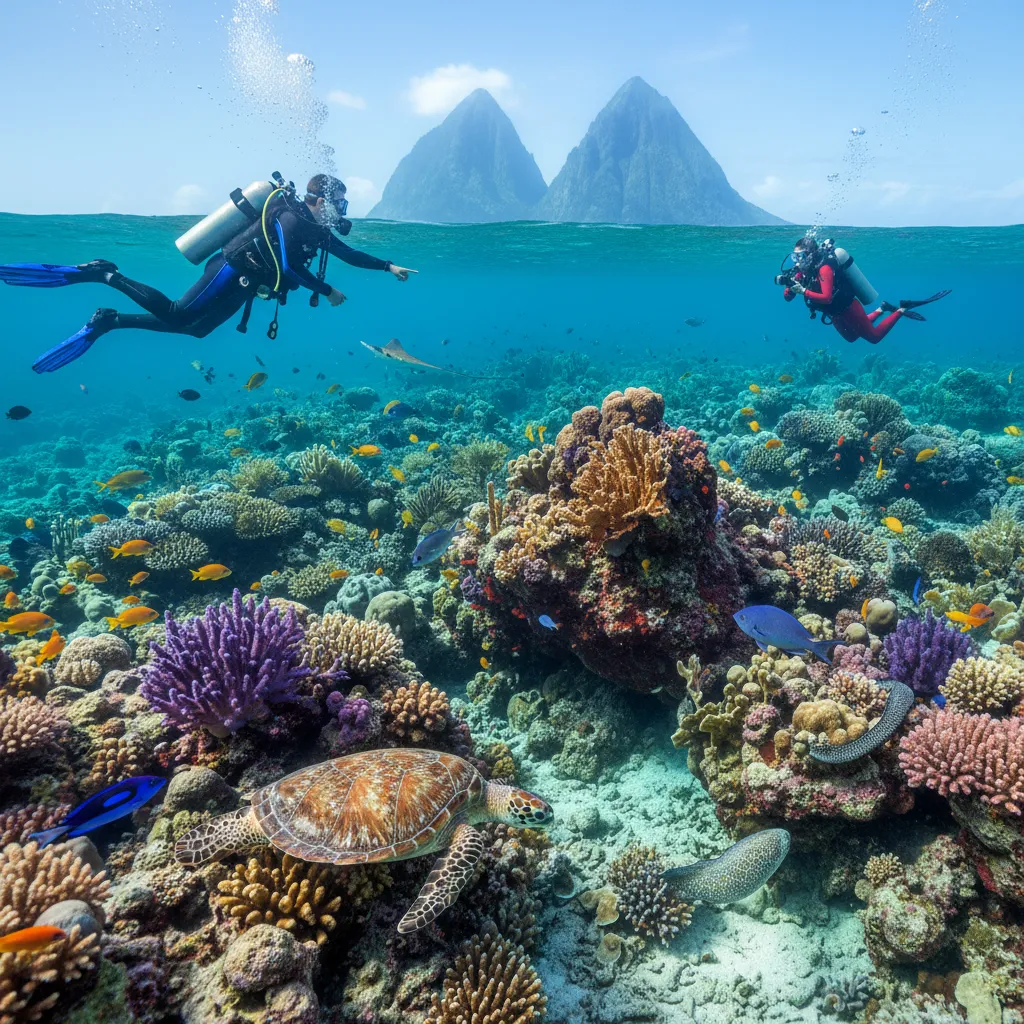
Diving in Soufriere & The Pitons
Why dive here
Soufriere & The Pitons offers some of St. Lucia's richest diving, with 250+ marine species recorded in the area - including bull sharks, dolphins, eagle rays, humpback whales and oceanic whitetip sharks. Water sits around 28°C.
Diving Soufriere means walls, plain and simple. We’re talking world-class wall diving, plummeting beneath the dramatic Piton peaks. Think visibility often stretching past 30 metres, letting you really appreciate the sheer scale as the reef drops away into the blue. Our favourite dive here is probably Superman's Flight, named for the movie scene shot nearby, where you drift along a vibrant wall, often spotting large pelagics cruising by. We love the feeling of hanging mid-water, looking down into the abyss, then glancing up to see the iconic Pitons piercing the surface. Keep an eye out for the smaller stuff too, like the Harlequin Bass tucked into crevices or the shy Brotula peeking from its hideout. The currents can be playful, especially around the points, but they also bring in the bigger fish - we’ve had some fantastic encounters with Mahi Mahi here. If you’re lucky, you might even spot a Leatherback Sea Turtle slowly finning past in season, usually April to June. It’s a superb spot for intermediate divers who appreciate dramatic topography and healthy reefs.
Soufriere & The Pitons Dive Site Map
Dive sites and dive centres in Soufriere & The Pitons
Soufriere & The Pitons Dive Sites
10 dive sites in Soufriere & The Pitons
ANGELN
The Angeln. We love this wreck because it’s a proper ship, not some dinky little boat sunk for divers. This container vessel went down in 2010 after taking on water, and at 132 metres long, she’s a big girl, sitting upright at 33 metres. You can really feel the scale of her as you descend onto the bridge structure. The sheer size means you can spend a full dive just exploring the stern, or poking around the massive cargo holds that are now home to schools of snapper and barracuda. Look closely at the superstructure; we often spot turtles cruising past, and the occasional eagle ray glides over the deck. It’s a bit of a deep dive, so it’s best for advanced divers comfortable with their buoyancy, but the visibility is usually excellent, often 20 metres or more. We'd suggest going early in the morning before any potential boat traffic picks up. It's a fantastic site for feeling like you're truly exploring a lost piece of maritime history, not just another artificial reef.
Anse Chastanet Reef
Anse Chastanet Reef is exactly the kind of site we gravitate towards when we just want to float and take it all in. It’s a comfortable, easy dive, dropping gently from about 3 metres down to 20, making it perfect for a relaxed afternoon or even a night dive. What we really love here is the sheer density of small stuff if you slow down and look for it. We've spent entire dives in just a few square metres, spotting tiny blennies peeking from coral heads and the almost transparent bodies of juvenile fish flitting between the seafans. It’s shore-accessible, which is a big plus – no long boat rides needed. The currents are usually negligible, just a gentle sway, and visibility typically holds strong at 15-20 metres, even after a bit of rain. Keep an eye out for triggerfish patrolling the reef crest and banded cleaner shrimp setting up their stations. Our favourite memory is finding a trio of suspicious lizardfish, perfectly camouflaged, just waiting for something unsuspecting to swim by. This spot truly shines for macro enthusiasts and anyone looking for a stress-free, beautiful dive.
Coral Gardens, Saint Lucia
Coral Gardens is exactly what it says on the tin, and we love it for its sheer, unadulterated coral health. Dropping to around 19m, it’s a gentle slope, perfect for a long, relaxed dive where you can truly take your time. We've spent entire no-decompression limits here just hovering, watching the way the light plays on the brain corals and the dense thickets of sea fans. Visibility averages a comfortable 19m, often more, letting you appreciate the scale of the coral structures. Look closely and you’ll find plenty of Big-eye Anchovies shimmering, or a cheeky Saddled Blenny peeking from a crevice. We’ve seen Reef Scorpionfish here too, masters of camouflage, so keep those eyes peeled. Our favourite time to dive Coral Gardens is mid-morning, when the sun is high enough to illuminate everything without being directly overhead. It's a forgiving site, ideal for newer divers wanting to build confidence, but still engaging enough for experienced eyes to spot those smaller, less obvious creatures like Conklin's Cardinalfish hiding amongst the polyps. It’s a wonderful place to slow down and truly observe.
Fairyland
Fairyland is a solid spot just off the coast in Soufriere. You'll drop down onto a sloping reef, often finding schools of Atlantic thread herring shimmering in the sun. We've spotted more than a few reef scorpionfish tucked into the corals, and the occasional banded pipefish if you’re patient and look closely. It’s a pretty easy dive, good for getting wet and enjoying the scenery without too much effort.
Lesleen M Wreck
The Lesleen M, a 50-metre freighter, was deliberately sunk in 1986 and now rests upright on a sandy bottom, its mast reaching up towards the surface. We love this wreck for its accessibility; sitting in just 20 metres of water, it’s a brilliant introduction to wreck diving. You can comfortably explore the cargo hold and bridge area, swimming through without needing to penetrate deep. Sunlight streams in through the open hatches, illuminating schools of big-eye anchovy that often swirl inside, providing a dazzling display. Coral and sponges have really taken hold, transforming the metal into a living reef. Look closely and you’ll spot Planehead Filefish blending in perfectly, or a Collared Eel peeking from a crevice. We’ve often seen barracuda hanging motionless off the bow, eyeing the smaller fish. For photographers, the wide-angle shots of the wreck’s silhouette against the blue are fantastic, especially in the late morning light. It’s a gentle dive, perfect for beginners or anyone wanting a relaxed exploration of a vibrant artificial reef.
Pinnacles
The Pinnacles at Soufriere is one of our favourite dives in St. Lucia. It’s four volcanic fingers reaching up from 20m, practically begging you to weave between them. We love that feeling of being enclosed and then released, swimming through shafts of light filtering down. It’s not a drift, but the surge can be playful, pushing you gently around the formations. Look closely in the crevices for Pygmy Morays and the Saddled Blenny, often tucked into the sponges. We’ve spent entire safety stops watching the Puffcheek Blennies darting in and out of their little homes on the reef. Down deeper, around 20-25m, the volcanic rock is painted with corals, and you’ll often spot a Reef Scorpionfish blending in perfectly. Keep an eye out in the blue for passing Triggerfish. This site really suits divers who appreciate detailed observation and don’t mind a gentle current. It’s a dive where you want to go slow, poke around, and soak in the details rather than rush through.
STANLEY BEE
The Stanley Bee wreck sits upright at 27 metres, a fishing boat sunk deliberately to create an artificial reef. It’s an interesting dive, with the wheelhouse largely intact and accessible for a quick look inside. Schools of jacks often cruise past, and you'll spot resident lionfish tucked into the superstructure. It's a solid wreck dive for those comfortable at depth, offering a compact exploration without strong currents.
Superman's Flight
Superman's Flight is one of our absolute favourites in St. Lucia, precisely because it delivers exactly what it promises: a flight. You drop in near the base of Petit Piton, and the current just takes you, gently, along that dramatic wall. It’s a proper drift, so effortless you feel like you’re soaring. The coral here is healthy, lots of plate corals stretching out, big gorgonians swaying, and we always spot schools of Atlantic Thread Herring shimmering like mercury. Keep an eye out for the smaller stuff tucked into crevices, particularly the Puffcheek Blennies; they’re little characters. We’ve also seen Horse-eye Jacks cruising past the deeper sections, and if you’re really lucky, a pod of Long-beaked Dolphins might glide by in the blue. For us, the joy is in the journey itself, the sensation of moving without effort, watching the reef unfold. It’s an intermediate drift, really just because you need to be comfortable with the current, but it’s not typically challenging. We’d suggest going in the morning; the light on the wall is stunning.
Turtle Reef
Turtle Reef is an easy dive in the Soufriere marine park, just south of Sugar Beach. We often drop in here for a second dive, something relaxed after a deeper drift. The reef slope is gentle, mostly coral heads and sponges, making it a good spot for newer divers or those who want to take their time with a camera. Look closely among the corals for Banded Pipefish and Planehead Filefish, they're often tucked away. We’ve also had decent luck spotting Chain Morays here, particularly in the mid-depths around 15 metres.
WAUWINET
The Wauwinet wreck holds a certain mystique for us. She’s a big girl, an 84-meter motor vessel, and she met her end in 1981 after hitting another wreck, the Witshoal II, which is quite the maritime coincidence. We love how the reef has truly reclaimed her, turning the ship into an artificial reef that’s now home to so many creatures. Dropping down, the sheer scale of the Wauwinet is impressive. Her bow section is often our favourite part to explore, with schools of jacks circling overhead and barracuda hanging motionless in the slight current. We’ve found her wheelhouse offers some intriguing swim-throughs, but always check your buoyancy – silt can be an issue inside. Keep an eye out for a grumpy moray eel we often see peeking from a pipe near the stern. The wreck bottoms out around 30 meters, so it’s a good one for advanced divers keen on getting a decent bottom time on a substantial piece of history. Visibility averages around 20 meters, but we’d suggest going in the morning before any afternoon chop stirs things up too much. It’s a dive that rewards slow exploration.
Soufriere & The Pitons Dive Centres
1 dive shop and operator in Soufriere & The Pitons
Ocean Wildlife in Soufriere & The Pitons
250 species recorded in Soufriere & The Pitons
Soufriere & The Pitons Daylight & Sunrise/Sunset
Sunrise and sunset times for Soufriere & The Pitons, calculated from coordinates
Today - Sunday 11 October
Sunrise
05:55
Sunset
17:49
Daylight
11h 54m
Golden Hour
17:20
First light (dawn) at 05:34 · Last light (dusk) at 18:10
Monthly Averages
| Month | Sunrise | Sunset | Daylight |
|---|---|---|---|
| Jan | 06:32 | 17:55 | 11h 23m |
| Feb | 06:29 | 18:10 | 11h 41m |
| Mar | 06:13 | 18:15 | 12h 2m |
| Apr | 05:52 | 18:18 | 12h 26m |
| May | 05:39 | 18:24 | 12h 45m |
| JunLongest | 05:37 | 18:33 | 12h 56m |
| Jul | 05:44 | 18:37 | 12h 52m |
| Aug | 05:52 | 18:28 | 12h 36m |
| Sep | 05:54 | 18:07 | 12h 14m |
| OctNow | 05:55 | 17:46 | 11h 51m |
| Nov | 06:04 | 17:35 | 11h 30m |
| DecShortest | 06:20 | 17:39 | 11h 19m |
Times are approximate local times based on longitude. Actual times may vary slightly depending on the exact timezone observed in Soufriere & The Pitons.
Where to Stay near Soufriere & The Pitons
Prices from Booking.com. We may earn a commission at no extra cost to you.
Marine Protected Areas near Soufriere & The Pitons
31 protected areas near Soufriere & The Pitons - please respect local regulations when diving
Cold Upwelling
Pitons(Qualibou and Canaries)
West Coast (incl. Soufriere, Rachette Reefs, Petit Piton, Gros Piton and Anse Chastenets)
Iyanola and Grande Anses, Esperance and Fond D'ors
East Coast (incl. Fond D'Or, Grand Anse Marine Reserve, Cas En Bas, Marquis, Esperance Harbour and Louvette Marine Reserves)
Pointe Sable
East Coast
East Coast
Mandelé
East Coast and Praslin
West Coast (incl. Anse la Raye/Canaries Local Fisheries Management Area and Marigot Bay)
Zone de gestion des Pitons
Showing 12 largest of 31
Getting to Soufriere & The Pitons
Vieux Fort
Kingstown
Fort-de-France
Plan & book
Ways to dive Soufriere & The Pitons, from day trips to liveaboards.
Day trips & courses
via GetYourGuideGuided dives, courses and snorkel trips with instant booking.
Find dive trips in Soufriere & The PitonsPlaces to stay
via Booking.comHotels and dive resorts near Soufriere & The Pitons.
Search stays in Soufriere & The PitonsDive insurance
Most travel insurance excludes or limits scuba. Check what you need before you go.
Dive insurance explainedPartner links: we may earn a commission if you book, at no extra cost to you. How we make money