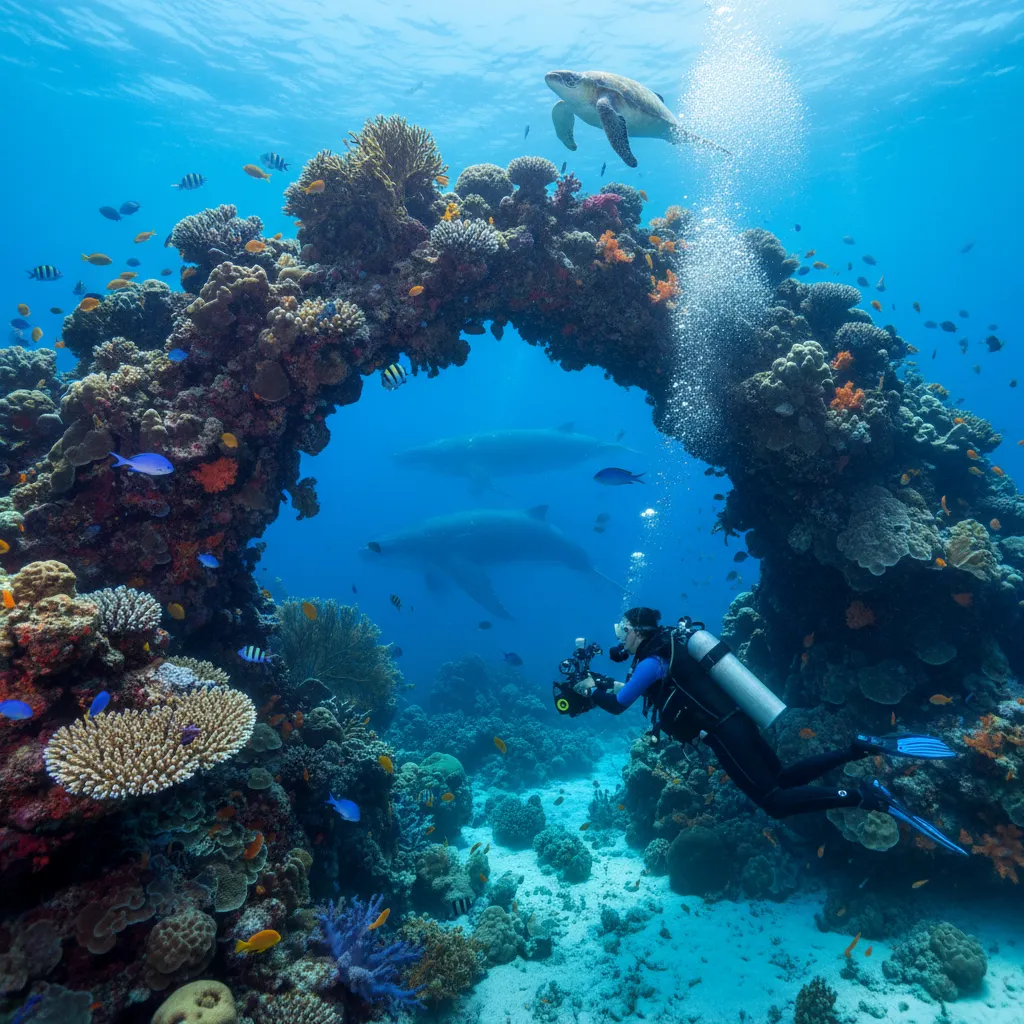
Diving in Vava'u Group
Why dive here
Vava'u Group offers some of Tonga's richest diving, with 312+ marine species recorded in the area - including barracuda, giant moray eels, humpback whales, sperm whales and whitetip reef sharks. Water sits around 28°C.
Vava'u diving means caves and humpbacks. We love this northern Tongan group for its unique blend of cavern exploration and close encounters with the ocean's gentle giants. From July to October, the humpbacks migrate here to calve and breed, and it’s a truly incredible experience to hear their songs vibrating through the water as you descend. Even outside whale season, the diving is pretty special. Our favourite dive sites tend to be the caves; think 'Swallows Cave' or 'Mariner's Cave'. You’re not just looking at a wall of coral here; you're often swimming through tunnels and into vast, sun-dappled caverns, where the light plays off the walls and the sound of your own breath is amplified. The visibility often holds at a comfortable 20-25m, making those shafts of light particularly dramatic. Keep an eye out for the resident schools of Double-bar Goatfish and Sleek Unicornfish that patrol the cave entrances, and if you’re lucky, a Gardiner's Headshield Slug might be inching along a rock face. Currents are generally mild around the islands, making it a great spot for those getting comfortable with drift dives, though some outer reefs can pick up a bit of a push. We’d suggest going early in the morning to beat any potential small boat traffic at the more popular cave sites.
Vava'u Group Dive Site Map
Dive sites and dive centres in Vava'u Group
Vava'u Group Dive Sites
13 dive sites in Vava'u Group
AX Factor Dive House Reef
The AX Factor house reef is one of those spots we keep coming back to, especially if we’re keen on a relaxed afternoon dive or a night dip. It starts shallow, a sandy expanse dotted with coral heads that are just begging for a closer look. We love how those isolated corals morph into denser, more fragile formations as you slope west, reaching about 13 metres before the real drop-off. At night, it’s a whole different show. Those corals glow, a real spectacle, and that’s when we’ve spotted some of our favourite critters here – nudibranchs, often the star of the show. During the day, keep an eye out for the Blue-banded Pualu flitting about and the ever-present Zebra Eviotas. We’ve found the average visibility hovers around 11 metres, which is perfectly fine for hunting down the smaller stuff. It’s a great site for macro lovers and anyone who appreciates a calmer dive with plenty to discover without feeling rushed.
AX Factor Dive House Reef
The AX Factor house reef is one of those spots we keep coming back to, especially if we’re keen on a relaxed afternoon dive or a night dip. It starts shallow, a sandy expanse dotted with coral heads that are just begging for a closer look. We love how those isolated corals morph into denser, more fragile formations as you slope west, reaching about 13 metres before the real drop-off. At night, it’s a whole different show. Those corals glow, a real spectacle, and that’s when we’ve spotted some of our favourite critters here – nudibranchs, often the star of the show. During the day, keep an eye out for the Blue-banded Pualu flitting about and the ever-present Zebra Eviotas. We’ve found the average visibility hovers around 11 metres, which is perfectly fine for hunting down the smaller stuff. It’s a great site for macro lovers and anyone who appreciates a calmer dive with plenty to discover without feeling rushed.
CLAN MACWILLIAM
The Clan MacWilliam isn't just a wreck, it's a colossal piece of history, and we love how it totally dominates the seabed in Vava'u. This isn't some small fishing boat; at 140 meters long, it’s a seriously big steamship, sunk intentionally back in 1905 to clear a channel. Dropping down, the sheer scale of it hits you – the bow points towards the surface, its massive plates covered in decades of growth. Visibility here can vary, but even on a slightly murkier day, the outline of this monster emerging from the blue is impressive. Our favourite part is cruising along the deck, imagining the life that once bustled here. Now, schools of fusiliers swirl like silver blizzards around the superstructure, darting away as you approach. Look closely, and you'll spot resident lionfish tucked into shadowed corners, their venomous spines fanning out. We’ve even seen grey reef sharks patrolling the deeper sections, making a wide circle before disappearing into the gloom. It’s a site for experienced wreck divers, certainly, those who appreciate the historical weight and the slow reclamation by the ocean. Don't expect intricate penetration; this is about absorbing the grandeur of a century-old behemoth. Plan for a long bottom time, you'll need it to take it all in.
Clown fish city
Clownfish City, despite its slightly cheesy name, delivers exactly what it promises, and then some. We love sites that lean into their specialisms, and here, you’ll find anemones packed with clownfish – sometimes a dozen or more in a single host. It’s a shallow dive, maxing out around 20 metres, so you get plenty of bottom time to simply hover and watch their frantic, comical movements. Drop in along the wall, which offers a nice mix of corals and the occasional pelagic cruising by, maybe a trevally or two eyeing up the baitfish schools. But the real show is closer to the sheltered bay. We’d suggest saving most of your air for this section. Slip through the short swim-through – nothing too dramatic, just a cool transition – and you're in. Suddenly, you're surrounded. We’ve counted anemones as big as dinner plates, absolutely teeming with clownfish, some nipping, some just swaying. Look closely, and you’ll spot nudibranchs, little blennies peeking out, and plenty of juvenile reef fish darting between the coral heads. It’s an easy, joyful dive, perfect for photographers or anyone who just wants to grin their way through a tank.
FANTASY
We love Fantasy. It’s a modest wreck, just a sailing yacht that found the wrong rock in a rainstorm back in ‘79, but it’s sitting upright in only 10 metres of water. We’ve always found it a gentle, almost melancholic dive, especially on a sunny afternoon when the light streams through the water. You drop straight onto the deck. The mast lies broken across the hull, a tangle of lines that have become nurseries for juvenile damselfish. Inside the saloon, now stripped bare, you’ll often find lionfish perched on what’s left of the bulkheads, their fins fanned out. The coral growth here isn’t spectacular, more a patchwork of encrusting sponges and small brain corals, but it gives the wreck a soft, aged texture. Out on the bow, a resident school of fusiliers often hangs, moving as one with the surge. It’s an easy dive, perfect for photographers wanting to play with ambient light and a forgiving subject, or for anyone who enjoys the quiet contemplation of a wreck slowly returning to the sea. We’d suggest going early in the morning, before the day boats get there, for the best chance of spotting a reef shark cruising by.
Fingers
Fingers is one of those Vava'u sites we always try to squeeze in, especially for newer divers or when we just want a relaxed, vibrant dive. It’s an easy run down to 18 metres, following the coral formations that give the site its name, fingers of reef pushing out from the main wall. We love dropping in here mid-morning, when the sun really lights up the coral – the pinks and purples of the soft corals shimmer, and you’ll see schools of Bicolor Chromis darting in and out of the hard coral heads. Keep an eye out for the Trumpetfish hovering vertically, trying to blend in. Our favourite part is the small swim-throughs; they're not tight, more like arches, and sometimes you’ll find a sleepy Undulated Moray tucked away inside. Visibility here is usually great, a comfortable 20 metres most days. We've often seen turtles glide past, and the occasional Napoleon wrasse will cruise by, unbothered. It's a proper healthy reef, full of fish, and really suits anyone looking for an unhurried dive with plenty to see without battling current.
GLEN MACWILLIAM
We love a good wreck, and the Glen MacWilliam is a corker, especially if you’re into a bit of history with your dive. She’s a decent sized steamship, 115 metres long, sunk after a copra fire back in the day, though we hear the chromium ore cargo she was carrying is worth a fortune now. The wreck sits at 40 metres, making it a dive for those comfortable with deeper profiles. Descending onto the Glen MacWilliam, you really get a sense of her scale. The bow comes into view first, then the huge superstructure looming out of the blue. You can spend a good chunk of your bottom time just circumnavigating her, marvelling at how completely the reef has taken hold. Schools of fusiliers swirl around the mast, so thick they occasionally block the light, and we've spotted resident trevally patrolling the decks. The cargo holds are open, offering some intriguing swim-throughs, but watch your buoyancy – it’s easy to stir up the silt. We'd suggest going early in the morning for the best visibility and fewer other divers. This site is a proper deep wreck dive, great for experienced divers who appreciate history and don’t mind a bit of a current sometimes.
Historic Dive Wreck Clan Mc William
Steaming into Neiafu Harbour, you’d never guess the Clan McWilliam lies just off Koko Bay. She's a fantastic wreck, sunk on Christmas Day 1927, and what a history she has. At 127 metres long, this steel copra freighter still feels massive even at a max depth of 28 metres. We love dropping onto the stern, swimming past the enormous rudder, and then heading towards the bow. The cargo holds are open, so you can poke your head in and imagine her laden with copra, while schools of fusiliers now mill about where the cargo once sat. Visibility averages about 12 metres, which honestly, just adds to the atmosphere, giving the wreck a proper sense of scale and age. Look closely for the smaller stuff – we’ve found ghost pipefish tucked into the coral, and the anemones are often home to glass shrimps. The sheer volume of fish is impressive, with barracuda patrolling the mast and batfish gliding over the decks. Our favourite part has to be the night dive; the fluorescent corals glow under a torch, and you’ll spot sleeping parrotfish or hunting morays. The Clan McWilliam isn't a high-adrenaline drift, but a leisurely, explorative dive that rewards patience and a keen eye. She’s perfect for anyone wanting a relaxed, historically rich wreck experience.
Mariner's Cave
Mariner's Cave isn't just a dive, it's a sensory trip. You descend into what feels like a normal wall, then fin towards a dark opening. The entrance is completely submerged, maybe 3 metres down, and it feels like slipping into another dimension. What we love about this site is the instant shift in atmosphere. Inside, you hit this massive air pocket, a cathedral ceiling of rock, and the light refracts through the water, creating a surreal, ethereal blue glow. It’s like being in a giant, misty planetarium. The fog effect from the trapped air is genuinely unique; it makes every movement feel slightly dreamlike. Visibility in the cave itself depends on how much surge is pushing through, but even on a calmer day, that blue haze is ever-present. We’ve spotted parrotfish picking at the rock walls and little blennies peeking out of crevices. It's not about big pelagics here; it's about the pure, otherworldly experience. Our favourite time to go is mid-morning, when the sun is higher and really gets to play with the light inside. It's a relatively shallow dive, topping out at 8 metres, making it accessible for intermediate divers comfortable in overhead environments. Just remember to duck your head slightly as you surface into the air pocket.
Playground
Playground offers a gentle introduction to Vava'u diving, maxing out at 20m. It's an easy drift over a soft coral slope, great for new divers or anyone wanting a relaxed afternoon. We usually spot reef sharks cruising by and plenty of schooling fusiliers. It's not a thrill-seeker's site, but it's reliably pleasant.
Swallows Cave
Swallows Cave, in Tonga's Vava'u Group, is one of those places that just makes you grin. We’ve been through a fair few caves in our time, and this one consistently delivers. It's not a deep dive, peaking around 12 meters, so it’s perfect for newer divers or anyone who just wants an easy, beautiful experience. What we love most here are the light shafts. On a sunny day, they cut through the water like lasers, illuminating the schools of fusiliers that swirl around inside. Seriously, sometimes they're so thick they block your view of the exit. We've seen Mimic Surgeonfish darting through the beams, and Palespot Eviotas peering from the crevices. Keep an eye out for a well-camouflaged Flasher Scorpionfish on the rocky bottom, too – they're masters of disguise. The sheer volume of fish is impressive for a cave environment, and it's a great spot for some relaxed photography. Our top tip? Get there mid-morning for the best light, before any afternoon chop picks up. It’s an easy entry and exit, just a calm surface swim into the main chamber.
The Arch
The Arch in Vava'u is one of our favourite dives, not just for the obvious attraction of the structure itself, but for the genuine sense of wildness it carries. Dropping down, you immediately notice the water clarity, often 30 metres plus. We usually head straight for the archway, about 10 metres wide and completely draped in soft corals, their polyps swaying gently in the subtle surge. It’s like swimming through a living tunnel. Once through, the reef opens up to a sloping wall, dotted with big table corals and home to schools of black-back butterflyfish and broom filefish. We’ve had incredible encounters here, like the time a sailfish zipped past in the blue, barely a blur. Keep an eye out for grey reef sharks cruising by; they often make a pass through the arch itself, adding to that thrilling, untamed feel. It’s an intermediate dive, straightforward enough for most, but the currents can pick up, so be ready for a bit of a workout. We love visiting in the morning, just as the light starts to angle through the arch, making the corals glow.
Show all 13 dive sites in Vava'u Group
Vava'u Group Dive Centres
2 dive shops and operators in Vava'u Group
Ocean Wildlife in Vava'u Group
312 species recorded in Vava'u Group
Vava'u Group Daylight & Sunrise/Sunset
Sunrise and sunset times for Vava'u Group, calculated from coordinates
Today - Sunday 11 October
Sunrise
05:11
Sunset
17:37
Daylight
12h 25m
Golden Hour
17:07
First light (dawn) at 04:49 · Last light (dusk) at 17:59
Monthly Averages
| Month | Sunrise | Sunset | Daylight |
|---|---|---|---|
| Jan | 05:12 | 18:20 | 13h 8m |
| Feb | 05:30 | 18:13 | 12h 43m |
| Mar | 05:39 | 17:53 | 12h 14m |
| Apr | 05:46 | 17:28 | 11h 41m |
| May | 05:56 | 17:11 | 11h 15m |
| JunShortest | 06:07 | 17:08 | 11h 1m |
| Jul | 06:10 | 17:16 | 11h 6m |
| Aug | 05:58 | 17:26 | 11h 28m |
| Sep | 05:34 | 17:32 | 11h 58m |
| OctNow | 05:08 | 17:38 | 12h 30m |
| Nov | 04:52 | 17:51 | 12h 59m |
| DecLongest | 04:55 | 18:09 | 13h 14m |
Times are approximate local times based on longitude. Actual times may vary slightly depending on the exact timezone observed in Vava'u Group.
Where to Stay near Vava'u Group
Prices from Booking.com. We may earn a commission at no extra cost to you.
Marine Protected Areas near Vava'u Group
23 protected areas near Vava'u Group - please respect local regulations when diving
Nomuka SMA
'O'ua SMA
Mango SMA
Fonoifua SMA
Matuku SMA
Felemea SMA
Kotu SMA
Hunga SMA
Ha'afeva SMA
'Ovaka SMA
Taunga SMA
Ofu SMA
Showing 12 largest of 23
Getting to Vava'u Group
Vava'u Island
Nuku'alofa
Lifuka
Plan & book
Ways to dive Vava'u Group, from day trips to liveaboards.
Day trips & courses
via GetYourGuideGuided dives, courses and snorkel trips with instant booking.
Find dive trips in Vava'u GroupPlaces to stay
via Booking.comHotels and dive resorts near Vava'u Group.
Search stays in Vava'u GroupDive insurance
Most travel insurance excludes or limits scuba. Check what you need before you go.
Dive insurance explainedPartner links: we may earn a commission if you book, at no extra cost to you. How we make money