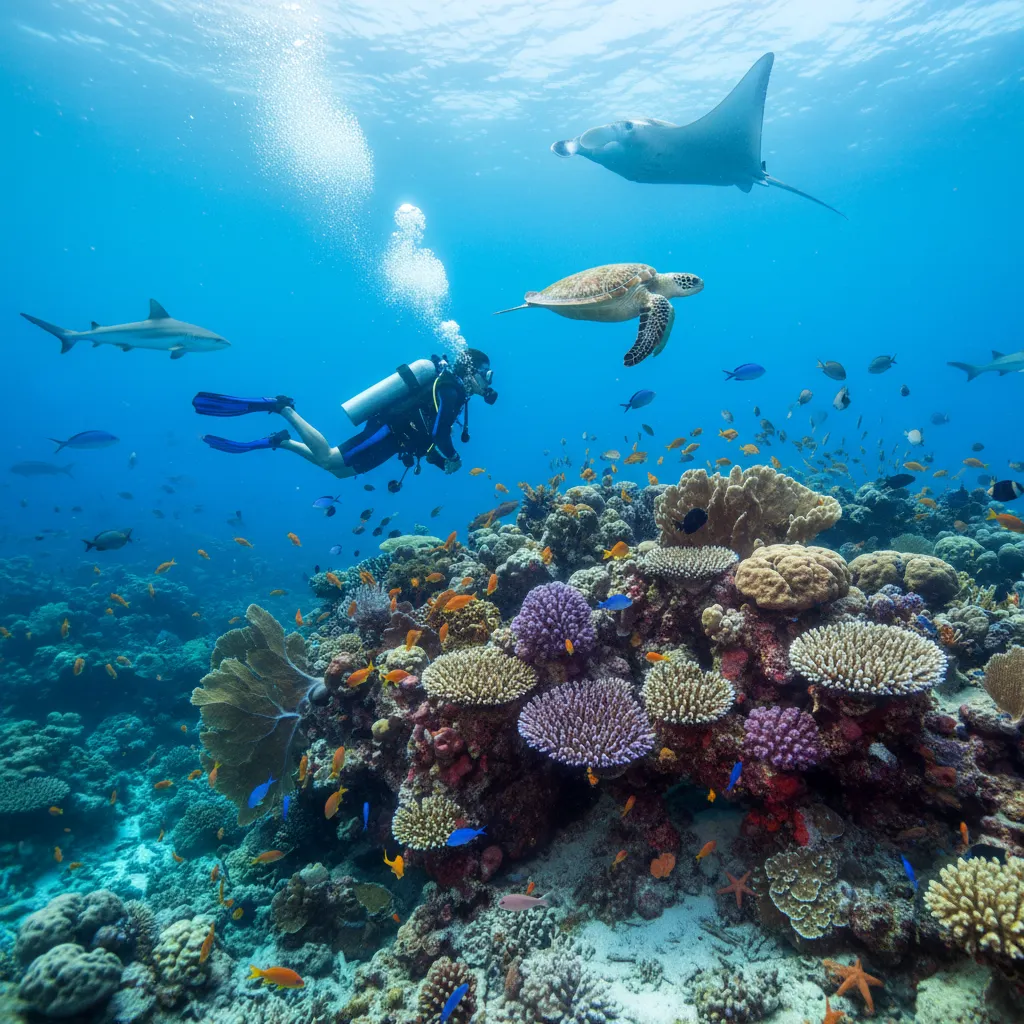
Diving in Funafuti Atoll
Why dive here
Funafuti Atoll offers some of Tuvalu's richest diving, with 152+ marine species recorded in the area - including blacktip reef sharks, eagle rays, grey reef sharks, humpback whales and whitetip reef sharks. Water sits around 30°C.
Funafuti Atoll. We’re talking about diving at the edge of the world here, and you really feel it. With no dive centres, this is proper expedition diving, the kind that demands a sturdy boat and a well-planned itinerary. We love the feeling of exploring genuinely virgin reefs, places where the fish haven't learned to be shy. The channels into the lagoon can be exhilarating, especially when the tide rips, pulling you past schools of Golden Trevally and patrolling reef sharks. Out on the outer reefs, the coral formations are simply immense. Think Montipora plates stretching further than you can see, and Staghorn coral thickets that feel like underwater forests. You'll spot Banded-tail Coral-cod tucked into crevices and parrotfish, like the Rivulated and Bicolour, constantly munching away. Keep an eye out for the smaller stuff too; Coral Blennies peering from their homes and the iridescent flash of a bluefin filefish. The wreck site is a fun bonus, often attracting schooling fusiliers and the occasional Red-flushed Cod. We’d suggest focusing on the morning dives for the best light penetration on the outer reef walls; the colours truly pop. Prepare for variable conditions, though, from glassy calm lagoon dives to more challenging drifts in the passages. This is raw, unfiltered Pacific diving.
Funafuti Atoll Dive Site Map
Dive sites and dive centres in Funafuti Atoll
Funafuti Atoll Dive Sites
6 dive sites in Funafuti Atoll
Funafuti Conservation Area
Alright, let’s talk about the Funafuti Conservation Area. This isn't a heart-pounding drift dive or a thresher shark bonanza. What it is, though, is a beautifully calm, almost meditative experience. Imagine gliding over solid coral structures – the huge, branching cauliflower corals are particularly striking – with schools of those brilliant two-spot bristletooths just hanging in the water, shimmering. We love how relaxed you feel here. It’s shallow, typically 5-20m, meaning you get fantastic light penetration, illuminating every detail of the reef. We’d suggest going in the morning; the light is softer then, and the parrotfish, like the bridled and dusky varieties, are out munching away. You’ll definitely spot angelfish weaving through the bommies and those gorgeous humpbacked conchs slowly making their way across the sand patches. It’s a site for truly slowing down, for getting up close with a coral blenny peering out from its hidey-hole, or watching a mimic surgeonfish blend into the crowd. This is our pick for photographers, for new divers finding their fins, or for anyone who just wants to soak up the serene beauty of a truly healthy, protected reef. The tranquility here is something special.
Funafuti South Pass
Funafuti South Pass? This is it. Our pick for Tuvalu. You’re dropping into a proper channel dive here, not for the faint of heart, but oh, is it worth the effort. The current can be fierce, absolutely ripping through the pass, which is exactly why everything big hangs out here. We’re talking grey reef sharks, and lots of them, often schooling up. The trick is to time it right, ideally on an incoming tide, but even then, be ready for a ride. We often spend the first part of the dive just hanging in the blue, watching the show. Schools of blue and gold fusiliers stream past, thick as a curtain. Look closer and you’ll spot keeltail needlefish patrolling, sleek and silver. Deeper, around 20-25m, the coral starts to get interesting with some big brain corals and staghorns clinging on, despite the flow. Keep an eye out for undulated morays tucked into crevices. It’s a sensory overload: the rumble of the current, the sheer number of fish, the feeling of flying. This is a site for advanced divers who love a bit of a thrill and aren't afraid of a strong drift. It’s a genuine taste of remote Pacific power.
NZ 4031
NZ 4031 isn't your typical Tuvalu reef dive. This is for the wreck heads, the history buffs, and anyone who appreciates a good story with their bottom time. What we have here is an old aircraft, a real piece of history that crashed on takeoff, according to the Pacific Islands Monthly back in '81. It sits at a manageable 20 meters, meaning you get good light penetration and plenty of time to explore. We love the eerie quiet down there, the way the light filters through the water and plays on the twisted metal. You can spend a good chunk of your dive picking out bits of fuselage, imagining the plane's final moments. It’s been down there long enough for the reef to start claiming it, so expect to see some interesting growth and a surprising number of smaller reef fish darting in and out of the wreckage. It's not a huge site, but it's one of our favourite spots for a contemplative dive, a real contrast to the vibrant outer reefs. Go early to avoid any surge, and take your time.
SISCO
Sisco isn't your typical Tuvaluan drift dive, but it’s a compelling peek into recent history. This motor vessel ran aground near Vaitupu in 1981, eventually declared a total loss and now rests partially submerged on the reef. What you get is a wreck that’s been thoroughly integrated into its surroundings; barnacles and corals cling to the rusty hull, attracting a good number of reef fish. You can fin around the exposed superstructure, spotting anything from parrotfish grazing nearby to small reef sharks cruising the perimeter. We'd suggest this site for photographers looking for a unique subject, or anyone who appreciates a wreck that tells a story, rather than just a dive.
Te Ava Tepuka
Te Ava Tepuka is, hands down, our favourite dive in Funafuti. We love a good wall dive, and this one delivers. It’s an outer reef site, so you’re looking at serious pelagic action. Drop in, and you’re immediately enveloped by visibility that often stretches beyond 30 metres – it feels like diving in air. The wall itself is a tapestry of corals, particularly the delicate Devonshire cup corals and robust corrugated corals, providing shelter for the smaller stuff. But the real show is out in the blue. We’ve seen schools of big-eye trevally so thick they momentarily block the sun. Whitetip reef sharks are common here, just cruising the current line, and if you keep an eye out into the deeper blue, we’ve even spotted the distinctive shape of a humphead wrasse. Keep an eye on your depth here, it’s easy to get distracted by the action and drift a bit deeper than planned. It’s an intermediate dive for a reason, strong currents can pick up, but that’s often when the big fish come out to play. It’s best suited for divers comfortable with a bit of drift and who really want to experience the raw power of an ocean reef.
VAN CAMP NO 1
The *Van Camp No 1* isn't just a sunken fishing boat, it’s a time capsule. This 48-meter tuna clipper, grounded during Cyclone Bebe in 1972, lies remarkably intact, right on Funafuti’s main lagoon beach. We love that you can literally walk up to it, fins in hand, and descend straight into its ghostly embrace. This is a wreck dive for everyone, especially if you're keen on exploring a piece of history without the usual depth challenges. We’ve spent hours here, tracing the outline of the stern, imagining the chaos of that storm. The shallow depth means sunlight floods the interior, illuminating schools of small baitfish that swirl through the holds like liquid silver. Look closely amongst the twisted metal and you'll spot resident moray eels peeking from crevices, and we’ve even come across a curious reef shark or two patrolling the bow. Our favourite part? Seeing how the local kids use it as a playground, diving and jumping off the exposed sections at high tide. It makes the wreck feel alive, not just a relic. Dive it at high tide for the best visibility inside the hull, and keep an eye out for the colourful nudibranchs colonising the rust-encrusted plating.
Funafuti Atoll Dive Centres
No dive centres listed in Funafuti Atoll yet. Browse all dive centres.
Ocean Wildlife in Funafuti Atoll
152 species recorded in Funafuti Atoll
Funafuti Atoll Daylight & Sunrise/Sunset
Sunrise and sunset times for Funafuti Atoll, calculated from coordinates
Today - Sunday 11 October
Sunrise
05:44
Sunset
17:59
Daylight
12h 15m
Golden Hour
17:31
First light (dawn) at 05:23 · Last light (dusk) at 18:20
Monthly Averages
| Month | Sunrise | Sunset | Daylight |
|---|---|---|---|
| Jan | 05:57 | 18:30 | 12h 33m |
| Feb | 06:08 | 18:30 | 12h 22m |
| Mar | 06:09 | 18:18 | 12h 10m |
| Apr | 06:07 | 18:02 | 11h 56m |
| May | 06:09 | 17:53 | 11h 44m |
| JunShortest | 06:16 | 17:54 | 11h 38m |
| Jul | 06:20 | 18:00 | 11h 41m |
| Aug | 06:14 | 18:04 | 11h 50m |
| Sep | 05:59 | 18:02 | 12h 3m |
| OctNow | 05:42 | 17:59 | 12h 17m |
| Nov | 05:34 | 18:04 | 12h 29m |
| DecLongest | 05:41 | 18:17 | 12h 36m |
Times are approximate local times based on longitude. Actual times may vary slightly depending on the exact timezone observed in Funafuti Atoll.
Where to Stay near Funafuti Atoll
Prices from Booking.com. We may earn a commission at no extra cost to you.
Marine Protected Areas near Funafuti Atoll
4 protected areas near Funafuti Atoll - please respect local regulations when diving
Nuku Locally Managed Marine Area
Funafuti
Nukulaelae Locally Managed Marine Area
Vaitupu Locally Managed Marine Area
Getting to Funafuti Atoll
Funafuti
Plan & book
Ways to dive Funafuti Atoll, from day trips to liveaboards.
Day trips & courses
via GetYourGuideGuided dives, courses and snorkel trips with instant booking.
Find dive trips in Funafuti AtollPlaces to stay
via Booking.comHotels and dive resorts near Funafuti Atoll.
Search stays in Funafuti AtollDive insurance
Most travel insurance excludes or limits scuba. Check what you need before you go.
Dive insurance explainedPartner links: we may earn a commission if you book, at no extra cost to you. How we make money