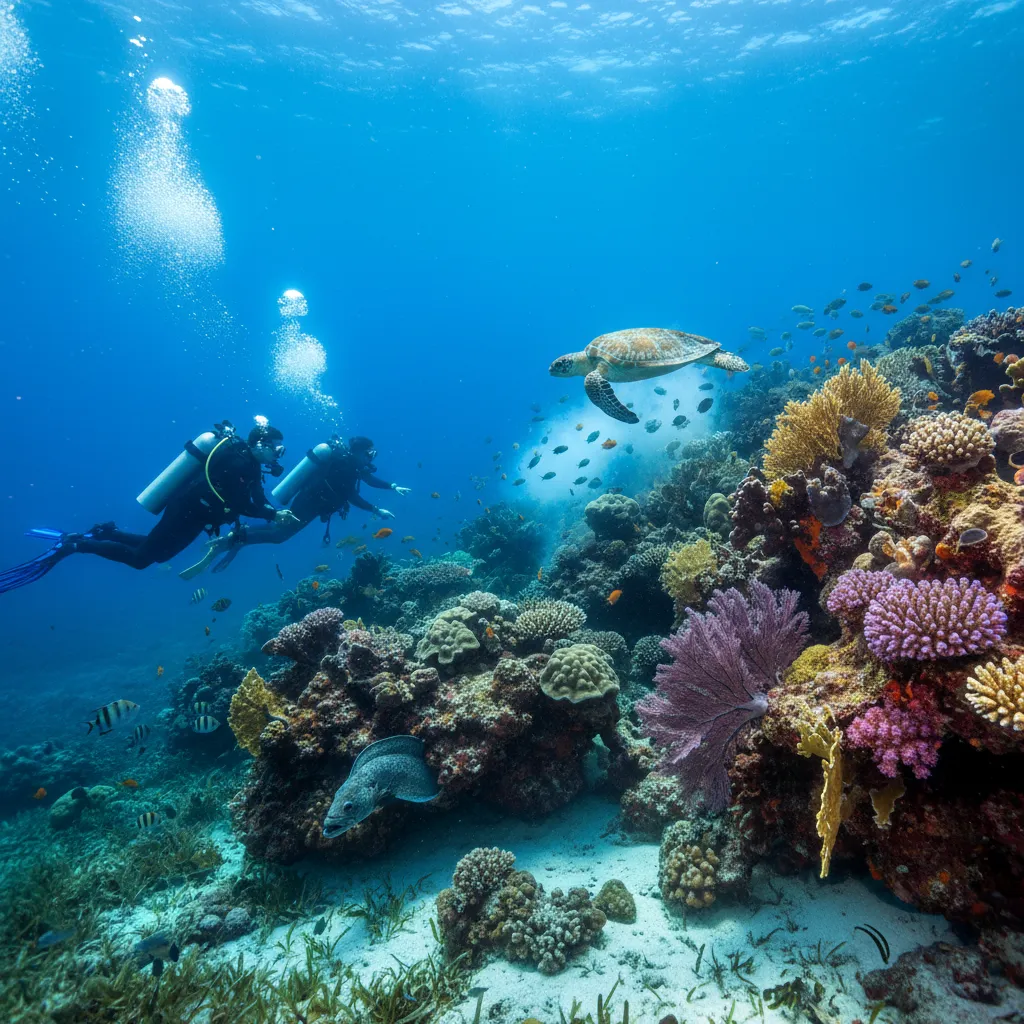
Diving in Al Hoceima
Why dive here
Al Hoceima offers some of Morocco's richest diving, with 140+ marine species recorded in the area - including dolphins, ocean sunfish (mola mola), octopuses, sea turtles and sperm whales. Water ranges 16-23°C, warmest July, August, September.
Al Hoceima National Park, nestled on Morocco’s Mediterranean coast, is probably our favourite Moroccan dive destination. It feels like a real secret, especially considering the sheer number of dive sites - 156 of them and almost thirty centres, though many are small, local operations. The diving here is superb, far exceeding what most people expect from this corner of the Med. Think dramatic walls dropping into the blue, intricate reef systems, and some intriguing wrecks, all bathed in surprisingly good visibility for the region. We love Al Hoceima for its unique mix of Atlantic and Mediterranean species; it’s not unusual to spot a slender rockfish darting among colourful cardinal fish, while overhead, Scopoli's Shearwaters skim the surface. Our pick for a truly memorable dive has to be exploring the caves. There's one particular grotto where the light filters through cracks in the ceiling, illuminating schools of tiny lanternfish, making the water glitter like a cosmic dust cloud. It’s a magical experience. You'll often spot the quirky stout bobtail squid here, too, nestled amongst the reddish crabs and Norway lobsters. For those with a keen eye, the chance to see species like the greater lanternshark or a blackmouth catshark makes it a compelling destination. Currents can pick up, especially around the exposed headlands, so it's worth chatting with the local guides to time your dives right. Generally, the summer months offer the calmest conditions and best visibility.
Al Hoceima Dive Site Map
Dive sites and dive centres in Al Hoceima
Al Hoceima Dive Sites
155 dive sites in Al Hoceima
ALECOS
Alecos is one of those Mediterranean wrecks we keep coming back to. A bulk carrier that went down in 1975, she’s split into a few sections, which makes for some interesting navigation. At only 10 metres, it’s a comfortable dive, giving you plenty of bottom time to really explore. We love finning through the gaping cargo holds, shafts of sunlight cutting through the gloom, illuminating the schools of glinting damselfish that swirl inside. The wreck itself is a riot of colour now, sponges and soft corals having completely taken over the metalwork. Look closely in the nooks and crannies and you’ll spot moray eels peering out, sometimes a curious octopus. It’s a proper historical dive, feeling like you’ve stumbled upon a sunken ghost ship. If you’re into wreck photography, the light here can be stunning, particularly mid-morning. It’s also a good one for newer wreck divers, giving a taste of penetration without anything too tight or complex.
ALEX
The ALEX is a scatter of a fishing vessel, sitting at a comfortable 17 meters, making it a good wreck for those looking to get their fins wet on something a bit more substantial than a reef. We’ve found the remains spread out enough to offer a decent amount of poking around. Look closely among the twisted metal and you’ll often spot moray eels tucked into crevices, and schools of damselfish flitting over the rusted hull sections. It’s a calm dive, usually with minimal current, well-suited for divers who enjoy taking their time to observe how marine life reclaims man-made structures.
ALFREDO
Alfredo sits shallow, barely six metres deep, and that’s precisely why we love it. Forget the deep tech dives; this is pure, unadulterated wreck joy. We’re talking about a fishing vessel, likely scuttled or sunk by accident, now draped in Mediterranean life. You’ll find yourself finning over a hull completely encrusted with sponges and tunicates, the metalwork barely visible under a fuzzy blanket of growth. Visibility here can be stellar, often 15-20 metres, making it easy to appreciate the wreck’s full outline, even from a distance. Our favourite part? The stern, where the prop shaft usually sits. It’s a magnet for juvenile fish – little schools of damselfish darting in and out of the rusted metal, and sometimes a grumpy scorpionfish camouflaged on the hull. It's a relaxed dive, perfect for photographers wanting to practice their macro shots or anyone just keen to potter around a wreck without the pressure of depth. Head down mid-morning before any wind picks up, and you’ll get the best light filtering through the water.
ALGIBE A3
ALGIBE A3 feels like stepping into a forgotten corner of history, a real standout for us in Al Hoceima. This isn't just a hunk of metal on the seabed, it's a ship with a story, sunk deliberately, and now it’s a proper artificial reef. Dropping down to 30 meters, you start to make out the shape of the hull, largely intact, sitting upright. We love exploring the cargo holds, they're surprisingly open and you can penetrate a good distance with the right training, of course. What makes it special are the schools of bream and damselfish that swarm the superstructure. They're so dense sometimes, it's like swimming through a silver curtain. Look closely, and you’ll spot moray eels tucked into every nook and cranny, their heads poking out with that classic wary stare. The light here can be really dramatic, especially on a sunny afternoon, dappling through the deck plates. Our favourite detail is the stern, it’s still relatively defined, and you can imagine the ship in its working life. For experienced wreck divers who appreciate a wreck with a bit of character and plenty of fish life, ALGIBE A3 is a fantastic dive. Just be mindful of currents, they can pick up, especially further out.
ALTONA
The Altona wreck, lying off Al Hoceima, offers a really interesting dive. At a maximum depth of just two metres, this isn't about deep exploration, it’s about accessible history and light. The ship, a 145-metre motor vessel, went down in 1979 after an engine room fire, a proper maritime drama. We love how much of the superstructure is still there, poking just below the surface; it means you can practically snorkel over significant portions. It’s an excellent spot for newer divers, or for those who just want a relaxed, long bottom time. We’ve spent ages just drifting over the deck, watching the play of light on the twisted metal. The fish life here, while not in huge schools, is surprisingly diverse given the shallow depth. You’ll spot damselfish flitting through the beams and occasionally a curious octopus tucked into a crevice. Our favourite detail is the sheer scale of it; even shallow, you get a real sense of its former life. Conditions are usually calm, making it a reliable pick when you're in the area.
ARALAR
Aralar isn't your typical deep Mediterranean wreck, and that's precisely why we love it. This shallow site sits in a mere three metres of water, making it accessible to pretty much anyone, snorkelers included. But don't let the depth fool you, this is a seriously atmospheric spot. The wreck itself, a Spanish steamship scuttled during the Rif War in 1923, is broken but remarkably intact in parts, with ribs and plating still forming recognisable sections of the hull. Our favourite time to dive Aralar is early morning, before the day boats arrive, when the light filters through the surface, dappling the sand and the ship's remains. Shoals of tiny damselfish dart through the corroded metalwork, and we often spot octopus tucked away in crevices, their eyes watching you curiously. It’s an easy, relaxing dive, perfect for photographers wanting to play with ambient light and wide-angle shots, or just for soaking in a piece of history that’s slowly being reclaimed by the sea. Just watch for the occasional surge if there’s a swell running.
ARANDA CHICO
Aranda Chico is a fantastic little wreck, and we love it for its sheer accessibility and how much it packs into such a shallow dive. This isn't some deep, dark technical challenge; it's a playful explore, maxing out at a mere 2m. We’re talking snorkel depth, but don't let that fool you into thinking it's not a proper wreck. You can spend a full hour just poking around the remains of the tug vessel. What makes it special? The light. It streams through the superstructure, illuminating the schools of small bream darting in and out, their scales flashing like scattered coins. Look closely, and you'll spot blennies perched on the rusted metal, watching you with curious eyes. It’s ideal for photographers wanting to practice natural light wreck shots, or for newer divers and even snorkelers who want a genuine wreck experience without the depth. Our favourite time to dive it is late afternoon when the sun hits it at an angle, painting the whole scene in golden hues.
ARRAYA MENDI
The Arraya Mendi, sitting upright at 15 metres, is our kind of wreck dive. It’s got history you can practically feel, a Spanish merchant ship sunk during a storm back in the 1930s. We love how time and the Mediterranean have just completely taken over this vessel. Swimming through the holds, it’s not just the dark, encrusted metal you notice; it’s the schools of damselfish that seem to flicker in and out of the shadows, and the way moray eels peek out from every conceivable crevice. This wreck really feels alive. Barnacles and sponges coat the superstructure, creating a textured, almost organic landscape. We always take our time to peek into the engine room; the light filters down, illuminating the rusted machinery in a way that’s almost eerie. It’s a site that rewards a slow, deliberate dive, giving you time to appreciate the transformation of steel into a living reef. Visibility here can vary, but on a good day, with the sun high, the colours really pop. It’s an accessible depth too, making it a fantastic spot for anyone comfortable with wreck penetration, without needing advanced certs. Just remember, it is an old wreck, so watch your buoyancy inside.
Arrecife del Cañaveral
Arrecife del Cañaveral offers a solid Mediterranean reef dive off Al Hoceima. Expect a mix of hard and soft corals, with smaller reef fish darting amongst them. It's a relaxed spot, suitable for divers looking for a straightforward, pleasant dive without strong currents. We'd suggest it for divers who appreciate the subtler beauty of a healthy, accessible reef.
ARUNDALE
The Arundale isn’t about depth, that's for sure. At a maximum of one metre, this is a snorkel or freedive site, but don’t let that fool you into thinking it's not worth the effort. We love the way this old steamship lies just below the surface, its ribs breaking the water at low tide. It’s perfect for those calm, sunny mornings when the Mediterranean is like glass, letting you see every detail of the wreck’s skeleton. We’d suggest a slow swim over the remains, watching the sunlight play across the rusted metal. Shoals of tiny fry flicker amongst the twisted beams, and you’ll often spot a curious octopus tucked into a crevice. It’s a site that feels incredibly intimate, like you’ve stumbled upon a secret piece of history. Our favourite part is imagining the ship’s past, right there beneath your mask. It’s a different kind of dive, and a truly memorable one for its accessibility and charm.
ASTENE III
ASTENE III, sitting shallow at 14 metres, offers a quick, satisfying dive. It’s a fishing vessel, not a grand ocean liner, but that’s its charm. We love the way it’s settled almost upright, the wheelhouse still largely intact. You can fin right through the holds, which feel surprisingly spacious, even for a wreck this size. Sunlight filters through the gaps, illuminating schools of chromis darting in and out of the shadows. What makes it special for us is the dense growth of orange and yellow sponges covering the hull. It’s like a living tapestry, especially vibrant in the late morning light. Look closely and you'll spot moray eels peeking from crevices, their heads swaying gently. Octopus often hide in the darker corners of the engine room – a patient eye usually gets a glimpse. This is a great spot for newer wreck divers, or anyone who just wants a relaxed dive with plenty to see without needing deep-diving skills. We'd suggest going in the morning before any afternoon chop picks up.
BADALONA
Badalona isn't your usual wreck dive, mostly because it’s not really a dive at all. This is a surface snorkel, a chance to get right up close to a piece of history without even getting your hair wet if you don’t want to. We think it’s absolutely brilliant for non-divers or families. The tanker, sunk by a German torpedo in 1941, sits just beneath the waves, its massive hull breaking the surface in places. We’ve spent hours here, just floating above, watching the light play on the rusted metal. You can clearly make out the ship’s structure, the deck plates, and even some of the superstructure reaching up. It’s a strange, almost eerie feeling to be so close to something so large that was once a working vessel. What makes Badalona shine, in our opinion, is how nature has reclaimed it. Barnacles cling to every exposed surface, and small fish, mainly damselfish and wrasse, dart in and out of the shadows cast by the wreckage. It’s a protected spot, so even on breezy days, the water tends to stay calm, offering pretty good visibility for surface viewing. Our tip? Go early in the morning before any boat traffic stirs things up; the calm surface makes for incredible reflections off the metal. It’s a completely different experience from swimming over a deeper wreck; you feel the weight of its history right there.
Show all 155 dive sites in Al Hoceima
- BLACKHEATH
- BRIDGET CAROLINE
- Cala Iris
- Cala Iza
- CAMPONAVIA
- CARLINA
- CARPIO
- CASTILLO SAN MARCOS
- Centro de Buceo
- CITOS (POSSIBLY)
- COLLINDALE
- CONDE DE FIGOLS
- Cueva de las Palomas
- DELFINA
- DIMITRIOS (PROBABLY)
- Draga Nautilus
- DYNA
- EAST NO.1 AERO BARGE
- ELBERFELD
- El Boquete
- El Cabezo
- EUGENIO DUTRUS
- EVANTHIA & EVERETTS
- EXCELLENT
- FEDRA
- FERROLANO
- FIONA SHELL
- FRANCISCO VEIGA
- GENERAL VALDES
- GEORGIE
- GNEISENAU
- GRACIA DE DIOS (POSSIBLY)
- GUADARRAMA
- GUINIGUADA
- GUTENFERD
- HENDRIK
- HERMANOS ARIAS CAPARROS
- HMS Ark Royal
- HMS Britannia
- HMS Escort
- HMS Porcupine
- IOANNIS NOMIKOS
- ISLA DE COLUMBRETES (POSSIBLY)
- ISLA DEL HIERRO
- ISSA SEGUNDA
- JACOBO
- JACOMINA (POSSIBLY)
- JACS
- JOSEFINA
- JOSEFINA DE LOS RIOS
- JUAN DE JUANES
- La Caldera Nueva
- La Calera
- La Calita
- LADY AVERGREER
- Laja Benítez
- Laja de Dentro
- Laja de Fuera
- Laja de la Lana
- Laja de la Sal
- Laja de la Sirena
- Laja del Maíz
- Laja de San José
- LANDFORT
- LANDFORT
- La Piedra del Abadejo
- La Playita
- LARACHE
- Las Calderas (Wreck)
- LAVORO
- Los Candelabros
- Los Molinos
- LUSIANA
- MAGIC CASTLE
- MAJORBELL
- MALABATA
- MARAZUL
- MARIA ANTONIETA
- MARIA PIA
- MARIAS Y MANUEL
- MARIA VICTORIA
- MARIJU
- MARI MONCHO
- MARK LANE
- MARY
- MAZAGAN
- MELUCHA
- MIAU
- MICHALIS
- MONTE LA NINA
- MYRON C TAYLOR
- NEW FLAME (DEBRIS FROM)
- NEW FLAME (PART OF)(POSSIBLY)
- NICOLAS PAQUET
- NO.482
- OAKMOOR
- OAK-MOORE WRECK
- OKEANUS
- OLTERRA
- OS 35
- PAGAO
- PAGAO (POSSIBLY)
- PANAGLOSA
- PECIO PUERTO PAJARES
- PENAGLOSA
- Peñon de Alhucemas
- Peñón del Santo
- Pepe’s Point
- PERLIO
- PETRA
- PETRAGEN ONE
- PETRO KARPOFF
- Playa - La Garita
- PUERTO DE PAJARES
- Punta de la Mona
- PUNTAMAR I
- RAINBOW
- REGENT LION
- REVELLA
- RIBEL
- RIO MERO
- ROSSLYN
- SALGAR
- SANTA IRENE
- SEA LADY
- SERTOSA 15
- SLAOUI
- STELLA CIRRUS
- SWIFT (PROBABLY)
- TARA E
- TERESITA DE JESUS
- The Gorgonian (Wreck)
- TORREBERMEJA
- Tres Forcas Cape
- TRIOS
- VIRGEN DE ICIAR
- VIRGEN DE LA BONANOVA
- VIRGEN DE LA LUZ
- WEISSHORN
- XENY
- YVETTE
- Zona de cursos Marina del Este
- ZURICH
Al Hoceima Dive Centres
28 dive shops and operators in Al Hoceima
Abysub
Almunecar Dive Center
Black Frog Divers
BUCEO ALGECIRAS
Buceo Almunecar
BUCEO AQUALIA
BUCEO CALAHONDA
Buceo La Herradura
Show all 28 dive centres in Al Hoceima
- Buceo Pretorianos
- Burbujas
- Centro De Buceo Y Viajes Molamola Dive S.L.
- Chems Diving
- DIFFERENT SCUBA SCHOOL
- Dive Charters Gibraltar
- Diving with Nic
- ESCUELA DE BUCEO BUBBLES SEA
- Escuela de surf
- Estepona Dive Center
- FAISHASUB
- Into the Blue Diving
- LEON MARINO Diving Center
- Nerja Dive Resort SL
- PUERTOBUCEO
- RUBIBUCEO
- Scubamar
- Scuba Tours
- SLOW DIVING LA HERRADURA
- Victor Fernandez Center
Ocean Wildlife in Al Hoceima
140 species recorded in Al Hoceima
Al Hoceima Daylight & Sunrise/Sunset
Sunrise and sunset times for Al Hoceima, calculated from coordinates
Today - Sunday 11 October
Sunrise
06:24
Sunset
17:53
Daylight
11h 30m
Golden Hour
17:19
First light (dawn) at 05:58 · Last light (dusk) at 18:19
Monthly Averages
| Month | Sunrise | Sunset | Daylight |
|---|---|---|---|
| Jan | 07:32 | 17:29 | 9h 56m |
| Feb | 07:11 | 18:01 | 10h 50m |
| Mar | 06:35 | 18:28 | 11h 53m |
| Apr | 05:50 | 18:54 | 13h 4m |
| May | 05:17 | 19:20 | 14h 3m |
| JunLongest | 05:04 | 19:40 | 14h 36m |
| Jul | 05:15 | 19:40 | 14h 25m |
| Aug | 05:39 | 19:14 | 13h 35m |
| Sep | 06:03 | 18:32 | 12h 29m |
| OctNow | 06:27 | 17:48 | 11h 21m |
| Nov | 06:57 | 17:15 | 10h 18m |
| DecShortest | 07:25 | 17:08 | 9h 43m |
Times are approximate local times based on longitude. Actual times may vary slightly depending on the exact timezone observed in Al Hoceima.
Where to Stay near Al Hoceima
Prices from Booking.com. We may earn a commission at no extra cost to you.
Marine Protected Areas near Al Hoceima
10 protected areas near Al Hoceima - please respect local regulations when diving
Alboran
Parc National d'Alhoceima
Al-Hoceima National Park
Côte des Bokkoyas
Complexe du Bas Tahaddart
Jbel Moussa
Littoral de Jbel Moussa
Cirque d'El-Jebha
Lagune (Marais) de Smir
El Jebha
Getting to Al Hoceima
Gibraltar
Tétouan
Málaga
Plan & book
Ways to dive Al Hoceima, from day trips to liveaboards.
Day trips & courses
via GetYourGuideGuided dives, courses and snorkel trips with instant booking.
Find dive trips in Al HoceimaPlaces to stay
via Booking.comHotels and dive resorts near Al Hoceima.
Search stays in Al HoceimaDive insurance
Most travel insurance excludes or limits scuba. Check what you need before you go.
Dive insurance explainedPartner links: we may earn a commission if you book, at no extra cost to you. How we make money