Diving in Fernando de Noronha
Why dive here
Fernando de Noronha offers some of Brazil's richest diving, with 44+ marine species recorded in the area - including sea turtles. Water ranges 27-29°C, warmest March, April, May.
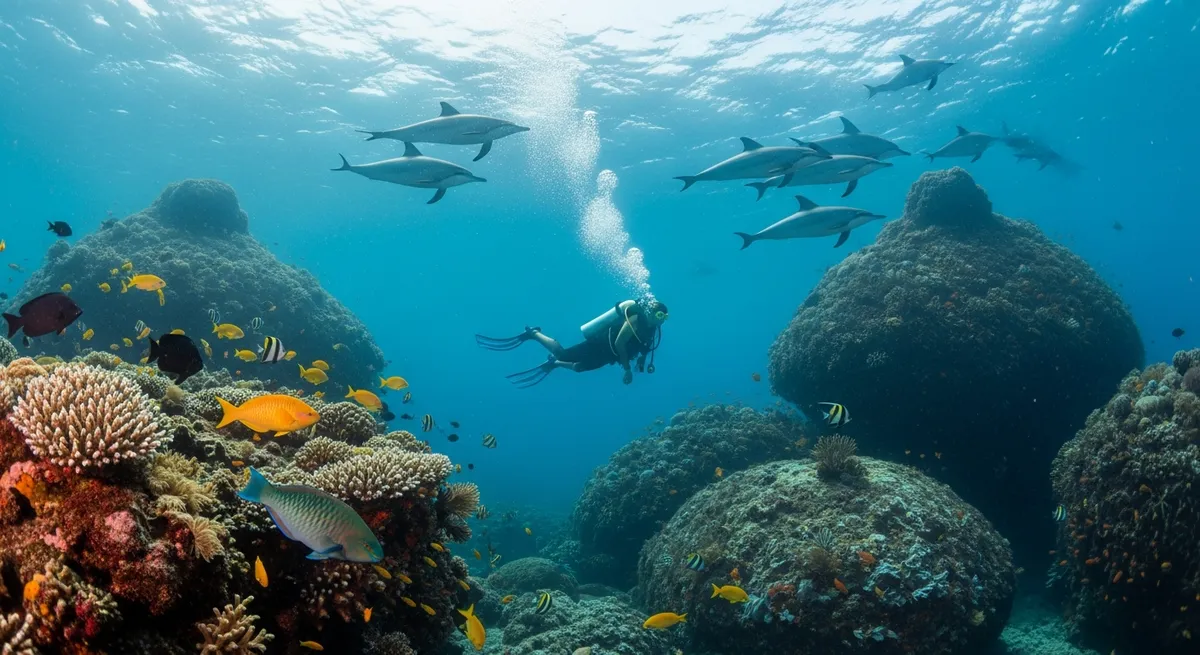
Fernando de Noronha feels like the whole ocean just exhales here. It’s an intermediate diver’s dream, mainly because of the strong currents that often sweep through, but the reward is immense. We love drifting past pinnacles and submerged reefs, the visibility often reaching 30 meters or more, which is just spectacular for Brazil. Our favourite dive is the wreck of the Corveta Ipiranga, which sank in 1983 and now hosts an incredible array of life. Expect to see big schools of Caesar and Doctorfish, sometimes so thick they obscure the wreck itself. Green turtles are common, just cruising by, completely unfazed. If you time it right, early mornings are best for spotting the famous spinner dolphins. They put on an aerial show you won’t forget, though we generally leave them to their natural behaviour and just enjoy the spectacle from the boat. Fernando de Noronha isn't for the absolute beginner, but if you're comfortable with a bit of current, you’ll be rewarded with some of Brazil’s most vibrant and pristine underwater landscapes. It’s a place that just feels wild and untouched.
Fernando de Noronha Dive Site Map
Dive sites and dive centres in Fernando de Noronha
Fernando de Noronha Dive Sites
98 dive sites in Fernando de Noronha
Alvarenga
Alvarenga offers a straightforward dive in Fernando de Noronha, suitable for divers looking for a relaxed exploration. Expect to see the common reef fish of the area, like parrotfish and surgeonfish, alongside a scattering of moray eels tucked into crevices. It’s a good spot if you’re after a pleasant dive without any particular challenges, a chance to simply enjoy being underwater.
Alvarenga
Alvarenga is a fascinating wreck, and for us, it's a solid choice if you're looking for something a bit different in Noronha. This isn't some perfectly preserved ghost ship; it's the remains of an old iron frigate that went down over a century ago. You drop onto a seabed at around 19 meters, and there it is – the scattered, but still substantial, hull of the Alvarenga. We love finning slowly around the twisted metal, imagining the rigging and sails that once propelled it. It feels genuinely historical. Visibility here averages about 12 meters, sometimes a touch more, which gives the whole scene a wonderfully atmospheric, slightly moody feel. Inside the larger sections, you’ll find schools of Atlantic thread herring swirling, a silver curtain against the dark iron. Keep an eye out for green turtles, they often glide past the wreck, using it as a landmark. It's a relaxed dive, suitable for most divers looking for a glimpse into the past, and a chance to see how nature reclaims man-made structures.
Alvarenga
Alvarenga is a fascinating wreck, and for us, it's a solid choice if you're looking for something a bit different in Noronha. This isn't some perfectly preserved ghost ship; it's the remains of an old iron frigate that went down over a century ago. You drop onto a seabed at around 19 meters, and there it is – the scattered, but still substantial, hull of the Alvarenga. We love finning slowly around the twisted metal, imagining the rigging and sails that once propelled it. It feels genuinely historical. Visibility here averages about 12 meters, sometimes a touch more, which gives the whole scene a wonderfully atmospheric, slightly moody feel. Inside the larger sections, you’ll find schools of Atlantic thread herring swirling, a silver curtain against the dark iron. Keep an eye out for green turtles, they often glide past the wreck, using it as a landmark. It's a relaxed dive, suitable for most divers looking for a glimpse into the past, and a chance to see how nature reclaims man-made structures.
Atlantis Divers
Atlantis Divers, a site we always make time for in Fernando de Noronha, genuinely feels like diving into another world. The clear water, often 30 metres plus visibility, lets you see the distinct rock formations here from a distance. As you descend, the light plays through these crevices, creating dramatic shadows where you often find nurse sharks resting. Our favourite encounters here are the resident lemon sharks, often patrolling the edges of the reef, and the surprisingly active coney, darting between corals. The reef itself, a mix of rock and coral, hosts a surprising number of smaller creatures too. Keep an eye out for the delicate harlequin brittle stars tucked away, or the slender parrotfish grazing on the massive starlet corals. We’ve also seen mahi-mahi cruise past in the blue, though that’s more a lucky bonus. This site is great for divers who appreciate dramatic topography and don't mind a little current, which can sometimes pick up, making it a drift dive. It’s a good spot for photography, especially with the clarity.
Baixa Grande
Baixa Grande is one of Fernando de Noronha's noteworthy reef dives. The coral structures here are impressive, often attracting a good variety of reef fish. It’s a solid choice for a relaxing afternoon dive, suitable for divers who appreciate a healthy reef environment without needing big pelagics. We’d suggest it for an easy second or third dive of the day.
Baixa Grande
Baixa Grande is one of Fernando de Noronha's noteworthy reef dives. The coral structures here are impressive, often attracting a good variety of reef fish. It’s a solid choice for a relaxing afternoon dive, suitable for divers who appreciate a healthy reef environment without needing big pelagics. We’d suggest it for an easy second or third dive of the day.
Baixinha
Baixinha offers a solid dive on a substantial coral reef in Fernando de Noronha. We’ve seen a good variety of reef fish here, from parrotfish munching on coral to schools of snapper hugging the deeper sections. It’s a pretty straightforward dive, suitable for most experience levels looking for a classic Noronha reef encounter without too much fuss.
Baixinha
Baixinha offers a solid dive on a substantial coral reef in Fernando de Noronha. We’ve seen a good variety of reef fish here, from parrotfish munching on coral to schools of snapper hugging the deeper sections. It’s a pretty straightforward dive, suitable for most experience levels looking for a classic Noronha reef encounter without too much fuss.
Baixios de Jaguaribe
Baixios de Jaguaribe is a solid coral reef dive in Fernando de Noronha. We've often found ourselves in decent current here, drifting past colourful hard corals and plenty of reef fish. It’s a good spot for a relaxed drift, especially if you're looking to see some of the common Noronha residents like surgeonfish and parrotfish. Not a deep dive, making it suitable for all experience levels.
Baixios de Jaguaribe
Baixios de Jaguaribe is a solid coral reef dive in Fernando de Noronha. We've often found ourselves in decent current here, drifting past colourful hard corals and plenty of reef fish. It’s a good spot for a relaxed drift, especially if you're looking to see some of the common Noronha residents like surgeonfish and parrotfish. Not a deep dive, making it suitable for all experience levels.
Baixo de Fóra
Baixo de Fóra offers a solid dive experience in Fernando de Noronha. It’s a significant coral reef, known for a good showing of local species. We generally find a mix of the usual suspects here, making it a reliable spot for a relaxed dive. Good for those looking to enjoy a typical Noronha reef without too much fuss.
Baixo de Fóra
Baixo de Fóra offers a solid dive experience in Fernando de Noronha. It’s a significant coral reef, known for a good showing of local species. We generally find a mix of the usual suspects here, making it a reliable spot for a relaxed dive. Good for those looking to enjoy a typical Noronha reef without too much fuss.
Show all 98 dive sites in Fernando de Noronha
- Baixo do Japu
- Baixo do Japu
- Baixo do Rio do Fogo
- Baixo Grande
- Baixo Grande
- Baixo Pará
- Baixo Pará
- Baixos de Jenipabu
- Baixos de Jenipabu
- Baixo Seco
- Baixo Seco
- Barra da Ilha
- Barra da Ilha
- Barra da Ilha
- Barra de Catuama
- Barra de Catuama
- Barra do Corta Cachorro
- Barreta de Maria Farinha
- Barreta de Maria Farinha
- Batelao de Cima
- Batelao de Cima
- Bellatrix
- Bellatrix
- Cabeça de Negro
- Cabeça de Negro
- Cabeco Amarelo
- Chata de Noronha
- Comandante Pessoa
- Copernico
- Corveta Camaquã
- Draga Massangana
- Florida
- Galeao Sao Paulo
- Gales de Maragogi
- Gonçalo Coelho
- Lagoa do Bomfim
- Lajes do Miaí
- Lajes do Miaí
- Let's Dive
- Lupus
- Lupus
- MARGUERITE
- Margueritte
- Mercurius
- Mercurius
- Minuano
- Naufragio Reboque
- Parrachos de Maracajaú
- Pedra Nova
- Pedra Nova
- Phoenix
- Picãozinho
- Pirangi
- Pirapama
- Piscinas Naturais - Porto de Galinhas
- Porto de Galinhas
- Rebocador Marte
- Recife da Conceição
- Recife de Natal
- Recife de Natal
- Recife do Tubarão
- Recife Minhoto
- Recifes de Sióba
- Remolcador Marte
- Restinga do Minhoto
- Risca Seca
- Sao Jose
- Sao Luiz
- Saveiros
- Saveiros
- Serigado de Fora
- Servemar 1
- Servemar I
- Servemar X
- Servemar X
- Tartaruguinha
- Taurus
- Taurus e Virgo
- Vapor Bahia
- Vapor de Baixo
- Vapor de Baixo
- Vapor dos 48
- Veleiro Orca
- Veleiro Yemanja
- Virgo
- Walsa
Fernando de Noronha Dive Centres
6 dive shops and operators in Fernando de Noronha
Ocean Wildlife in Fernando de Noronha
44 species recorded in Fernando de Noronha
Fernando de Noronha Daylight & Sunrise/Sunset
Sunrise and sunset times for Fernando de Noronha, calculated from coordinates
Today - Sunday 11 October
Sunrise
06:01
Sunset
18:14
Daylight
12h 14m
Golden Hour
17:47
First light (dawn) at 05:40 · Last light (dusk) at 18:35
Monthly Averages
| Month | Sunrise | Sunset | Daylight |
|---|---|---|---|
| Jan | 06:15 | 18:45 | 12h 30m |
| Feb | 06:25 | 18:45 | 12h 20m |
| Mar | 06:25 | 18:35 | 12h 9m |
| Apr | 06:22 | 18:19 | 11h 57m |
| May | 06:24 | 18:11 | 11h 47m |
| JunShortest | 06:30 | 18:12 | 11h 42m |
| Jul | 06:34 | 18:18 | 11h 44m |
| Aug | 06:30 | 18:22 | 11h 52m |
| Sep | 06:15 | 18:18 | 12h 3m |
| OctNow | 05:59 | 18:14 | 12h 15m |
| Nov | 05:52 | 18:19 | 12h 26m |
| DecLongest | 05:59 | 18:32 | 12h 33m |
Times are approximate local times based on longitude. Actual times may vary slightly depending on the exact timezone observed in Fernando de Noronha.
Where to Stay near Fernando de Noronha
Prices from Booking.com. We may earn a commission at no extra cost to you.
Marine Protected Areas near Fernando de Noronha
13 protected areas near Fernando de Noronha - please respect local regulations when diving
Área De Proteção Ambiental Marinha Recifes Serrambi
Área De Proteção Ambiental Naufrágio Queimado
Área De Proteção Ambiental De Santa Cruz
Área De Proteção Ambiental De Guadalupe
Área De Proteção Ambiental Barra Do Rio Mamanguape
Reserva Extrativista Acaú-Goiana
Área De Relevante Interesse Ecológico Orla Marítima
Parque Natural Municipal Do Forte De Tamandare
Parque Estadual Marinho De Areia Vermelha
Arie Lagoa Azul
Área De Relevante Interesse Ecológico São Miguel
Floresta Nacional Da Restinga De Cabedelo
Showing 12 largest of 13
Getting to Fernando de Noronha
João Pessoa
Recife
Natal
Plan & book
Ways to dive Fernando de Noronha, from day trips to liveaboards.
Day trips & courses
via GetYourGuideGuided dives, courses and snorkel trips with instant booking.
Find dive trips in Fernando de NoronhaPlaces to stay
via Booking.comHotels and dive resorts near Fernando de Noronha.
Search stays in Fernando de NoronhaDive insurance
Most travel insurance excludes or limits scuba. Check what you need before you go.
Dive insurance explainedPartner links: we may earn a commission if you book, at no extra cost to you. How we make money