Igo Nyoga - Halmahera

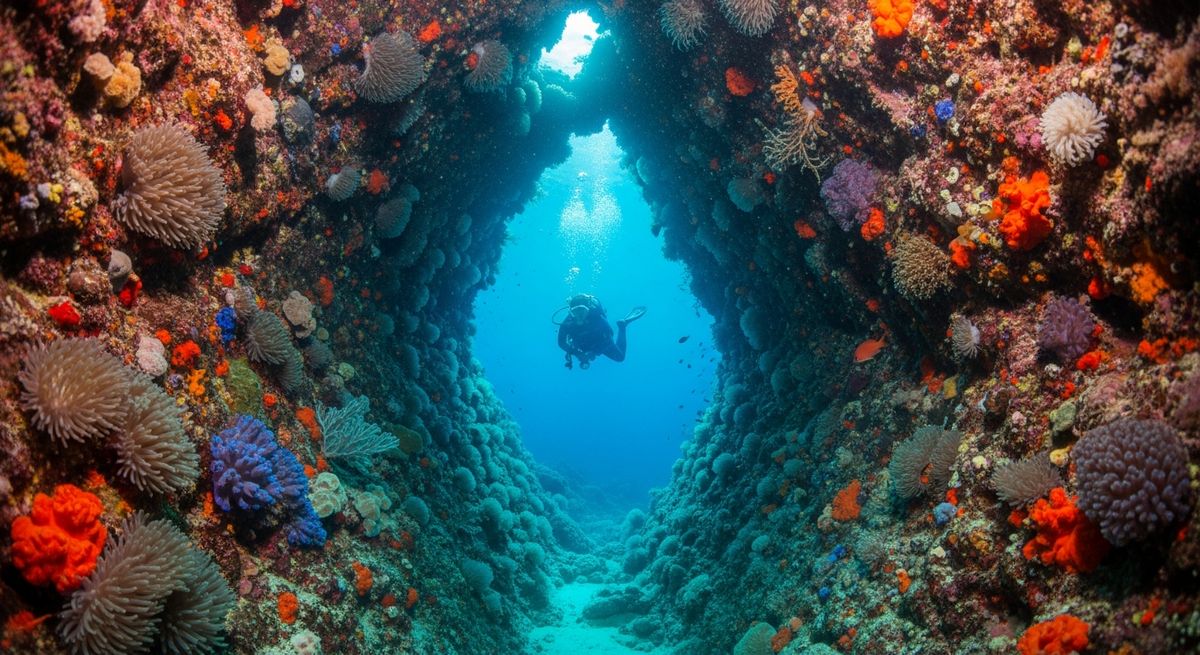
Makena Landing, or "Five Caves" as most of us call it, really shines for divers who appreciate the finer details of an easy shore dive. We love the labyrinth of swim-throughs and small caverns here, making it feel like you’re exploring a secret world. At only 10m deep, it’s a perfect spot for extended bottom times, letting you properly search out the smaller stuff – like the Leopard Blennies peeking from crevices or the colourful Orangetail Filefish camouflaged against the coral. What makes it special is the unique light play inside the caves; sunlight filters down in shafts, illuminating schools of Brick Soldierfish that often pack the ceiling. You’ll frequently bump into Green Sea Turtles, of course, resting on ledges or cruising slowly past. Our pick for the best experience? Go early in the morning, before the crowds, when the water is calmest and the light is at its most dramatic. Just watch your buoyancy in the tighter spots – it’s easy to kick up the silt if you’re not careful.

Location
Halmahera, Indonesia, Southeast Asia
Coordinates
-0.458800, 127.692700
Type
cave

Marine Protected Area: KKP3K Pulau Sali, Gane Barat Utara

Best Time to Dive in Halmahera

The warmest water temperatures in Halmahera occur in November, averaging 30.1°C. The coolest conditions are in August at 28.5°C.

Monthly Water Temperatures

  • January: 29.0°C
  • February: 28.8°C
  • March: 29.1°C
  • April: 29.5°C
  • May: 29.9°C
  • June: 29.6°C
  • July: 29.0°C
  • August: 28.5°C
  • September: 28.6°C
  • October: 29.4°C
  • November: 30.1°C
  • December: 29.8°C

Nearby Dive Sites in Halmahera

Nearest Dive Centres to Igo Nyoga

Marine Life in Halmahera

Home to 141 recorded species including 69 reef fish, 48 hard corals, 7 seagrass & algae, 4 clams & mussels, 3 crabs & lobsters, 2 sea cucumbers.

Notable Species

Recommended Packing List for Igo Nyoga

Based on average water temperature of 29.3°C, currents 7 cm/s.

  • Shorty or Rashguard - warm 29°C water needs minimal exposure protection
  • Mask - essential for every dive
  • Fins
  • BCD - buoyancy compensator
  • Regulator - your most safety-critical piece of gear
  • Dive Computer - tracks depth, time, and NDL
  • Surface Marker Buoy (SMB) - essential for boat pickups
  • Dive Torch - useful for crevices and colour at depth
  • Underwater Camera - capture your diving memories

Frequently Asked Questions

What is the typical diving depth range at Igo Nyoga?
The typical diving depth at Igo Nyoga reaches a maximum of 20m. Divers will explore a gradual slope adorned with corals, extending down to 25m in some areas. This makes it an ideal site for various experience levels within the intermediate range.
What kind of marine life and underwater topography can divers expect to see at Igo Nyoga?
At Igo Nyoga, divers can expect a vibrant underwater topography featuring a gradual slope with full coral coverage, especially in the shallows. The site is teeming with diverse marine life, including Blacktip Reef Sharks, Bumphead Parrot Fish, Snappers, Sweet Lips, and Fusseliers. Macro enthusiasts will also delight in spotting rare creatures like Bargibanti, Pontohi, and Denise Seahorses; learn more about these fascinating species in our wildlife database.
How challenging is diving at Igo Nyoga, and is it suitable for beginner or advanced divers?
Diving at Igo Nyoga is rated as intermediate difficulty. While the site offers beautiful gradual slopes and rich coral life, strong currents are possible, which can add to the challenge. Therefore, it is best suited for divers with some experience, rather than absolute beginners.
What is the best time of year to dive at Igo Nyoga for optimal visibility and marine encounters?
Information regarding the best time of year to dive at Igo Nyoga for optimal visibility and marine encounters is not available in the provided data. We recommend checking our When to Dive section for general guidance on the region.
Are there any specific scuba diving certifications required to dive at Igo Nyoga?
The provided data for Igo Nyoga does not specify any particular scuba diving certifications required. Given its intermediate difficulty and potential for strong currents, it is generally recommended that divers hold at least an Advanced Open Water certification or equivalent experience.
What are the typical water conditions, including currents and temperature, at the Igo Nyoga dive site?
At the Igo Nyoga dive site, divers should be prepared for strong currents, which are possible. The average visibility is excellent, typically around 20m, offering clear views of the vibrant marine life and corals. Information regarding typical water temperatures is not available in the provided context.