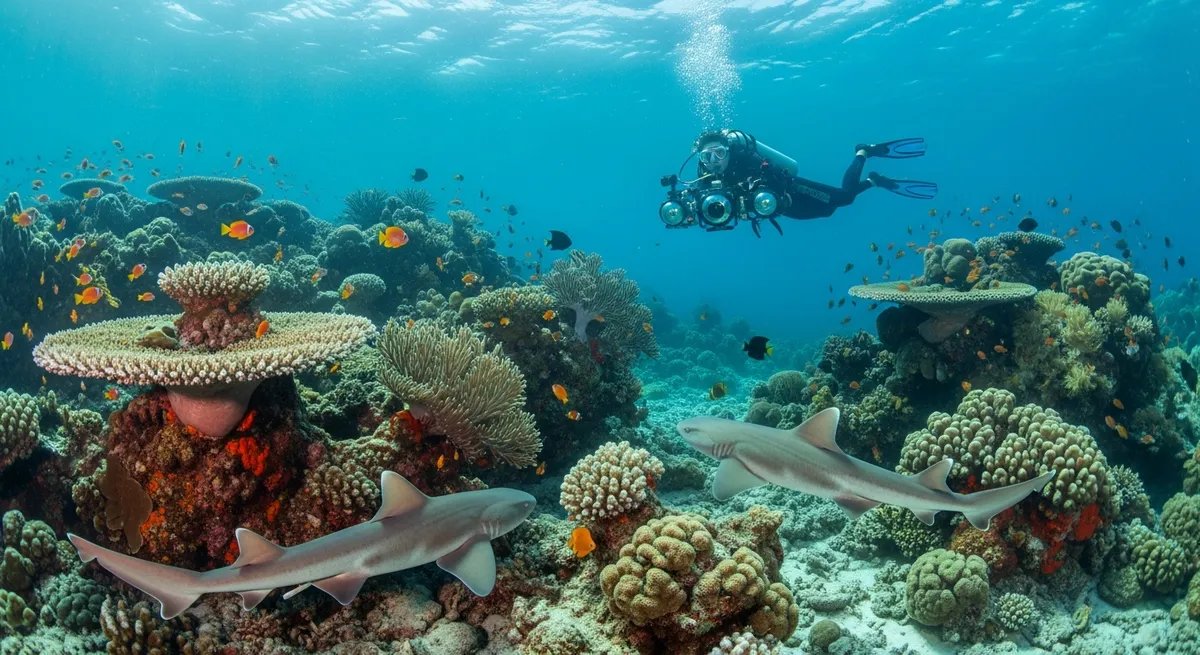
Diving in Halmahera
Why dive here
Halmahera offers some of Indonesia's richest diving, with 131+ marine species recorded in the area - including sea turtles, sperm whales and pufferfish. Water ranges 29-30°C, warmest April, May, December.
Halmahera feels like exploring uncharted territory, even in Indonesia. It’s frontier diving, pure and simple, and we love that raw, untamed feel. You’ll find healthy reefs here, largely untouched, where the corals - particularly the staghorn and turbinaria - grow in massive, sprawling formations. Diving a wall, you might spot pinkfish darting through the coral branches and thick schools of bullet mackerel swirling in the blue. What makes Halmahera special for us is the genuine sense of discovery. We’ve been on dives where we felt like the first people to ever drop in, and that’s a rare thrill these days. Beyond the reefs, there are scattered WWII wrecks, silent reminders of another era, now home to silver sillago and flathead sleepers. Currents can be present, as you’d expect from a place with such vibrant marine life, so intermediate diving experience is a good idea. Our tip? Go during the dry season for the clearest visibility and calmest surface conditions, making those deeper wall dives even more rewarding. It’s not a place for resort crowds; it’s for divers who want to see what diving used to be like.
Halmahera Dive Site Map
Dive sites and dive centres in Halmahera
Halmahera Dive Sites
39 dive sites in Halmahera
Dive site
Halmahera is still pretty wild, and at Dive site, you get a real sense of that raw energy. It's a spot where we’ve seen things like the tiny Sparse Eviota flitting between coral heads, and the more vibrant Yellow-red Pygmygoby darting about. Look for Bear Paw Clams tucked into the substrate and keep an eye out for the distinctive chocolate chip sea star. We'd say it’s a good one for macro lovers and anyone who appreciates a quieter dive away from the crowds. It’s not going to blow your mind with massive schools, but it offers a solid, peaceful exploration.
Dive site
Halmahera's "Dive site" feels less like a specific spot and more like a secret handshake. It’s a place we keep going back to, not for the grand pelagic show, but for the intricate details. We love dropping onto the slopes here, letting our eyes adjust to the soft coral hues, then slowly, painstakingly, searching for the micro-marvels. Our last visit saw us spending a good thirty minutes with a pair of pygmy seahorses, so well camouflaged on a gorgonian fan they practically dared us to find them. Keep an eye out too for the prickly spotted drupe snails, their shells are incredible up close, and the often-overlooked banded blennies darting in and out of crevices. We’d suggest going slow, really slow. This isn't a site for zipping along; it rewards patience and a good macro lens. You might even spot a snakehead cowry or a small giant clam tucked into the reef. It’s perfect for the photographer, the naturalist, or anyone who finds joy in the smaller, more delicate side of the ocean.
Dive Site
Dive Site in Halmahera offers a mellow experience, good for a relaxed afternoon. We’ve found a decent number of gobies here, particularly the Blackbelly and Yellow-red Pygmygobies, which always make for a satisfying macro hunt. You’ll also spot the occasional chocolate chip sea star and some sturdy staghorn coral formations. It's a straightforward dive, well-suited for divers who enjoy taking their time and observing the smaller stuff.
Dive Site
This particular Dive Site in Halmahera, we’ve found, is a proper showcase for what makes the region so special. It's not about big pelagics here, though you might catch a flash of Spanish mackerel passing through. Instead, Dive Site shines when you slow down. We love the way the reef is home to so many different sweetlips, from the striking Indian Ocean orientals to smaller, more demure species. Spend some time scanning the anemones for Sebae Anemones and their resident clownfish, and keep an eye on the seagrass beds – they’re not just for show; Clump Seagrass provides shelter for small reef dwellers. You’ll spot bullet mackerel zipping by and plenty of honeycomb groupers tucked into crevices. For the macro enthusiasts, we’ve had some fantastic luck with pygmy seahorses, though they take a keen eye and a patient fin. The banded blennies are always a laugh to watch as they dart in and out of their perches. This is a site best enjoyed by divers who appreciate the smaller details and are willing to take their time.
Dive Site
Halmahera’s ‘Dive Site’ might not have the snappiest name, but it delivers on some excellent critters. We often spot yellow-red pygmygobies here, perched just so, along with the distinctive minor scorpionfish camouflaged against the reef. Look for bear paw clams tucked into crevices. The staghorn coral is doing well, providing plenty of nooks and crannies for sparse eviota and blackbelly pygmygobies. It’s a good spot for macro enthusiasts, or anyone who enjoys a relaxed dive without too much current, making it suitable for divers comfortable with finding the smaller stuff.
Giovannis Point
Giovannis Point sits in a channel between two islands, about a 20-minute boat ride northeast from Nabucco Spice Island Resort. Expect currents here, often quite strong, which keep things moving and bring in a decent amount of fish life. We’ve seen blacktip reef sharks cruising the edges and schools of grunts and yellowtail fusiliers swirling past. The coral garden is quite pretty, with some impressive table corals and barrel sponges, and there’s a small cave to poke around in. Maximum depth is 25 meters, and visibility usually hovers around 22 meters. It’s a good spot for divers comfortable with a bit of a push, offering a nice mix of reef architecture and pelagic encounters.
Gonton Packet
Notable reef in Halmahera, Indonesia. reef in Indonesia.
Hol Sulamadaha
Hol Sulamadaha, just a quick 30-minute hop from Ternate’s city centre, really delivers on those dense coral gardens. We love the way the light filters through the shallower staghorn and birdsnest coral formations, especially first thing in the morning. It’s a site that feels instantly welcoming, with visibility often hitting 18 metres, making it perfect for both divers and snorkelers. Dropping to a max of 21 metres, you’re enveloped by schools of blue-lined surgeonfish and longfin bannerfish that drift through the reef like confetti. We've seen a surprising number of green turtles here, sometimes three on a single dive, casually munching on the thalassia seagrass beds near the sand patches. Keep an eye out for the smaller stuff too; the nudibranchs and flatworms are particularly colourful against the smooth cauliflower coral. It’s a gentle drift, allowing plenty of time to really soak it all in. Hol Sulamadaha suits anyone looking for a relaxed, vibrant reef dive without needing to venture far from shore.
Igo Nyoga
Igo Nyoga sits a short boat ride from Kusu Island, offering a gently sloping reef that maxes out around 20 metres. We often find strong currents here, so it’s a drift dive for sure, but that usually means good pelagic action. The real draw is the shallows, absolutely packed with coral, particularly impressive stands of staghorn. Keep an eye out for Blacktip Reef Sharks patrolling the blue, and if you’re lucky, a Bumphead Parrotfish munching on the reef. It’s a lovely site for a relaxed drift, especially if you appreciate dense coral coverage and a chance at some bigger fish.
Kusu East Two Coconut
Kusu East Two Coconut, just five minutes from Nabucco Spice Island Resort, makes for a solid morning dive. We’ve found the reefscape here particularly interesting the further east you go, with a nice mix of soft corals and sturdy hard corals. It's a shallower spot, topping out around 22 meters, with visibility usually hovering around 15 meters, so plenty of light gets in. Keep an eye out for Blacktip Reef Sharks patrolling the coral blocks, and we often spot Humphead Parrotfish cruising by. Fair warning, the current can pick up a bit, so be ready for a gentle drift or a bit of a workout.
Kusu South
Kusu South sits just a short boat ride from Nabucco Spice Island, making it an easy add-on to a day's diving. We usually start in the bay on the south side of Kusu, letting the gentle current carry us southwest towards Kusu Island Resort. The reef plateaus around 23 meters, where the staghorn corals stretch out like bony fingers. Keep an eye out for the Blackbelly Pygmygoby darting through the coral branches; they're tiny but fascinating. Visibility averages around 19 meters, giving you a decent view to spot the well-camouflaged stonefish and scorpionfish. It’s a good, easy dive for shaking off the rust or just enjoying a relaxed afternoon.
Mimmas Point
Mimmas Point, a quick five-minute hop from Nabucco Spice Island Resort, offers a gentle introduction to Halmahera’s underwater scene. We found it’s a site that rewards a slow pace, with lovely coral blocks scattered across a sandy, rocky slope down to about 21 metres. Keep an eye out for the shoals of blue triggerfish that seem to own this spot, and if you’re patient, you might spot bannerfish and angelfish tucked beneath the table corals, perhaps keeping a low profile from the occasional blacktip reef shark. Visibility averages around 15 metres, making it a good, relaxed dive.
Show all 39 dive sites in Halmahera
- Mujiu
- Nabucco Outer Reef 1
- Nabucco Spice Island
- NAD Lembeh
- Nanas Reef
- NOBLE HAWK
- Ochi Mokoko
- Proco House Reef
- Pulau Pokal
- Sabatang Kecil 2
- Sali Bay East Freestyle
- Seromadopo
- Shark Diving Indonesia
- Sofias
- Tafraka
- Tanjung Bakau 1
- Tanjung Bakau 2
- Tanjung Bakau 3
- Tanjung Dehibira
- Tanjung Duva Duva
- Tanjung Gorua
- Tanjung Neraka
- Tanjung Neraka
- The Overhang Kusu South
- Tomajiko, Hiri Island
- TOULOUR
- Wreck Taman Nukila
Halmahera Dive Centres
7 dive shops and operators in Halmahera
Ocean Wildlife in Halmahera
131 species recorded in Halmahera
Halmahera Daylight & Sunrise/Sunset
Sunrise and sunset times for Halmahera, calculated from coordinates
Today - Sunday 11 October
Sunrise
06:14
Sunset
18:20
Daylight
12h 7m
Golden Hour
17:53
First light (dawn) at 05:53 · Last light (dusk) at 18:41
Monthly Averages
| Month | Sunrise | Sunset | Daylight |
|---|---|---|---|
| Jan | 06:36 | 18:43 | 12h 7m |
| Feb | 06:41 | 18:48 | 12h 7m |
| MarShortest | 06:36 | 18:43 | 12h 7m |
| Apr | 06:27 | 18:34 | 12h 7m |
| May | 06:23 | 18:30 | 12h 7m |
| JunLongest | 06:27 | 18:34 | 12h 7m |
| Jul | 06:32 | 18:40 | 12h 7m |
| Aug | 06:32 | 18:38 | 12h 7m |
| Sep | 06:23 | 18:29 | 12h 7m |
| OctNow | 06:13 | 18:19 | 12h 7m |
| Nov | 06:11 | 18:18 | 12h 7m |
| Dec | 06:22 | 18:29 | 12h 7m |
Times are approximate local times based on longitude. Actual times may vary slightly depending on the exact timezone observed in Halmahera.
Where to Stay near Halmahera
Prices from Booking.com. We may earn a commission at no extra cost to you.
Marine Protected Areas near Halmahera
15 protected areas near Halmahera - please respect local regulations when diving
KKP Timur Patani-Pulau Sayafi, Patani
KK Kepulauan Widi
KK Kepulauan Guraici
KK Pulau Makian dan Pulau Moti
KK Pulau Mare
KK Pulau Yiew
KKP3K Pulau Sali, Gane Barat Utara
KKP3K Pulau Kelo dan Songara, Obi Timur
KKP3K Pulau Mandioli
KAWASAN KONSERVASI PERAIRAN DAERAH KOTA TIDORE KEPULAUAN
SUAKA PULAU KECIL KABUPATEN HALMAHERA TENGAH
KKP3K Pulau Dowara Lamo, Gane Barat Selatan
Showing 12 largest of 15
Getting to Halmahera
Ternate
Manado
Ambon
Plan & book
Ways to dive Halmahera, from day trips to liveaboards.
Day trips & courses
via GetYourGuideGuided dives, courses and snorkel trips with instant booking.
Find dive trips in HalmaheraPlaces to stay
via Booking.comHotels and dive resorts near Halmahera.
Search stays in HalmaheraDive insurance
Most travel insurance excludes or limits scuba. Check what you need before you go.
Dive insurance explainedPartner links: we may earn a commission if you book, at no extra cost to you. How we make money