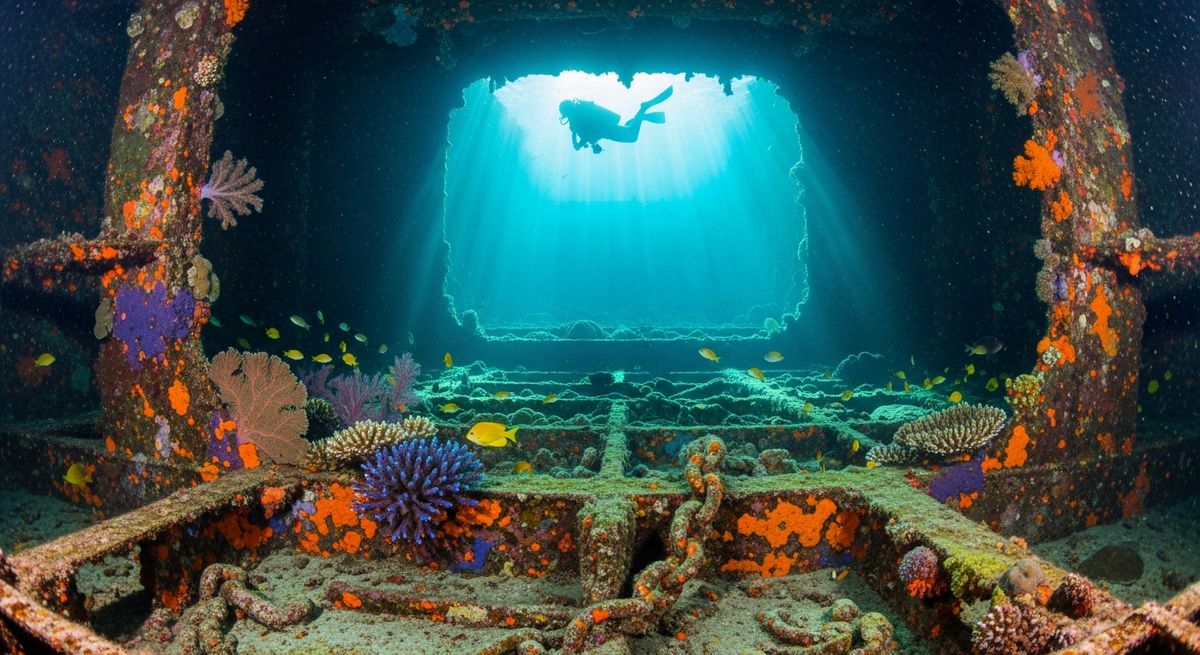
B-24 Bomber Wreck
Protected Area
Kepulauan Togean
Why dive here
With 238+ marine species recorded in the area - including blacktip reef sharks, giant moray eels, pygmy seahorses, seahorses and sperm whales - B-24 Bomber Wreck offers some of Sulawesi's richest wreck diving. Water ranges 29-31°C, warmest June, October, November.
Okay, so the B-24 Bomber Wreck in Sulawesi. This isn't just another pile of metal; it’s a genuine piece of history, resting upright on the seabed like it’s still waiting for its crew. We love the sheer scale of it, and the way the light filters down, creating these long, dramatic shadows around the fuselage. You can still make out the cockpit, the gun turrets, and the wings, which are pretty much intact. Our favourite part has to be finning along the length of the plane, spotting where the staghorn corals have really taken hold, especially on the top surfaces. There are sections absolutely blanketed in them, swaying with the surge. Keep an eye out for the slender snake eels poking their heads out from the sandy patches nearby, and we’ve seen lined-lip cowries clinging to the darker parts of the wreck. It’s a dive that combines that thrilling sense of discovery with a quiet respect for the past. This one really suits divers who appreciate historical sites and don’t mind a deeper profile. The current isn't usually an issue here, which is a bonus, allowing you to really take your time and explore without battling a flow.
Safety Notes
Wreck site - avoid penetration without wreck diving certification. Watch for sharp metal and entanglement hazards.
B-24 Bomber Wreck Wreck History
Year Sunk
1945
Vessel Type
aircraft
Cause
combat
The Consolidated B-24 Liberator was a workhorse of the Allied air forces during World War II, a four-engine heavy bomber known for its long range and heavy payload. Over 19,000 were produced, serving in every theater of the war, from the skies over Europe to the vast expanses of the Pacific. These aircraft were instrumental in strategic bombing campaigns, maritime patrol, and transport duties, playing a crucial role in the eventual Allied victory.
This particular B-24, part of the 307th American Bomb Squadron, met its fate on May 3, 1945. During a mission against Japanese-occupied Sulawesi, the aircraft was hit by anti-aircraft fire while attacking a seaplane base. With the aircraft critically damaged, the pilot was forced to ditch in the sea. While some of the crew managed to survive the ordeal, their formidable bomber sank beneath the waves, becoming an underwater time capsule of the Pacific War's final, intense months.
Today, the B-24 wreck rests on a sandy bottom, offering a poignant and fascinating dive. The aircraft is broken into several sections, but key features remain remarkably recognizable. Divers can explore the cockpit area, the massive wingspan with its four radial engines, and spot propellers half-buried in the sand. The site is often patrolled by schools of fish, and the wreckage has become an artificial reef, decorated with corals and sponges, a peaceful final resting place for a once-mighty war machine.
Nearest Dive Centres to B-24 Bomber Wreck
Dive shops near B-24 Bomber Wreck
Kogutu
Kadiriri Paradise
Black Marlin
reconnect dive centre
Reviews for B-24 Bomber Wreck
Conditions
Ocean conditions, forecast and tides for B-24 Bomber Wreck
B-24 Bomber Wreck Ocean Conditions
Monthly averages for B-24 Bomber Wreck, sourced from Open-Meteo marine data + Copernicus Marine (EU) - nearest station: Open-Meteo marine grid (1.5, 124.75) (0km away)
October Averages
Sea Temperature
30°C
87°F · Range: 29.6–31.2°C
Current Speed
1 cm/s
Direction: W (270°)
Chlorophyll-a
0.099 mg/m³
Very clear (oligotrophic)
Salinity
33.17 PSU
Based on 4 years of monitoring data · Data sources: Open-Meteo marine data + Copernicus Marine (EU)
Plan & book
Ways to dive Sulawesi, from day trips to liveaboards.
Day trips & courses
via GetYourGuideGuided dives, courses and snorkel trips with instant booking.
Find dive trips in SulawesiPlaces to stay
via Booking.comHotels and dive resorts near Sulawesi.
Search stays in SulawesiDive insurance
Most travel insurance excludes or limits scuba. Check what you need before you go.
Dive insurance explainedPartner links: we may earn a commission if you book, at no extra cost to you. How we make money
Where to Stay near B-24 Bomber Wreck
Prices from Booking.com. We may earn a commission at no extra cost to you.