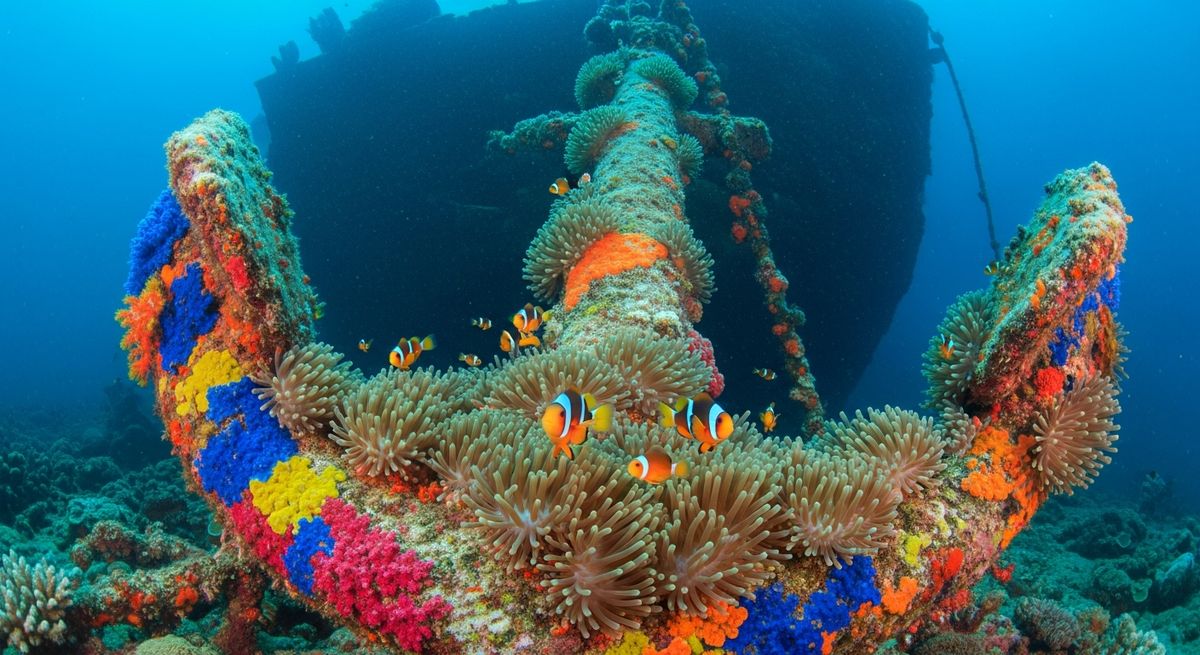
B24 Liberator
Protected Area
Kepulauan Togean
Why dive here
With 238+ marine species recorded in the area - including blacktip reef sharks, giant moray eels, pygmy seahorses, seahorses and sperm whales - B24 Liberator offers some of Sulawesi's richest wreck diving. Water ranges 29-31°C, warmest June, October, November.
The B24 Liberator in Sulawesi isn't just another wreck; it's a profound swim through history, and frankly, we love it for that. This isn't one of those wrecks picked clean or broken into a million pieces. Here, the sheer scale of the aircraft, lying largely intact on the seabed, is what hits you first. You can trace the outline of its wings, see the gaping bomb bay, and peer into the cockpit – it’s genuinely eerie and incredibly cool. We’d suggest going early, before other boats, to really soak in the quiet magnitude of the place. As you descend, the fuselage slowly materialises from the blue, often shrouded in schooling fusiliers so dense they momentarily obscure the wreck itself. Inside, you’ll find small reef sharks often resting, and the tail section has become a condo for lionfish. It’s a photographer’s dream, particularly for those who appreciate the somber beauty of a war grave transformed into a living reef. This dive suits experienced wreck divers who understand the reverence and respect required for such a site, and for anyone who wants a tangible connection to the past beneath the waves.
Typical B24 Liberator Dive Profile
Illustrative profile based on site depth and type. Actual dive profiles vary - always follow your dive computer and training.
Safety Notes
Wreck site - avoid penetration without wreck diving certification. Watch for sharp metal and entanglement hazards.
Always perform a 3-minute safety stop at 5m before surfacing.
B24 Liberator Wreck History
Year Sunk
1945
Vessel Type
aircraft
Cause
unknown
This US Navy PB4Y-1 Liberator, the naval version of the famed B-24 bomber, met its fate on May 26, 1945, during the final months of World War II. While on a bombing mission against a Japanese seaplane base near Peleng Island in the Banggai Archipelago, the aircraft was struck by anti-aircraft fire. The plane crashed into the sea, tragically killing ten of the eleven crew members. The wreck lay undiscovered for over 50 years until it was found by local fishermen in 2000.
Diving this historic war grave is a poignant experience. The aircraft lies in several large sections on a sloping sandy bottom at depths between 14 and 22 meters. Divers can explore the remarkably intact wings, complete with massive engines and propellers partially buried in the sand. The cockpit section, machine guns, and ammunition belts are scattered nearby, offering a direct connection to the aircraft's final moments. Over the years, the wreckage has been colonized by a stunning array of soft and hard corals, attracting schools of fish and making it a beautiful, albeit solemn, memorial to its crew.
Nearest Dive Centres to B24 Liberator
Dive shops near B24 Liberator
Kogutu
Kadiriri Paradise
Black Marlin
reconnect dive centre
Reviews for B24 Liberator
Conditions
Ocean conditions, forecast and tides for B24 Liberator
B24 Liberator Ocean Conditions
Monthly averages for B24 Liberator, sourced from Open-Meteo marine data + Copernicus Marine (EU) - nearest station: Open-Meteo marine grid (1.5, 124.75) (0km away)
October Averages
Sea Temperature
30°C
87°F · Range: 29.6–31.2°C
Current Speed
1 cm/s
Direction: W (270°)
Chlorophyll-a
0.099 mg/m³
Very clear (oligotrophic)
Salinity
33.17 PSU
Based on 4 years of monitoring data · Data sources: Open-Meteo marine data + Copernicus Marine (EU)
Plan & book
Ways to dive Sulawesi, from day trips to liveaboards.
Day trips & courses
via GetYourGuideGuided dives, courses and snorkel trips with instant booking.
Find dive trips in SulawesiPlaces to stay
via Booking.comHotels and dive resorts near Sulawesi.
Search stays in SulawesiDive insurance
Most travel insurance excludes or limits scuba. Check what you need before you go.
Dive insurance explainedPartner links: we may earn a commission if you book, at no extra cost to you. How we make money
Where to Stay near B24 Liberator
Prices from Booking.com. We may earn a commission at no extra cost to you.