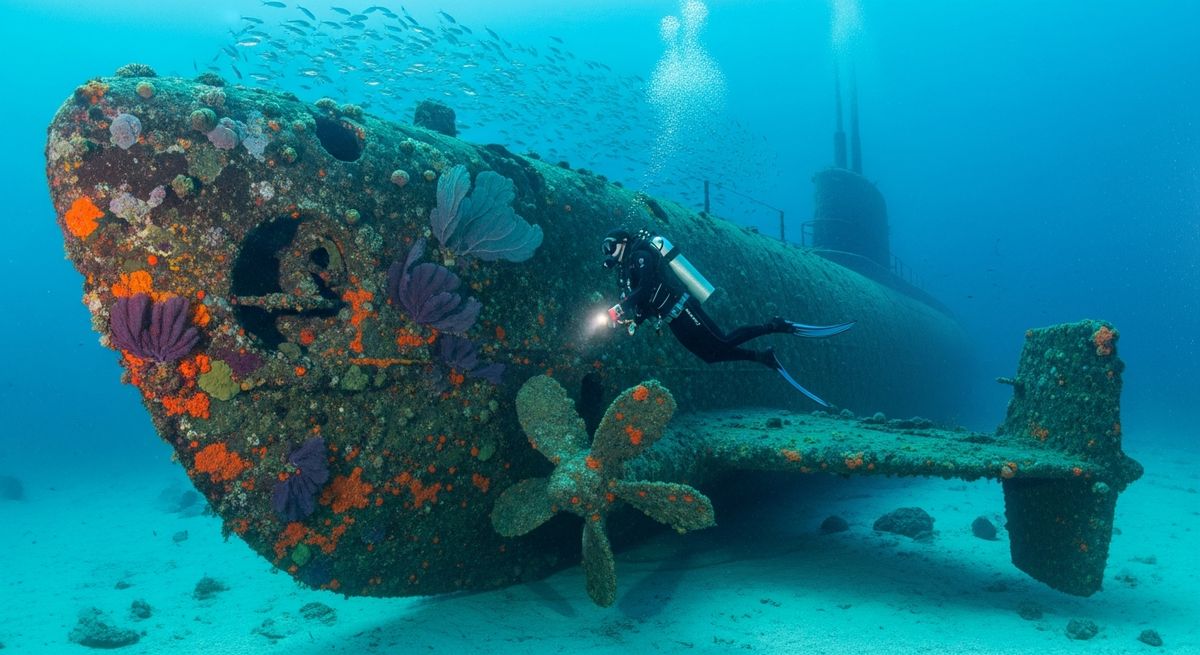
Bimoli wreck
Protected Area
KK Kota Bitung
Why dive here
With 238+ marine species recorded in the area - including blacktip reef sharks, giant moray eels, pygmy seahorses, seahorses and sperm whales - Bimoli wreck offers some of Sulawesi's richest wreck diving. Water ranges 29-31°C, warmest June, October, November.
The Bimoli wreck, sitting upright on the seabed in Sulawesi, is one of those wrecks we just keep coming back to. We love how the light plays through the upper decks, especially on a sunny morning, creating these shifting patterns on the corridors below. It's a proper exploration dive, with plenty of swim-throughs to navigate if you're comfortable with overhead environments. Our favourite part has to be the engine room, which is surprisingly intact, full of old machinery encrusted with sponges and whip corals. You’ll spot schools of yellow-stripe scad darting in and out of the holds, and often a grumpy stonefish or two camouflaged on the hull. We'd suggest arriving early, before the crowds, to really soak in the atmosphere. It's a deep wreck, so definitely one for experienced divers comfortable with their buoyancy.
Typical Bimoli wreck Dive Profile
Illustrative profile based on site depth and type. Actual dive profiles vary - always follow your dive computer and training.
Safety Notes
Wreck site - avoid penetration without wreck diving certification. Watch for sharp metal and entanglement hazards.
Bimoli wreck Wreck History
Year Sunk
1944
Vessel Type
cargo ship
Cause
unknown
Lying in the depths of Manado Bay, the "Bimoli" wreck is a haunting relic of World War II that has blossomed into a spectacular artificial reef. This Japanese cargo ship, likely the Bimoli Maru, was a casualty of the Pacific conflict, sunk by Allied bombers during a raid in 1944. Its final mission was cut short, sending the vessel to the seabed where it has remained for decades, a silent monument to a turbulent past. Today, it stands as one of North Sulawesi's most iconic wreck dives.
Descending onto the Bimoli is like traveling back in time. The ship rests upright and is largely intact, allowing divers to explore its decks, cargo holds, and superstructure. Over the years, nature has claimed the vessel, covering its steel frame in a vibrant carpet of corals and sponges. The wreck acts as a magnet for marine life, attracting large schools of fusiliers, batfish, and jacks. Exploring its coral-encrusted corridors offers a unique combination of historical discovery and breathtaking marine biodiversity, making it an unforgettable dive for experienced wreck divers.
Nearest Dive Centres to Bimoli wreck
Dive shops near Bimoli wreck
MINANGA DIVERS
Tagaroa Dive Center
Manado Adventure Diving Center
Cocotinos Manado A Boutique Dive & Spa
Thalassa Dive Resort - Manado
Murex Dive
Reviews for Bimoli wreck
Conditions
Ocean conditions, forecast and tides for Bimoli wreck
Bimoli wreck Ocean Conditions
Monthly averages for Bimoli wreck, sourced from Open-Meteo marine data + Copernicus Marine (EU) - nearest station: Open-Meteo marine grid (1.5, 124.75) (0km away)
October Averages
Sea Temperature
30°C
87°F · Range: 29.6–31.2°C
Current Speed
1 cm/s
Direction: W (270°)
Chlorophyll-a
0.099 mg/m³
Very clear (oligotrophic)
Salinity
33.17 PSU
Based on 4 years of monitoring data · Data sources: Open-Meteo marine data + Copernicus Marine (EU)
Plan & book
Ways to dive Sulawesi, from day trips to liveaboards.
Day trips & courses
via GetYourGuideGuided dives, courses and snorkel trips with instant booking.
Find dive trips in SulawesiPlaces to stay
via Booking.comHotels and dive resorts near Sulawesi.
Search stays in SulawesiDive insurance
Most travel insurance excludes or limits scuba. Check what you need before you go.
Dive insurance explainedPartner links: we may earn a commission if you book, at no extra cost to you. How we make money
Where to Stay near Bimoli wreck
Prices from Booking.com. We may earn a commission at no extra cost to you.