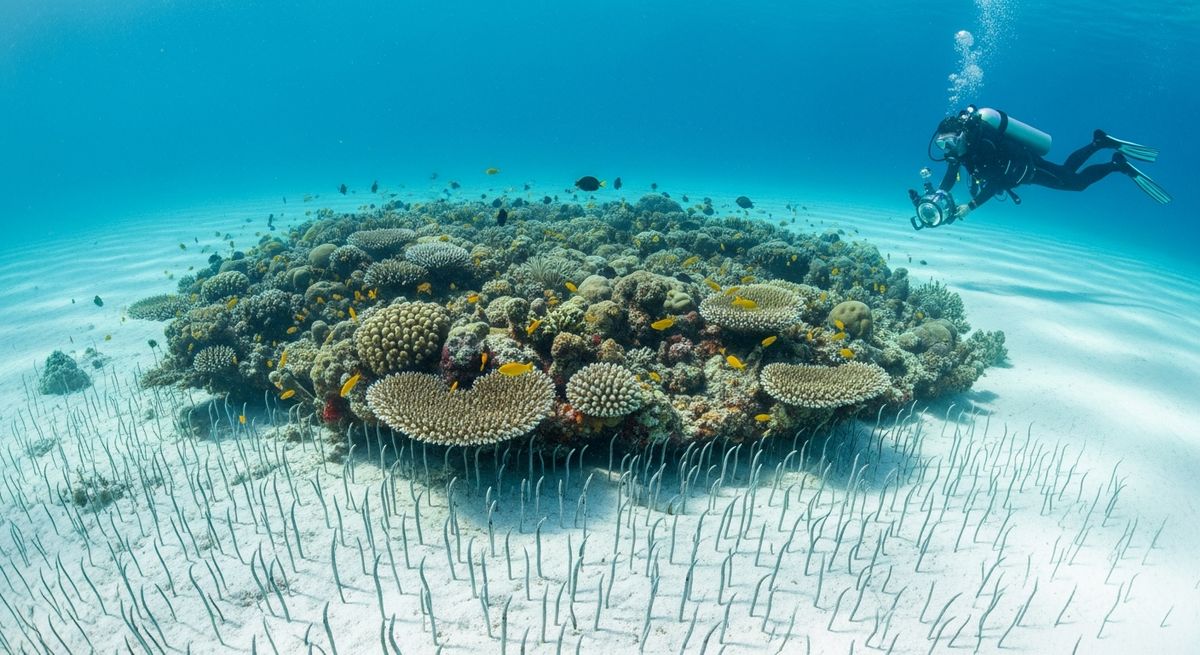
Ring of fire - Sulawesi

Sunset House Reef gets a lot of hype, and honestly, we think it deserves it. This isn't a deep, drift-diving spectacular, but for easy shore access and finding cool critters, it’s a winner. We’ve spent countless hours finning around here, and it rarely disappoints. Drop in right off the steps and you’re immediately into a busy, shallow world. The maximum depth of 16m means plenty of bottom time to hunt for the smaller stuff. We’ve had incredible luck spotting Secretary Blennies peering from their holes and even found a few shy Long-snout Seahorses tucked into the coral. Keep an eye out for the resident green turtles that glide by, seemingly unbothered by divers. The reef structure itself isn't dramatic, more of a gentle slope with plenty of nooks and crannies, perfect for spotting everything from parrotfish munching on coral to lurking moray eels. We’d suggest going in the late afternoon; the light is softer, and the dive boats usually clear out, leaving you with a more peaceful experience. It’s an ideal spot for macro enthusiasts, new divers building confidence, or anyone who just wants a relaxed, accessible dive without needing a boat.

Location
Sulawesi, Indonesia, Southeast Asia
Coordinates
-0.810700, 121.622600
Type
reef

Best Time to Dive in Sulawesi

The warmest water temperatures in Sulawesi occur in November, averaging 30.4°C. The coolest conditions are in September at 28.7°C.

Monthly Water Temperatures

  • January: 29.5°C
  • February: 29.4°C
  • March: 29.8°C
  • April: 30.3°C
  • May: 30.3°C
  • June: 29.7°C
  • July: 29.1°C
  • August: 28.8°C
  • September: 28.7°C
  • October: 29.5°C
  • November: 30.4°C
  • December: 30.2°C

Nearby Dive Sites in Sulawesi

Nearest Dive Centres to Ring of fire

Marine Life in Sulawesi

Home to 252 recorded species including 162 reef fish, 53 hard corals, 9 seagrass & algae, 9 sea snails & nudibranchs, 6 clams & mussels, 4 sea cucumbers.

Notable Species

Recommended Packing List for Ring of fire

Based on average water temperature of 29.7°C, currents 4 cm/s.

  • Shorty or Rashguard - warm 30°C water needs minimal exposure protection
  • Mask - essential for every dive
  • Fins
  • BCD - buoyancy compensator
  • Regulator - your most safety-critical piece of gear
  • Dive Computer - tracks depth, time, and NDL
  • Surface Marker Buoy (SMB) - essential for boat pickups
  • Dive Torch - useful for crevices and colour at depth
  • Underwater Camera - capture your diving memories

Frequently Asked Questions

What are the typical dive depths and maximum depths expected when diving the Ring of Fire in Indonesia?
The Ring of Fire dive site in Indonesia offers dives to a maximum depth of 13m. Divers can explore a wall dropping to deeper waters and a gradual slope, making it suitable for various depth profiles within this limit.
What kind of marine life and underwater topography can divers expect to see in Indonesia's Ring of Fire?
The Ring of Fire dive site in Indonesia features diverse underwater topography, including a wall dropping to deeper waters and a gradual slope rich in coral landscapes. Divers can expect to encounter vibrant marine life such as nudibranchs, shrimp, crabs, and the unique purple goby. Keep an eye out for larger pelagics like blacktip reef sharks and eagle rays cruising by.
How challenging are the dive sites in the Ring of Fire region of Indonesia, and is it suitable for beginner divers?
The Ring of Fire dive site in Indonesia is rated as intermediate difficulty. While it offers rich experiences, its intermediate rating suggests it might be more suitable for divers with some prior experience rather than absolute beginners.
What is the best time of year to dive the Ring of Fire in Indonesia, especially for hammerhead shark encounters?
The provided data for the Ring of Fire dive site does not specify the best time of year to dive or information regarding hammerhead shark encounters. For general guidance on seasonal diving in Indonesia, please refer to our When to Dive section.
What dive certifications and experience are required to dive in Indonesia's Ring of Fire?
While specific certification requirements are not detailed in the provided data, the Ring of Fire dive site is classified as intermediate difficulty. This suggests that divers should possess a certification level and experience appropriate for intermediate dives, typically beyond entry-level.
What are the typical current conditions and water visibility like when diving the Ring of Fire in Indonesia?
When diving the Ring of Fire in Indonesia, divers can expect excellent water clarity with an average visibility of 20m. The provided data does not specify typical current conditions for this site.