Tanjung Sabine - Sulawesi

Wellington Reef often gets overlooked, but we always have a soft spot for it, especially when the conditions line up. At its shallowest, around five metres, you’re drifting over rocks dusted with purple kina and the occasional flash of a yellow-eye mullet. The reef slopes north, down to fifteen metres, and that’s where we find the most action. Visibility averages six metres, so it’s not always gin-clear, but on a good day, after a spell of calm weather, the water takes on a surprisingly rich green hue. We love seeing the black stingrays here, gliding along the sand pockets, sometimes kicking up a cloud of silt. Keep an eye out for mottled triplefins darting between crevices and the occasional spotted stargazer, just a pair of eyes peeking from the seafloor. It’s a gentle drift, unhurried, with plenty of time to really look closely. We’d suggest this one for divers who enjoy a slower pace, who like to scout for the smaller stuff, and aren’t fazed by slightly greener water. It’s a great spot for a relaxed second dive.

Location
Sulawesi, Indonesia, Southeast Asia
Coordinates
-0.836200, 121.588400
Type
reef
Maximum Depth
10-25m

Best Time to Dive in Sulawesi

The warmest water temperatures in Sulawesi occur in November, averaging 30.4°C. The coolest conditions are in September at 28.7°C.

Monthly Water Temperatures

  • January: 29.5°C
  • February: 29.4°C
  • March: 29.8°C
  • April: 30.3°C
  • May: 30.3°C
  • June: 29.7°C
  • July: 29.1°C
  • August: 28.8°C
  • September: 28.7°C
  • October: 29.5°C
  • November: 30.4°C
  • December: 30.2°C

Nearby Dive Sites in Sulawesi

Nearest Dive Centres to Tanjung Sabine

Marine Life in Sulawesi

Home to 252 recorded species including 162 reef fish, 53 hard corals, 9 seagrass & algae, 9 sea snails & nudibranchs, 6 clams & mussels, 4 sea cucumbers.

Notable Species

Recommended Packing List for Tanjung Sabine

Based on average water temperature of 29.7°C, currents 4 cm/s.

  • Shorty or Rashguard - warm 30°C water needs minimal exposure protection
  • Mask - essential for every dive
  • Fins
  • BCD - buoyancy compensator
  • Regulator - your most safety-critical piece of gear
  • Dive Computer - tracks depth, time, and NDL
  • Surface Marker Buoy (SMB) - essential for boat pickups
  • Dive Torch - useful for crevices and colour at depth
  • Underwater Camera - capture your diving memories

Frequently Asked Questions

What is the typical diving depth at Tanjung Sabine and is it suitable for all certification levels?
The maximum diving depth at Tanjung Sabine is 12m, featuring a gradual slope leading to a mini wall. Given its intermediate difficulty, it is well-suited for divers with Open Water certification or higher who have some experience, but might not be ideal for absolute beginners.
What kind of marine life and coral can divers expect to see when diving at Tanjung Sabine?
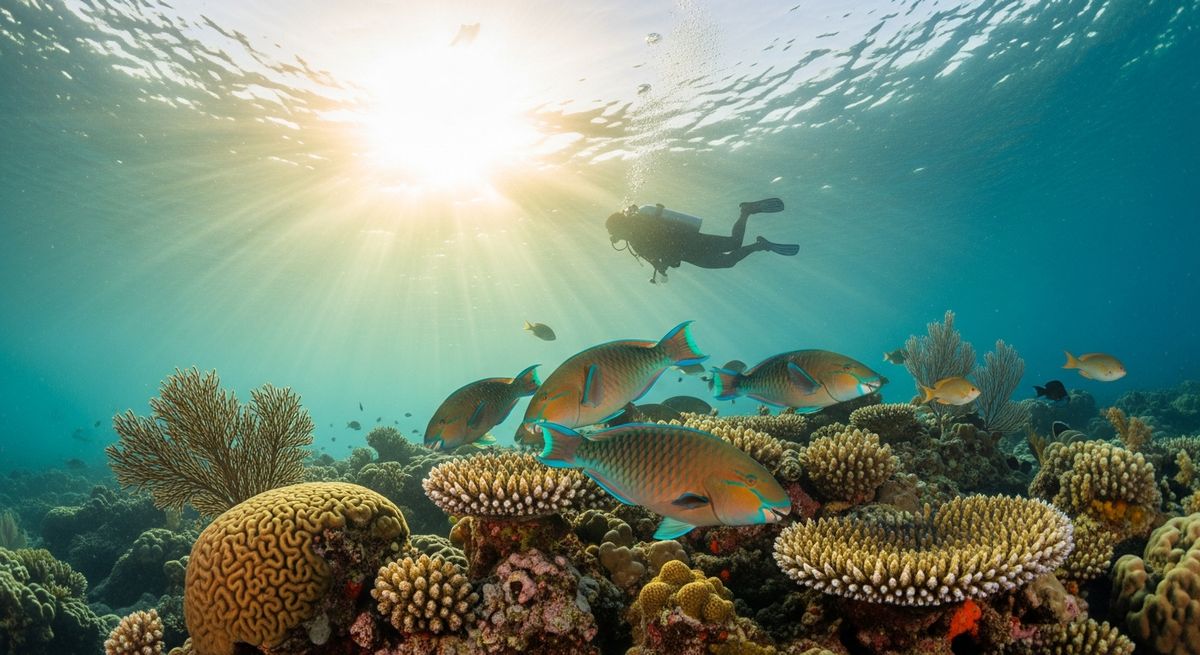
Divers exploring the reef at Tanjung Sabine can expect to encounter a vibrant array of marine life. Notable species include the majestic Blacktip Reef Shark, colorful Parrotfish, Damselfish, the distinctive Moorish Idol, and the elegant Pyramid Butterflyfish. The site offers plenty of reef life before reaching a drop-off with more dramatic formations.
How challenging are the dives at Tanjung Sabine, and is it recommended for beginner or advanced divers?
Dives at Tanjung Sabine are rated as intermediate difficulty. This makes it a great site for divers who have some experience beyond their initial certification, offering a gentle descent with plenty of reef life. While not typically recommended for absolute beginners, it provides an engaging experience for certified divers looking to expand their skills.
What is the best time of year to dive at Tanjung Sabine for optimal conditions and marine encounters?
The provided data does not specify the best time of year to dive at Tanjung Sabine for optimal conditions or marine encounters. For general information on seasonal diving, please visit our When to Dive section.
Are there any specific dive certifications required or recommended for diving at Tanjung Sabine?
Given the intermediate difficulty and a maximum depth of 12m, an Open Water Diver certification is generally sufficient for diving at Tanjung Sabine. However, divers with some experience beyond their initial certification will likely find the site more enjoyable and manageable.
What are the usual current conditions and visibility like at Tanjung Sabine?
The provided data does not include specific information regarding the usual current conditions or visibility at Tanjung Sabine. Divers should always check with local dive operators for the most up-to-date site conditions before planning their dive.