Snorkeling vs Scuba Diving: Which Is Right for You?
By DivePlnr Editorial Team | Published April 2026 | Updated April 2026
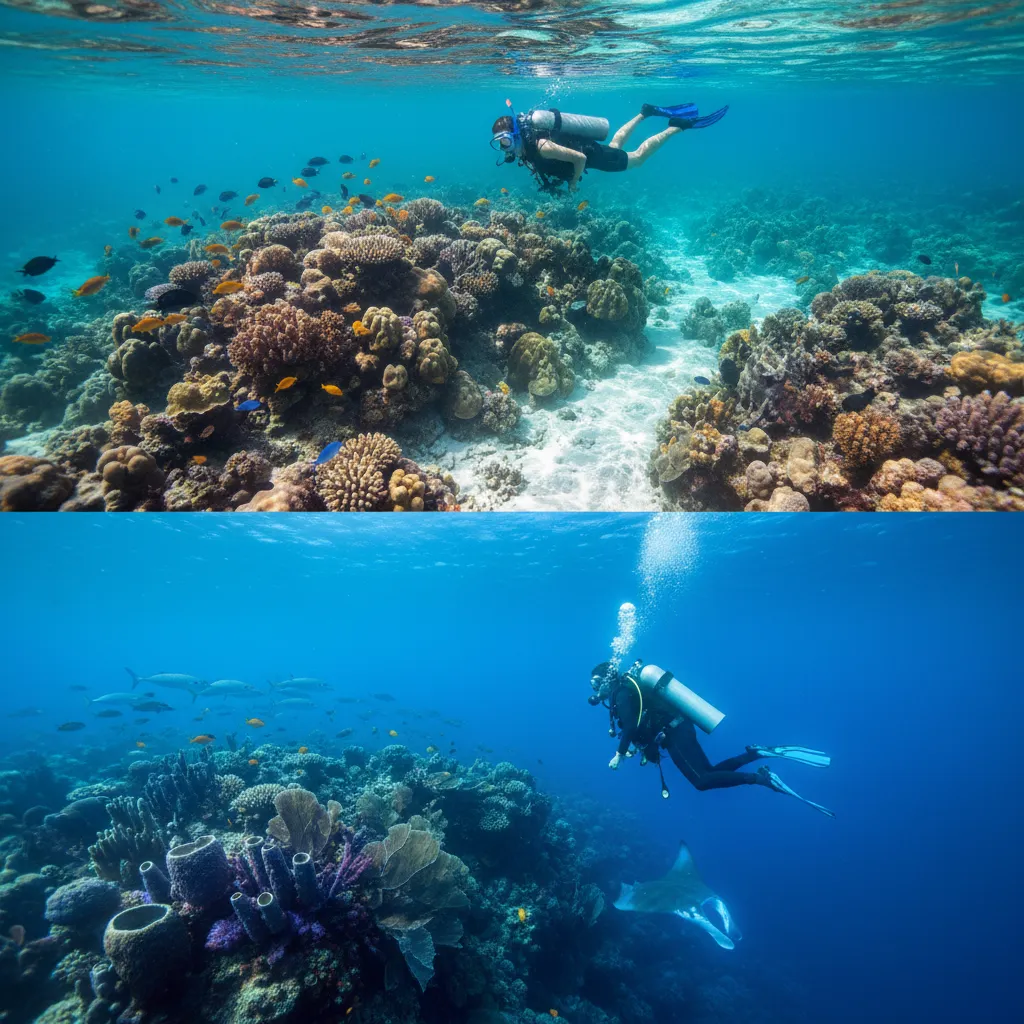
Snorkeling and scuba diving offer fundamentally different windows into the underwater world. One requires no training and minimal equipment; the other unlocks depths and experiences that surface-dwellers never see. Here's how to decide which is right for you - and why you might want both.
The Basics: What Sets Them Apart
Snorkeling keeps you at the surface. You float face-down, breathe through a tube, and observe the shallow underwater world from above. No certification, no complex equipment, no age restrictions beyond being a comfortable swimmer. Scuba diving takes you beneath the surface - typically 10-30 metres down - using a tank of compressed air and specialised equipment. It requires certification, more investment, and a basic level of physical fitness.
Side-by-Side Comparison
| Factor | Snorkeling | Scuba Diving |
|---|---|---|
| Certification needed | None | Yes (Open Water minimum) |
| Minimum age | Any (with supervision) | 10 years (PADI/SSI Junior) |
| Equipment cost | $30-100 | $2,000-5,000 (own) / $30-60 (rent) |
| Depth access | Surface only | Up to 40m recreational |
| Time in water | Unlimited (surface breathing) | 45-90 min per tank |
| Physical demand | Low - basic swimming | Moderate - must be medically fit |
| Learning curve | Minutes | 3-4 day course |
When Snorkeling Is Actually Better
Don't dismiss snorkeling as "scuba's lesser sibling." There are scenarios where surface observation genuinely offers superior experiences:
- Manta ray feeding - at night snorkelling sessions (like Kona, Hawaii), mantas feed on plankton attracted by lights at the surface. Snorkellers get the mantas barrel-rolling directly beneath them
- Whale shark encounters - most whale shark tourism worldwide is snorkel-based, as these gentle giants feed near the surface
- Shallow coral gardens - some of the world's healthiest reefs sit in 1-3 metres of water where sunlight is strongest, perfectly accessible from the surface
- Jellyfish lakes - Palau's famous Jellyfish Lake is snorkel-only (scuba is prohibited)
When Only Scuba Will Do
If you want to explore the underwater world in depth - literally - scuba opens doors that snorkeling simply cannot. Wreck penetration, deep walls, cave systems, night diving with bioluminescence, cleaning stations where marine life interacts up close, and the sheer immersion of being neutrally buoyant in a three-dimensional environment. There's nothing quite like it.
The Bridge: Try Diving / Discover Scuba
If you're a snorkeller curious about scuba, a Discover Scuba Diving experience is the perfect bridge. Available at most dive centres worldwide, it gives you a single supervised dive (usually to 6-12m) with minimal theory - just enough to know you want more. No commitment, no multi-day course. Think of it as a test drive for scuba.
Family Considerations
Families with young children often find snorkeling is the great equaliser. A 5-year-old can snorkel with confidence while parents dive nearby. Many tropical resorts offer combined packages - parents scuba dive from the same boat while kids snorkel with a guide on the surface. This way, everyone experiences the reef together.
Once children turn 10, they can enrol in junior scuba certifications through PADI or SSI, opening up family diving adventures.
Transitioning from Snorkeling to Diving
If you love snorkeling and want to take the next step, you're already ahead of the curve. Comfortable snorkellers have a huge advantage in scuba courses - they're already relaxed in the water, familiar with masks and fins, and used to breathing through a mouthpiece. The transition is natural and many instructors report that experienced snorkellers progress faster through their Open Water certification.
Destinations Great for Both
The best dive destinations are often equally spectacular for snorkeling. The right destination depends on your group's mix of abilities:
- Maldives - house reefs accessible from shore, world-class diving nearby
- Raja Ampat - shallow reefs with the highest marine biodiversity on Earth
- Red Sea (Egypt) - crystal-clear water, healthy reefs starting at 1m depth
- Great Barrier Reef - snorkel pontoons alongside dive boats
- Bonaire - shore-accessible reefs perfect for both activities
Cost Reality Check
Snorkeling is vastly cheaper. A quality mask, snorkel, and fins cost $50-100 and last for years. A day of guided snorkeling runs $20-50. Scuba certification costs $300-500 for the initial course, rental gear adds $30-60 per dive day, and boat dives range from $40-100 each. Owning your gear costs $2,000-5,000. However, for the depth of experience scuba provides, many divers consider it the best money they've ever spent.
Key Takeaways
- 1Snorkeling needs no certification, minimal equipment ($30-100), and is accessible to almost any age
- 2Scuba unlocks the underwater world below the surface but requires certification, investment, and medical fitness
- 3Some experiences (manta night feeds, whale sharks, jellyfish lakes) are actually better from the surface
- 4Discover Scuba Diving is the perfect zero-commitment bridge for curious snorkellers
- 5The best dive destinations - Maldives, Raja Ampat, Red Sea - are equally spectacular for both activities
Frequently Asked Questions
Can I scuba dive if I can't swim well?
You need basic swimming ability for scuba certification - PADI requires a 200m swim (any stroke) and 10 minutes of floating. You don't need to be a strong swimmer, but you must be comfortable in water. If you're nervous, take swimming lessons first; it will make your scuba course far more enjoyable.
Is snorkeling safe for non-swimmers?
With a life jacket or flotation vest, non-swimmers can snorkel safely in calm, shallow water with a guide. Many tropical tours provide flotation devices as standard. However, you should still be comfortable putting your face in water and breathing through a snorkel. Open-water snorkeling in currents is not suitable for non-swimmers.
At what age can children start scuba diving?
PADI and SSI offer Junior Open Water certification from age 10, with depth restrictions (12m max until age 12, then 18m until 15). Children aged 8-9 can do the PADI Bubblemaker programme in a pool or confined water. For younger children, snorkeling is the best way to build water confidence and a love of marine life.