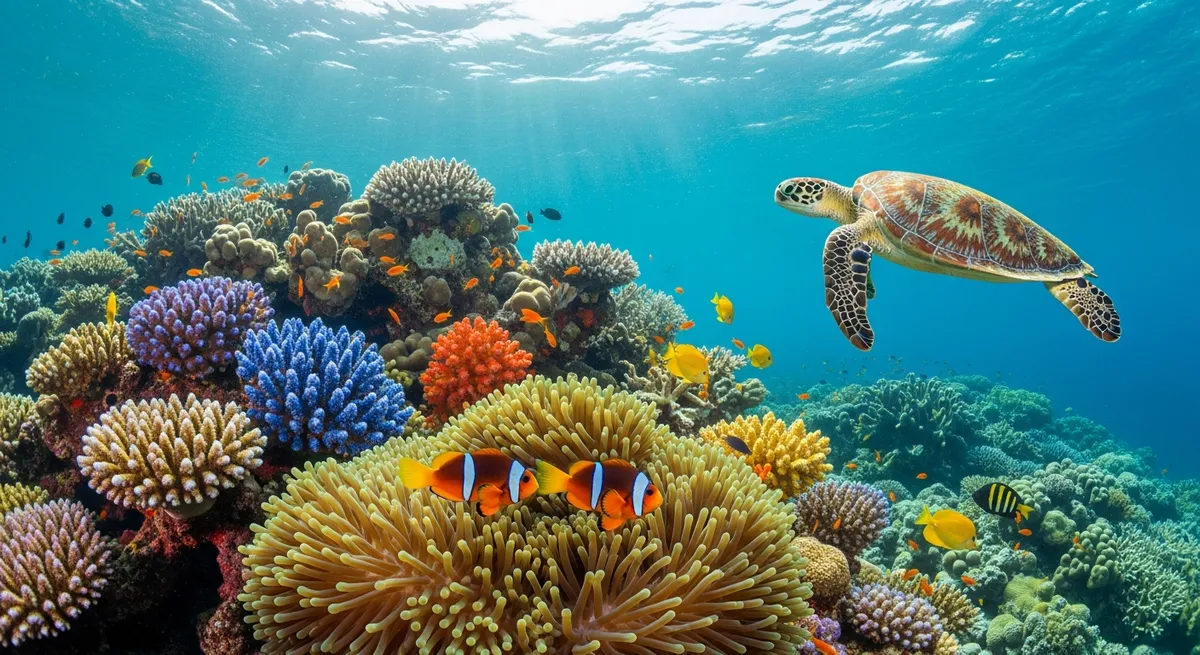
Diving in Great Barrier Reef
Why dive here
Great Barrier Reef offers some of Australia's richest diving, with 154+ marine species recorded in the area - including hammerhead sharks, sea turtles, tiger sharks and napoleon wrasse. Water ranges 24-30°C, warmest January, February, March.
Okay, let’s be real. The Great Barrier Reef is enormous. We're talking 2,300 kilometres of reef. So when people ask what diving is like here, our honest answer is, "Which bit?" What we love, though, is how accessible so much of it is, especially for new divers. The sheer scale means you're almost guaranteed to find a spot that clicks, whether you’re easing into a shallow reef or drifting along a deeper wall. You'll spend most dives finning over gentle slopes thick with Flowerpot and Turbinaria corals, where schools of Princess Parrotfish graze with almost cartoonish indifference. Keep an eye out for the Flashlight Fish, a personal favourite, with its bioluminescent eye patches. Visibility often pushes past 20 metres, giving you a chance to really soak in the colours. Our tip: if you’re coming between June and August, look into trips north of Cairns. That’s when the dwarf minke whales roll through. Hearing their calls underwater is something else, a low hum that vibrates through your chest. It’s a truly humbling experience to be in the water with them. The currents are generally mild, but a few of the outer sites can have a gentle push, perfect for a relaxed drift past silver-cheeked toadfish.
Great Barrier Reef Dive Site Map
Dive sites and dive centres in Great Barrier Reef
Great Barrier Reef Dive Sites
321 dive sites in Great Barrier Reef
Admiralty Anchorage
Admiralty Anchorage is one of those spots where you really get a feel for the scale of the Great Barrier Reef. We've always found it reliable for a good, solid dive. What strikes you first is the sheer density of the staghorn corals, they just go on and on, forming these huge, intricate structures. You can spend an entire dive just weaving through the channels, spotting the little stuff that calls them home. Our favourite time to drop in is early morning, before the day boats crowd the anchorage. The light hitting the coral is spectacular then, really bringing out the colours. Keep an eye out for the Blackspot Surgeonfish and Angel abu polos darting between the branches, and we’ve often found Southern bluefin tuna cruising the deeper edges. If you have good eyes, look for the tiny Red-streaked Blenny poking its head out of the coral. It’s not a drift dive, so you can take your time, really explore. We think it’s a perfect site for photographers or anyone who just wants to immerse themselves in a classic GBR coral landscape.
Agincourt Reef
Agincourt Reef is a collection of ribbon reefs on the outer edge of the Great Barrier Reef. Expect good visibility and a healthy variety of hard and soft corals. It's a solid choice for divers looking for a classic GBR experience, with consistent reef fish populations and the chance of spotting a reef shark or two patrolling the deeper edges. The sites here are generally straightforward, suiting all experience levels.
Agincourt Reef No. 1 - Trigger Fish City
Trigger Fish City. The name says it all, doesn’t it? We’ve dived Agincourt a fair few times, and this particular site is always a lively one, especially if you’re into the feistier side of reef life. Expect to feel like you’ve wandered into a busy street market, but underwater, with Triggerfish everywhere. These aren’t just any triggers, mind you, we’re talking Picasso triggers, titan triggers, often circling you with that unmistakable watchful eye. The coral here, particularly the pagoda and closed brain corals, creates some fantastic swim-throughs and overhangs. We always find ourselves spotting the intricate frills of lettuce coral tucked into crevices, a great contrast to the bolder parrotfish, like the Bullethead and Dusky, chomping away nearby. Look out for the Pacific Half-and-half Chromis darting amongst the coral – they add a lovely splash of colour. While the official depth is unknown, we’ve found it’s a comfortable multi-level dive, perfect for just exploring the reef structure rather than chasing depth. Our favourite time to hit this spot is mid-morning, just after the initial boat rush, when the triggers seem most active and the light filters through beautifully. It’s a great spot for photographers who enjoy capturing dynamic behaviour.
Agincourt Reef No. 4 - The Point
Agincourt Reef No. 4, or 'The Point', is one of those spots we always try to hit when we're up near Port Douglas. It's not the deepest dive, but the currents here often bring in some interesting action. We love dropping in on the outer edge, letting the gentle push carry us along as the reef wall drops away. You'll often find ourselves surrounded by schools of fusiliers, their silver scales flashing in unison, creating these incredible, moving curtains of fish. What really stands out for us are the colourful parrotfish – the Bicolor and Long-nosed varieties are everywhere, constantly munching on the coral. Look for the chunky Maori Wrasse, sometimes they're surprisingly curious. We’ve also had some fantastic encounters with groups of Blue-lined Surgeonfish just cruising past. The Staghorn coral formations here are impressive, creating loads of nooks and crannies for smaller reef fish like the bright Coral Beauties and shy Foxface. If you're into macro, keep an eye out for nudibranchs tucked away amongst the branching corals. It's a relaxed drift, perfect for photographers or anyone who just wants to soak up the busy reef scene without too much effort.
Agincourt Reefs
Agincourt Reefs, sitting right on the continental shelf edge, feels like a window into the Coral Sea. We love the sheer energy here, it’s often where the ocean really feels alive. You’re typically diving patch reefs, but they’re packed with Staghorn corals, growing in dense thickets that buzz with tiny Blue Green Chromis. Visibility can swing, 10m on an off day, but we’ve had 30m days where you can see the whole reef structure from the surface. Down below, keep an eye out for Foxface and those massive Orange-socket Surgeonfish cruising the reef top. The main event for us, though, is the sheer density of life in the shallows, especially if you catch it on an incoming tide. You get schools of fusiliers so thick they almost blot out the sun, and the chance of a False Killer Whale passing through isn't as rare as you’d think. This isn't a deep dive, maxing out at 16m, which means plenty of bottom time and lots of light penetration, making the colours really pop. It’s a site that rewards slow, observant diving.
Agincourt Reefs
Agincourt Reefs, sitting right on the continental shelf edge, feels like a window into the Coral Sea. We love the sheer energy here, it’s often where the ocean really feels alive. You’re typically diving patch reefs, but they’re packed with Staghorn corals, growing in dense thickets that buzz with tiny Blue Green Chromis. Visibility can swing, 10m on an off day, but we’ve had 30m days where you can see the whole reef structure from the surface. Down below, keep an eye out for Foxface and those massive Orange-socket Surgeonfish cruising the reef top. The main event for us, though, is the sheer density of life in the shallows, especially if you catch it on an incoming tide. You get schools of fusiliers so thick they almost blot out the sun, and the chance of a False Killer Whale passing through isn't as rare as you’d think. This isn't a deep dive, maxing out at 16m, which means plenty of bottom time and lots of light penetration, making the colours really pop. It’s a site that rewards slow, observant diving.
Alexandra Reefs
Alexandra Reefs. Now this is a spot we keep coming back to. While some of the more famous GBR sites can feel like a busy intersection, Alexandra gives you space to breathe. We’ve found the currents here are usually manageable, perfect for just drifting along and letting the reef unfold. Look closely, and you’ll find those big coral groupers eyeing you from their rocky hideouts, and the triangular butterflyfish are always flitting about in pairs. Our favourite thing about Alexandra is the sheer variety of hard corals. We’re talking about those intricate staghorns and the expansive plates of Montipora that create these incredible, sprawling underwater gardens. The yellow scroll corals add splashes of brighter colour, and it’s a genuinely relaxing dive. We’d suggest heading out in the morning; the light seems to hit the reef just right then, making everything pop. You might even spot a lesser valley coral if you have a keen eye. This isn’t a site for chasing pelagics, it’s for those who appreciate the details and the quiet artistry of a healthy reef.
Atkinson Reef
Atkinson Reef might not be as famous as some of its neighbours, but we think that’s part of its charm. It’s a good spot for a relaxed day on the water, especially if you’re looking to get away from the bigger crowds. What you’ll find here is a classic Outer Reef experience: healthy hard corals forming intricate mazes and plenty of smaller reef fish darting between them. We love dropping in here mid-morning. The light penetrates well, making the browns and greens of the coral really pop, and you often see schools of yellowstriped cardinalfish hanging just above the bommies. Keep an eye out for Smith’s cuttlefish, they’re masters of camouflage, but their iridescent eyes often give them away if you’re patient. We've also had some great encounters with fringe-eye flatheads here, hunkered down, just waiting. While it doesn't boast huge pelagics, it’s the kind of site where you can just drift and let the reef reveal its smaller secrets. It suits divers who appreciate the subtle beauty of a thriving coral ecosystem and aren't chasing the next big shark encounter.
Aylen Patch
Aylen Patch sits on the outer edges of the Great Barrier Reef, a spot we really enjoy for its particular brand of chaos. Forget those picture-perfect, manicured coral gardens; Aylen is a sprawling, wild mess of reef that feels wonderfully untamed. What we love here are the whitetip reef sharks. You'll often find them cruising the drop-off or even resting under ledges, indifferent to divers, which is always a treat. Keep an eye out for the flatback sea turtles, too. They’re a regular sight, sometimes just hovering, sometimes powering past, making their own path through the water. While Aylen doesn't deliver those "wall of fish" moments you get at some other sites, it's excellent for spotting individual characters: a stealthy great barracuda hanging in the blue, or a brownbanded bamboo shark tucked away in a crevice if you look closely. It's a site that rewards patience and a keen eye, perfect for divers who prefer exploring rather than just cruising along. It’s also one of our picks for a late afternoon dive; the light can be incredible then, painting the corals in deeper hues.
Baines Patches
Baines Patches, out in the Ribbon Reefs, is the sort of site that reminds you why you put up with early mornings and salty hair. It's not always on the standard itinerary, which we love; often means you’ll have it mostly to yourself. What you get here is a real feel for the Great Barrier Reef’s scale, with huge bommies rising from the seafloor. We’ve had some cracking dives here, often starting with a leisurely drift along the wall, past gorgonian fans the size of dinner tables. Look closely, and you’ll spot arc-eye hawkfish perched like tiny sentinels. Our favourite memory is a school of giant trevally, just hanging in the current, silver flanks flashing as they moved in unison. The light, particularly around mid-morning, filters through the water here in a way that just makes the coral glow. We’d suggest keeping an eye out for foxface and parrotfish munching away; the sound of their teeth on coral is surprisingly loud and satisfying. It’s a great pick for photographers who appreciate dramatic reef structures and reliable clarity.
Baines Patches
Baines Patches, out in the Ribbon Reefs, is the sort of site that reminds you why you put up with early mornings and salty hair. It's not always on the standard itinerary, which we love; often means you’ll have it mostly to yourself. What you get here is a real feel for the Great Barrier Reef’s scale, with huge bommies rising from the seafloor. We’ve had some cracking dives here, often starting with a leisurely drift along the wall, past gorgonian fans the size of dinner tables. Look closely, and you’ll spot arc-eye hawkfish perched like tiny sentinels. Our favourite memory is a school of giant trevally, just hanging in the current, silver flanks flashing as they moved in unison. The light, particularly around mid-morning, filters through the water here in a way that just makes the coral glow. We’d suggest keeping an eye out for foxface and parrotfish munching away; the sound of their teeth on coral is surprisingly loud and satisfying. It’s a great pick for photographers who appreciate dramatic reef structures and reliable clarity.
Barracuda Pass
Barracuda Pass, a channel dive in the Great Barrier Reef, often delivers exactly what its name suggests. We’ve seen decent schools of barracuda here, sometimes just hanging mid-water, other times moving with purpose. It's a fairly straightforward drift, good for divers who appreciate pelagic action over intricate coralscapes. You’ll want to keep an eye out into the blue.
Show all 321 dive sites in Great Barrier Reef
- Bashful Bommie
- Bashful Bommie
- Batt Reef
- Big Buoy
- Blue Wonder
- Briggs Reef - 360
- Brisk-Falcon Reef
- Broken Patches
- Bunker Reef
- Cairns Diving on the Outer Barrier Reef
- Carter Reef
- Castle
- Cat Reef
- Central, Breaking Patches
- Challenger Bay
- Channel Reef
- Clam Gardens
- Clipper
- Cod Hole
- Cod Hole
- Cod Reef
- Covered Reef
- Crack a Jack
- Creech Reef
- Crystal Cascades
- Cucumber Alley
- Daintree Reef
- Day Reef
- Dive Adventures on the Great Barrier Reef
- Down Under Diving
- East Ribbon Reef
- Eclipse Reef
- Ellis Reef
- Endeavour Reef
- Entrance Reef
- Escape Reef
- Esk Reef
- Euston Reef
- Evening Reef
- Eves Reef
- Exit Reef
- Eye Reef
- Fahey Reef
- Faraday Reef
- Farquharson Reef
- Feather Reef
- Ferguson Reef
- Fingers, Norman Reef
- Fin Reef
- Fison Reefs
- Flare Point
- Flinders Reefs
- Flora Reef
- Flora Reef
- Flora Reef
- Flynn Reef
- Flynn Reef - 2 Gordon's
- Flynn Reef - Coral Garden
- Flynn Reef - Coral Gardens
- Flynn Reef - Little Tracy's
- Flynn Reef - Three Sisters
- Fly Reef
- Forrester Reef
- Goggle Gardens
- Gordon s mooring
- Gorgonian Wall
- Great Barrier Reef
- Great Barrier Reef - Ribbon Reefs
- Great Barrier Reef - Ribbon Reefs
- Green Island - Fringing reefs
- Green Island - New York
- Halfway Wall
- Hall Thompson Reef
- Hammond Reef
- Ham Reef
- Hanry Reef
- Harrier Reef
- Hastings Reef
- Hastings Reef Blue Lagoon
- Hastings Reef - Coral Gardens
- Hastings Reef - Fish Bowl
- Hazelgrove Reefs
- Heath Reef
- Hedge Reef
- Hedley Reef
- Helix Reef
- Helsdon Reef
- Herald's Surprise
- Hicks Reef
- Holmes Reef
- Hope Reef
- Hopkinson Reef
- Howie Reef
- Irene Reef
- Iris Reef
- Jackson Patches
- Joan Reef
- John Brewer Reef
- John Brewer Reef
- Jubilee Reef
- June Reef
- Just Magic
- Kedge Reef
- Keeper Reef
- Kelso Reef
- Kestrel Reef
- King Reef
- Korea Reef
- Lady Elliot Reef
- Lagoon Reef
- Lake Reef
- Lansdown Reef
- Lark Reef
- Lena Reef
- Lighthouse Bommie
- Lighthouse Bommie
- Light Reef - Phil`s Bommie
- Linnet Reef
- Lloyds Reef
- Lodestone Reef
- Log Reef
- Long Reef
- Long Sandy Reef
- Lorne Reef
- Low Isles
- Lytton Reef
- Macdonald Reef
- Mackay Reef
- Mackay Reefs
- Macnamara Patch
- Magpie Reef
- Main Cay Reef
- Malcolm Patch
- Mantis Reef
- Maori Reef
- Martin Reef
- Marx Reef
- May Reef
- McCulloch Reef
- Mermaid s Cove
- Michaelmas Reef
- Michaelmas Reef
- Middle Reef
- Middle Reef
- Mid Reef
- Miles Reef
- Milln Reef
- Milln Reef - Rainbow
- Milln Reef - Swimming Pools
- Milln Reef - The Whale
- Milln Reef - The Whale
- Moore Reef
- Moore Reef - 5 Ways
- Moore Reef - East Timor
- Moore Reef - Labyrinth
- Moore Reef - Manta Ray Bay
- Moore Reef - West Timor
- Morey Reef
- Morning Reef
- Mull of Kintyre - Wilson Reef - GBR
- Munro Reef
- Murray Reefs
- Myrmidon Reef
- Nathan Reef
- Needle Reef
- New Reef
- Nicholas Reef
- Noddy Reef
- Noggin Reef
- Noreaster Reef
- Norman Reef
- Norman Reef - Caves
- Norman Reef - Playgrounds
- Norman Reef - Pontoon
- Norman Reef Pontoon
- Norman Reef - Troppo s
- Norman Reef - Waynes World
- Norman Wildside - Central
- Northern Small Detached Reef
- North Flinders Reefs
- North Horn
- North Horn
- North Reef
- North Wall
- North Warden Reef
- North West Reef
- North West Reef
- Nursery Bommie
- Obree Reef
- Ogilvie Reef
- Olive Patch
- Onyx Reef
- Opal Reef
- Osborne Reef
- Osprey Reef
- Osterlund Reef
- Ottaway Patch
- Otter Reef
- Outer Barrier Reef
- Oyster Reef
- Pandora Reef
- Park Reef
- Park Reef
- Pasco Reef
- Pearl Reef
- Peart Reef
- Pellowe Reef
- Petaj
- Petty Patch
- Phillips Reef
- Pickersgill Reef
- Pirates Wall - Wilson Reef - GBR
- Pith Reef
- Pixie Gardens
- Pixie Pinnacle
- Pixie Reef
- Pixie Wall
- Pixie Wall
- Plate Top
- Potter Reef
- Predators Playgound
- Pullen Reefs
- Quake Reef
- Rattlesnake Reefs
- Ribbon Number Eight Reef
- Ribbon Number Five Reef
- Ribbon Number Four Reef
- Ribbon Number Nine Reef
- Ribbon Number One Reef
- Ribbon Number Seven Reef
- Ribbon Number Six Reef
- Ribbon Number Ten Reef
- Ribbon Number Three Reef
- Ribbon Number Two Reef
- Ribbon Reefs
- Rib Reef
- Rodda Reef
- Rodda Reef
- Rosser Reef
- Round the Bend
- Ruby Reef
- Rudder Reef
- Saint Crispin Reef
- Satellite Reef
- Saxon reef
- Saxon Reef
- Saxon Reef Magic Wall
- Scott Reef
- Sea Reef
- Second Small Reef
- Shark Reef
- Sim Reef
- Snake Pit - GBR
- Snake Reef
- Southern Small Detached Reef
- South Flinders Reefs
- South Horne
- South of Nudey Beach
- South Warden Reef
- South West Reef
- Spitfire Reefs
- Split Bommie, Hastings Reef
- Spur Reef
- SS Yongala
- SS Yongala
- Stagg Patches
- Startle Reefs
- Stevens Reef
- Steve's Bommie
- Stonor Patch
- Strickland Reef
- Sudburry East Wall
- Sudbury Reef
- Swimming pool
- Swinger Reef
- Switzer Reef
- Table Top
- Taka Range
- Taylor Reef
- Temple of Doom
- The Abyss
- The Slashers Reefs
- Thetford Reef
- Thetford Reef
- Tijou Reef
- Toe Reef
- Tongue Reef
- Tree Peaks - Saxon Reef
- Troppo's
- Trunk Reef
- Turtle Bommie, Saxon Reef
- Turtle Reef
- Twin Peaks, Saxon Reef
- Tydeman Reef
- Undine Reef
- Unison Reef
- Unity Reef
- Waining Reef
- Wardle Reef
- Waterwitch Reef
- Weigall Reefs
- Wentworth Reef
- Wharton Reef
- William Reef
- Williamson Reefs
- Wilson Reef
- Wonderland
- Wreck Bay
- Yonge Reef
Great Barrier Reef Dive Centres
17 dive shops and operators in Great Barrier Reef
ABC Dive & Snorkel
Blue-Cruise Pty.Ltd
Coral Princess Cruises P/L
Dive Centre
Divers Den
Horseshoe
Lizard Island Lodge
Ocean Free & Ocean Freedom
Show all 17 dive centres in Great Barrier Reef
Ocean Wildlife in Great Barrier Reef
154 species recorded in Great Barrier Reef
Great Barrier Reef Daylight & Sunrise/Sunset
Sunrise and sunset times for Great Barrier Reef, calculated from coordinates
Today - Sunday 11 October
Sunrise
05:53
Sunset
18:16
Daylight
12h 22m
Golden Hour
17:47
First light (dawn) at 05:32 · Last light (dusk) at 18:37
Monthly Averages
| Month | Sunrise | Sunset | Daylight |
|---|---|---|---|
| Jan | 05:58 | 18:56 | 12h 58m |
| Feb | 06:14 | 18:50 | 12h 37m |
| Mar | 06:21 | 18:33 | 12h 12m |
| Apr | 06:25 | 18:10 | 11h 45m |
| May | 06:33 | 17:56 | 11h 23m |
| JunShortest | 06:42 | 17:54 | 11h 12m |
| Jul | 06:45 | 18:02 | 11h 16m |
| Aug | 06:35 | 18:10 | 11h 34m |
| Sep | 06:14 | 18:13 | 12h 0m |
| OctNow | 05:51 | 18:17 | 12h 26m |
| Nov | 05:37 | 18:28 | 12h 50m |
| DecLongest | 05:41 | 18:44 | 13h 3m |
Times are approximate local times based on longitude. Actual times may vary slightly depending on the exact timezone observed in Great Barrier Reef.
Where to Stay near Great Barrier Reef
Prices from Booking.com. We may earn a commission at no extra cost to you.
Marine Protected Areas near Great Barrier Reef
6 protected areas near Great Barrier Reef - please respect local regulations when diving
Starcke River (Ngulun)
Trinity Inlet
Annan River
Annan River
Trinity Inlet
Michaelmas and Upolu Cays
Getting to Great Barrier Reef
Cooktown Airport
Cairns
Mareeba
Plan & book
Ways to dive Great Barrier Reef, from day trips to liveaboards.
Day trips & courses
via GetYourGuideGuided dives, courses and snorkel trips with instant booking.
Find dive trips in Great Barrier ReefPlaces to stay
via Booking.comHotels and dive resorts near Great Barrier Reef.
Search stays in Great Barrier ReefDive insurance
Most travel insurance excludes or limits scuba. Check what you need before you go.
Dive insurance explainedPartner links: we may earn a commission if you book, at no extra cost to you. How we make money