WESTERN VENTURER
Why dive here
With 362+ marine species recorded in the area - including barracuda, blacktip reef sharks, dolphins, dwarf minke whales and humpback whales - WESTERN VENTURER offers some of Long Island's richest wreck diving. Water ranges 26-30°C, warmest August, September, October.
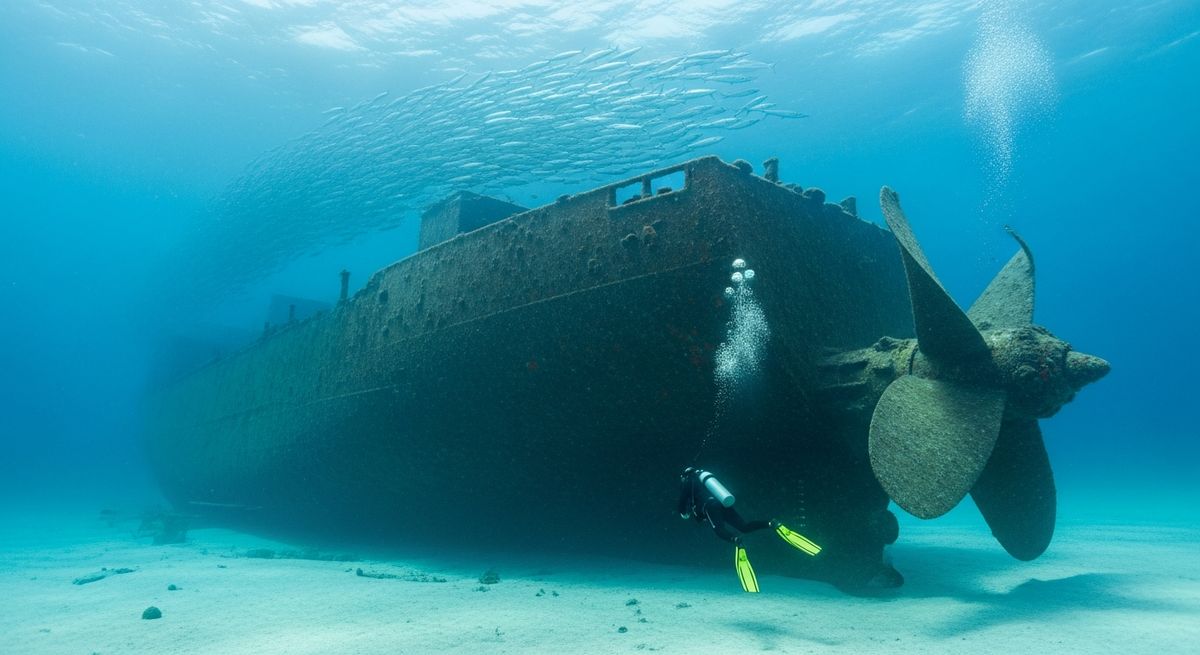
The Western Venturer isn't a deep dive, but don't let the zero-meter depth on paper fool you. This isn't a snorkel site. We’re talking about a serious wreck, a 59-meter carrier vessel built in 1944 that met its end in 1970. She sits largely intact, just beneath the surface in some sections, but the majority of her hull and superstructure are submerged, often in currents that make for a lively drift. What we love about the Venturer is her accessibility for penetration. You can swim through cargo holds that once carried supplies from Cape Canaveral, imagining her journey through the Bahamas. Sunlight filters down, illuminating schools of snapper darting through the rusted metal. Look closely and you'll spot lobsters tucked into every crevice, and occasionally a curious reef shark will cruise by, checking out the commotion. Our pick for the best time to dive is definitely slack tide, which can offer a calmer experience for exploring the deeper sections of the engine room. It's a wreck that really comes alive under your fins, making you feel a part of its history.
Safety Notes
Wreck site - avoid penetration without wreck diving certification. Watch for sharp metal and entanglement hazards.
Reviews for WESTERN VENTURER
Conditions
Ocean conditions, forecast and tides for WESTERN VENTURER
WESTERN VENTURER Ocean Conditions
Monthly averages for WESTERN VENTURER, sourced from Open-Meteo marine data + Copernicus Marine (EU) - nearest station: Open-Meteo marine grid (23.66, -74.95) (14km away)
October Averages
Sea Temperature
30°C
85°F · Range: 28–30.8°C
Current Speed
8.94 cm/s
Direction: NW (333.4°)
Chlorophyll-a
0.053 mg/m³
Very clear (oligotrophic)
Salinity
36.55 PSU
Based on 4 years of monitoring data · Data sources: Open-Meteo marine data + Copernicus Marine (EU)
Plan & book
Ways to dive Long Island, from day trips to liveaboards.
Day trips & courses
via GetYourGuideGuided dives, courses and snorkel trips with instant booking.
Find dive trips in Long IslandPlaces to stay
via Booking.comHotels and dive resorts near Long Island.
Search stays in Long IslandDive insurance
Most travel insurance excludes or limits scuba. Check what you need before you go.
Dive insurance explainedPartner links: we may earn a commission if you book, at no extra cost to you. How we make money
Where to Stay near WESTERN VENTURER
Prices from Booking.com. We may earn a commission at no extra cost to you.