Diving in Isla de la Juventud
Why dive here
Isla de la Juventud offers some of Cuba's richest diving, with 139+ marine species recorded in the area - including barracuda, orcas, sea turtles, sperm whales and pufferfish. Water ranges 26-30°C, warmest July, August, September.
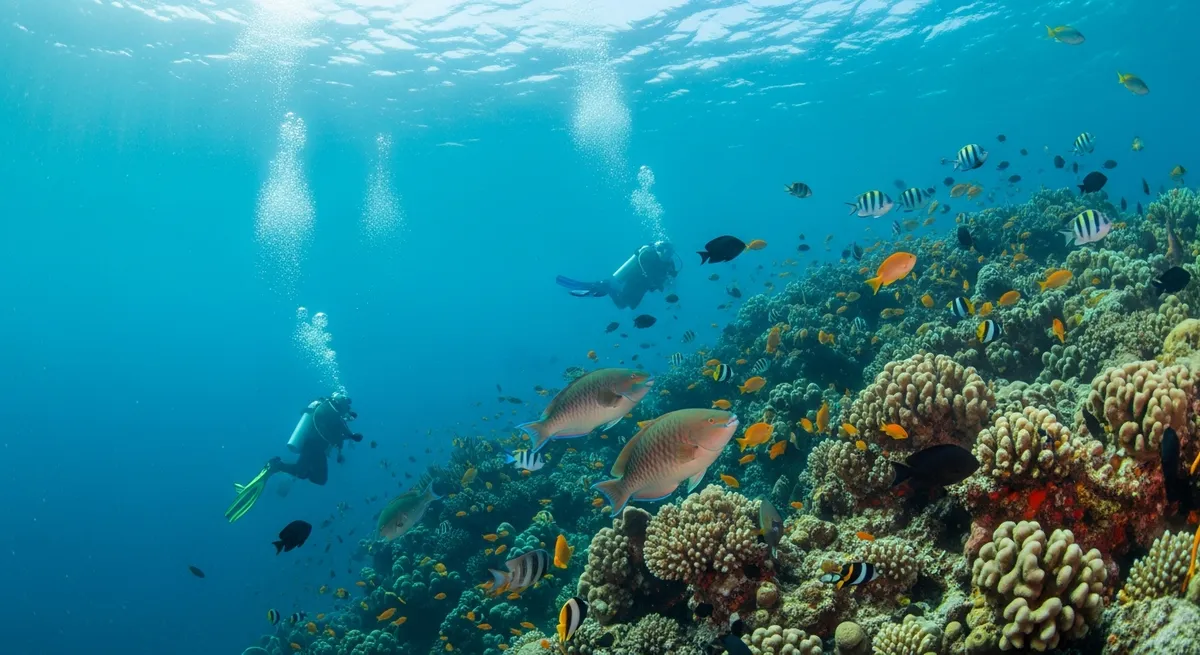
Isla de la Juventud, for us, is all about the dramatic walls. You’ll spend most dives drifting along these vertical faces, exploring the caves and tunnels carved into the limestone. We love the swim-throughs here, often bursting with schools of snapper and grunt, sometimes so thick they practically push you through. Keep an eye out for the big stuff too; we’ve had some cracking encounters with green sea turtles cruising the currents and even a couple of passing whale sharks in late spring, though they are certainly not a guarantee. The reef health here is genuinely impressive, a testament to its remote location. You’ll find healthy hard and soft corals clinging to every surface, providing shelter for a surprisingly diverse cast of characters. We’re always on the lookout for the endemic Cuban hogfish, which we’ve spotted on nearly every dive. The visibility is usually excellent, often pushing past 30 metres, making it easy to appreciate the scale of these impressive underwater landscapes. If you’re into wall diving with a touch of exploration, Isla de la Juventud is a proper treat.
Isla de la Juventud Dive Site Map
Dive sites and dive centres in Isla de la Juventud
Isla de la Juventud Dive Sites
26 dive sites in Isla de la Juventud
ALPHONSE X11
The Alphonse XII. Forget the big, deep wrecks for a moment. This one sits in a mere two metres of water, a splintered wooden hull spread across the shallows. We love it for how accessible it is, even for snorkelers, but it’s the history that really pulls us in. This was a Spanish cruiser, torpedoed by the US Navy in 1898, and you can still see the massive keel, ribs, and scattered hull plates. It’s a real contrast from the dramatic drop-offs elsewhere. Here, the light plays through the water, illuminating the dark wood and the shimmering schools of silvery fish that now dart through the wreckage. You can trace the outline of the deck, picking out details where the ship broke apart. Our favourite part is how the wreck has become an artificial reef, attracting curious French grunts and sergeant majors. It’s not about penetration or tricky navigation; it’s about a gentle exploration of history and the surprising amount of life that has claimed this old warship. It’s perfect for a relaxed second dive or for those days when you just want to soak up some shallow history.
ASTORIA
Now, Astoria. Not every wreck needs to be a deep technical dive to be genuinely interesting. This bulk carrier, grounded off Cabo San Antonio back in ’78, sits in just one metre of water. You read that right: one metre. We love it because it’s entirely different. It’s an exposed, skeletal structure, often breaking the surface, and frankly, it’s a masterclass in how marine life adapts to the harshest environments. Think of it as a living art installation. The sheer scale of the ship, at 195 metres long, is still impressive even if only bits remain visible. You’ll be snorkelling and free-diving rather than scuba, poking around rusted plating and twisted rebar. The sun filters through the shallow water, illuminating clouds of small baitfish darting amongst the shadows. We’ve seen juvenile barracuda lurking, and the way the light plays off the barnacled surfaces makes for incredible photos. It’s a photographer’s dream, honestly, especially late afternoon when the light softens. We’d suggest bringing a good wide-angle lens for this one. It’s not about finding rare species; it's about appreciating the raw power of the ocean claiming back this massive steel hulk. For divers who appreciate history and don't mind skipping the tanks for a day, it’s a fascinating look at the intersection of man-made structures and the natural world.
Baie des cochons
Baie des Cochons on Isla de la Juventud offers a good, straightforward Caribbean dive. We usually see plenty of snapper, grunts, and barracuda hanging around the coral patches. It’s a site that works well for divers looking for a relaxed afternoon, nothing too challenging, but still enjoyable.
Bajo Médano
Bajo Médano, off Isla de la Juventud, offers a gentle slope dive suitable for less experienced divers. You'll likely encounter smaller reef fish here, along with the occasional nurse shark resting on the sand. The currents are generally mild, making it a relaxing spot for a long bottom time. We think it’s a good introductory dive for the area.
Banco de Cazones
Out on the Banco de Cazones, the sheer scale of the reef system is what hits you first. We’ve drifted along walls that seem to go on forever, dropping into the deep blue. You’ll spot plenty of the usual Caribbean suspects here: groups of French grunts congregating under ledges, angelfish picking their way across the corals, and a good chance of a tiger grouper eyeing you from a crevice. Look closely and you’ll find patches of mustard hill coral and robust colonies of great star coral. It’s a site that rewards a relaxed pace, perfect for divers who appreciate wide-angle reefscapes and a solid mix of common but healthy fish life.
Barco Hundido
Barco Hundido, or “Sunken Ship,” off Isla de la Juventud, is one of those wrecks that really tells a story. We love this site because it’s not just a pile of metal; it feels like stepping back into a moment in time, a genuine relic of Cuba’s revolutionary past. The wreck, believed to be a former patrol boat, rests upright and mostly intact, inviting exploration. You’ll want to bring a torch, not just for peering into the darker corners, but to really make the colours pop. We usually drop onto the bow, then work our way aft, gliding past the bridge structure and down towards the stern. Keep an eye out for the resident green moray eels, they often peek out from shadowy crevices. Schools of glassy sweepers shimmer inside the hull, and we’ve often spotted eagle rays cruising by in the deeper blue. It’s a straightforward dive, suitable for most certified divers, with depths around 15-20 metres, making for good bottom time. Our favourite part is lingering on the deck, watching the light play on the sponges and corals that have started to reclaim the metal. It’s a quiet, reflective dive, perfect for photographers looking for an atmospheric shot. Just be mindful of the occasional mild current; it usually adds a nice drift to the experience.
Bay of Pigs
Okay, so the Bay of Pigs on Isla de la Juventud. It's not the dramatic wall diving you might find elsewhere in Cuba, but it’s got its own charm. Dropping to about 21 metres, it's a calm reef, perfect if you’re newer to diving or just want a relaxed second dive. You'll drift over some decent coral structures, usually spotting a good mix of smaller reef fish – think parrotfish munching away, some friendly sergeant majors, and often a few curious snapper eyeing you up. We've found the visibility here is generally pretty good, making it an easy, pleasant dive without any fuss.
Cajilone
Cajilone offers a straightforward dive, typical of Isla de la Juventud's western coast. We've often found small reef sharks patrolling the drop-off, with schools of jacks cruising overhead in the blue. Visibility is generally good here, making it a decent choice for divers looking for a relaxed outing without strong currents. It’s a solid, uncomplicated dive for those who appreciate classic Caribbean reef topography.
Cayo Largo
Cayo Largo, off Isla de la Juventud, is a straightforward dive for beginners. The reef sits at a consistent 17 meters, making it easy to manage. You'll likely spot smaller reef fish and some colourful corals here. It's a good spot for a relaxed introduction to Cuban diving, without strong currents or tricky navigation.
Cayo Piedra Reef
Cayo Piedra Reef is a really accessible spot, perfect if you’re new to diving or just want a relaxed potter around. At a mellow 14 meters, it’s a gentle introduction to the reefs of Isla de la Juventud. We often spot schools of snapper moving in unison, and the occasional barracuda lurking in the distance. The reef formations here are interesting, with plenty of nooks for grunt and juvenile fish to hide. It's a comfortable, easy dive and a good way to ease into your trip.
Cenote Cuba Checoslovaquia
Cenote Cuba Checoslovaquia offers a unique cave diving experience on Isla de la Juventud. It's a freshwater system, so you'll notice the distinct lack of reef fish, but the formations themselves are the main draw. We recommend this site for divers comfortable in overhead environments and those seeking a different kind of dive altogether. Visibility can be excellent, though a good torch is essential to truly appreciate the rockscapes.
Cenote mar
Cenote Mar on Isla de la Juventud offers an intriguing cave dive for those seeking something different in Cuba. You'll navigate through dark, cool chambers, exploring the unique geological formations typical of cenotes. It’s a site for experienced divers comfortable in overhead environments, a real contrast to the usual Caribbean reef dives.
Show all 26 dive sites in Isla de la Juventud
Isla de la Juventud Dive Centres
7 dive shops and operators in Isla de la Juventud
Ocean Wildlife in Isla de la Juventud
139 species recorded in Isla de la Juventud
Isla de la Juventud Daylight & Sunrise/Sunset
Sunrise and sunset times for Isla de la Juventud, calculated from coordinates
Today - Sunday 11 October
Sunrise
06:21
Sunset
18:06
Daylight
11h 45m
Golden Hour
17:36
First light (dawn) at 05:59 · Last light (dusk) at 18:29
Monthly Averages
| Month | Sunrise | Sunset | Daylight |
|---|---|---|---|
| Jan | 07:09 | 18:02 | 10h 53m |
| Feb | 07:00 | 18:23 | 11h 23m |
| Mar | 06:37 | 18:36 | 11h 59m |
| Apr | 06:08 | 18:47 | 12h 39m |
| May | 05:47 | 19:00 | 13h 12m |
| JunLongest | 05:42 | 19:13 | 13h 31m |
| Jul | 05:51 | 19:15 | 13h 24m |
| Aug | 06:04 | 19:00 | 12h 56m |
| Sep | 06:14 | 18:32 | 12h 19m |
| OctNow | 06:23 | 18:03 | 11h 40m |
| Nov | 06:39 | 17:44 | 11h 4m |
| DecShortest | 06:59 | 17:45 | 10h 46m |
Times are approximate local times based on longitude. Actual times may vary slightly depending on the exact timezone observed in Isla de la Juventud.
Where to Stay near Isla de la Juventud
Prices from Booking.com. We may earn a commission at no extra cost to you.
Marine Protected Areas near Isla de la Juventud
31 protected areas near Isla de la Juventud - please respect local regulations when diving
Península de Zapata
Ciénaga de Zapata
Ciénaga de Zapata
Ciénaga de Zapata
Cayo Campos - Cayo Rosario
Golfo de Batabanó
Lanzanillo-Pajonal-Fragoso
Cayo Largo
Sur de la Isla de la Juventud
Las Picúas-Cayo Cristo
Ciénaga de Lanier y Sur de la Isla de la Juventud
Cayería de las Cayamas - Los Guzmanes
Showing 12 largest of 31
Getting to Isla de la Juventud
Matanzas
Havana
Santa Clara
Plan & book
Ways to dive Isla de la Juventud, from day trips to liveaboards.
Day trips & courses
via GetYourGuideGuided dives, courses and snorkel trips with instant booking.
Find dive trips in Isla de la JuventudPlaces to stay
via Booking.comHotels and dive resorts near Isla de la Juventud.
Search stays in Isla de la JuventudDive insurance
Most travel insurance excludes or limits scuba. Check what you need before you go.
Dive insurance explainedPartner links: we may earn a commission if you book, at no extra cost to you. How we make money