Diving in Bora Bora
Why dive here
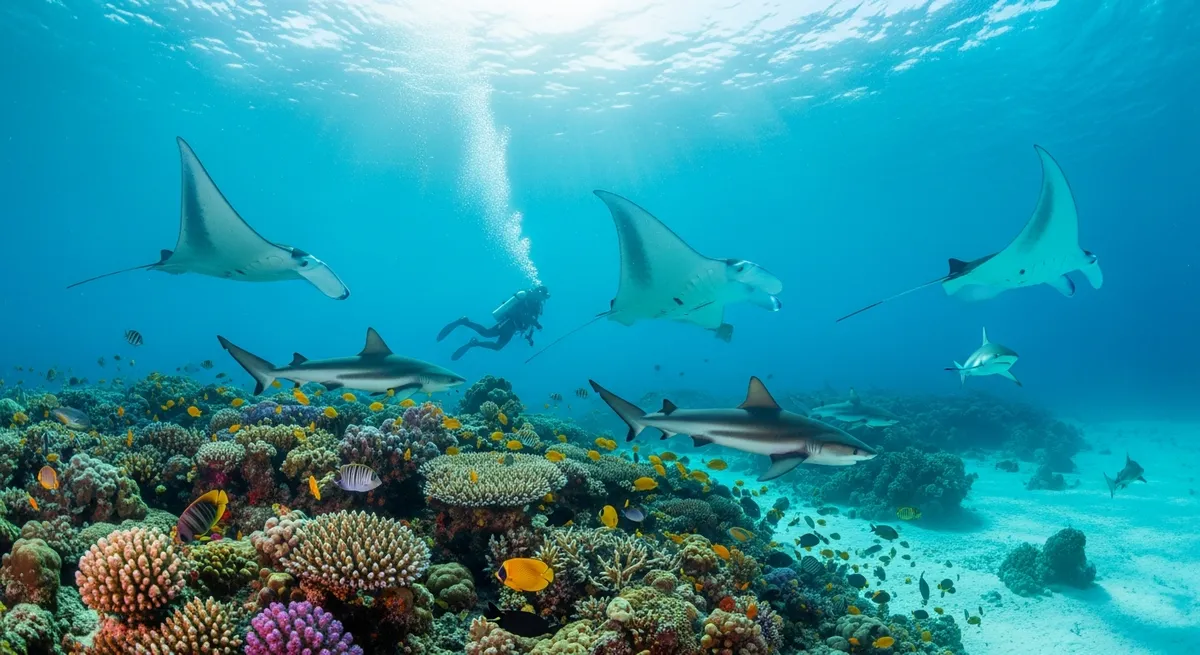
Bora Bora offers some of French Polynesia's richest diving, with 140+ marine species recorded in the area - including dolphins, eagle rays, humpback whales, manta rays and mobula rays (devil rays). Water ranges 27-29°C, warmest February, March, April.
Bora Bora. We know what you're thinking: honeymooners, overwater bungalows, maybe a quick snorkel. And yes, it’s all that, but the diving here really does hold its own, especially if you’re into big animal encounters in the lagoon. We love the easy drift dives just outside the main passes, where eagle rays often glide by with very little effort on your part. Inside the reef, the shark and ray feeding dives are a consistent hit, a close-up encounter with blacktip reef sharks and stingrays that never feels overly touristy, more like an energetic meeting. It’s warm, usually calm, and the visibility lets you see a good distance. Our favourite time of year to visit is late August through October. That's when humpback whales make their seasonal appearance. Hearing them sing underwater is something else entirely; it vibrates right through you.
Bora Bora Dive Site Map
Dive sites and dive centres in Bora Bora
Bora Bora Dive Sites
40 dive sites in Bora Bora
Anau
Anau is one of those spots we talk about constantly when Bora Bora comes up. It’s a genuine cleaning station inside the lagoon, a place where mantas really do show up with remarkable consistency. We’ve been lucky enough to spend entire dives just watching these giants glide in, circling the coral heads, almost posing for their regular scrub-down. It’s pretty special to see them come so close, wings flexing, completely unbothered by our presence as long as you play by the rules – no touching, no chasing, and if you can manage it, try to hold your breath as they pass directly overhead. They really do seem to dislike those big bubble plumes. The reef itself is pretty shallow, maxing out at 18 metres, with a decent spread of staghorn coral providing homes for lots of smaller stuff – we’ve seen arcs of fusiliers, clown tangs, and even an oriental flying gurnard once, fan-like fins spread wide. Visibility averages around 14 metres, which is usually plenty to watch the manta show unfold. This site is perfect for anyone keen to spend time observing these magnificent creatures up close in a calm, protected environment, even if you’re newer to diving.
Anau
Anau is one of those spots we talk about constantly when Bora Bora comes up. It’s a genuine cleaning station inside the lagoon, a place where mantas really do show up with remarkable consistency. We’ve been lucky enough to spend entire dives just watching these giants glide in, circling the coral heads, almost posing for their regular scrub-down. It’s pretty special to see them come so close, wings flexing, completely unbothered by our presence as long as you play by the rules – no touching, no chasing, and if you can manage it, try to hold your breath as they pass directly overhead. They really do seem to dislike those big bubble plumes. The reef itself is pretty shallow, maxing out at 18 metres, with a decent spread of staghorn coral providing homes for lots of smaller stuff – we’ve seen arcs of fusiliers, clown tangs, and even an oriental flying gurnard once, fan-like fins spread wide. Visibility averages around 14 metres, which is usually plenty to watch the manta show unfold. This site is perfect for anyone keen to spend time observing these magnificent creatures up close in a calm, protected environment, even if you’re newer to diving.
Aquarium
The Aquarium in Bora Bora is one of those sites we always make time for, even if we’ve been to the island a dozen times. It’s a gentle dip into the lagoon, maxing out at a comfortable 12m, making it perfect for a relaxed start to a trip or for introducing new divers to the reef. We love just hovering above the patches of staghorn coral, watching the silver-streaked rainbowfish shimmer and scatter as we drift past. It’s an easy, colourful dive, a real visual feast without the need for advanced skills. The sandy bottom between the coral bommies often has orange-lined triggerfish pottering about, and we’ve spotted green turtles gliding by on more than one occasion. The visibility here is usually excellent, around 18m, making everything feel incredibly vibrant. If you’re a photographer, this is a fantastic spot for close-up reef shots, especially mid-morning when the light really makes the dot and dash butterflyfish pop against the coral.
Aquarium
The Aquarium in Bora Bora is one of those sites we always make time for, even if we’ve been to the island a dozen times. It’s a gentle dip into the lagoon, maxing out at a comfortable 12m, making it perfect for a relaxed start to a trip or for introducing new divers to the reef. We love just hovering above the patches of staghorn coral, watching the silver-streaked rainbowfish shimmer and scatter as we drift past. It’s an easy, colourful dive, a real visual feast without the need for advanced skills. The sandy bottom between the coral bommies often has orange-lined triggerfish pottering about, and we’ve spotted green turtles gliding by on more than one occasion. The visibility here is usually excellent, around 18m, making everything feel incredibly vibrant. If you’re a photographer, this is a fantastic spot for close-up reef shots, especially mid-morning when the light really makes the dot and dash butterflyfish pop against the coral.
Avapeihi pass
Avapeihi Pass is one of Bora Bora's main channels, a good spot if you're looking for a drift dive. We've often encountered blacktip reef sharks here, sometimes grey reef sharks too, just cruising the currents. It's a fairly straightforward dive, usually with decent visibility, making it suitable for divers comfortable with some current but not necessarily looking for a high-intensity experience. You’ll be carried along, watching the pelagics pass by.
Cite corail
Cite Corail, off Bora Bora, is a gentle coral garden. Here, the reef is dotted with smaller corals, attracting a good variety of reef fish. It’s a relaxed dive, ideal for those looking for an easy drift or a longer bottom time exploring the shallower sections. If you’re hoping for pelagics, you’ll likely need to look elsewhere, but it's a solid choice for a peaceful afternoon.
Coral Garden
Coral Garden might be Bora Bora’s poster child for a reason. We love it because it’s exactly what you picture when someone says ‘French Polynesia’ – easy, bright, and full of curious fish. It’s a shallow drift over healthy coral bommies, often in less than 5 metres of water, so it's a perfect first dive or a leisurely second. The visibility is usually excellent, letting you spot those bluespotted stingrays tucked into the sand and the flash of orange-lined triggerfish zipping past. Our favourite time to go is mid-morning, just after the first boats have left and before the lunch rush. You’ll see schools of sickle butterflyfish and epaulette soldierfish weaving through the branching corals. Keep an eye out for the small giant clams, their mantles glowing electric blue or green. It’s a gentle introduction to Bora Bora's reefs, ideal for snorkelers too, or anyone wanting a relaxed, vibrant experience without any tricky currents.
Eagle-rays station
Dropping into Eagle-rays station in Bora Bora, the name really says it all. You'll often find a decent gathering of spotted eagle rays cruising through, sometimes in small schools, sometimes solo. It's a straightforward drift dive, generally calm, making it a good spot for newer divers looking for a reliable eagle ray encounter without too much effort. Visibility here is typically good, letting you just hang back and watch them glide past.
Fafapiti
Fafapiti is all about the mantas. And we mean *all* about the mantas. You drop in on a shallow wall, no current to speak of, maybe 15 metres max, and then you just wait. It’s like being in a theatre where the main act is always on time, and they usually do multiple encores. We’ve had dives here where three, four, even five mantas will loop around the cleaning stations, sometimes coming so close you can hear the faint whoosh of water as they pass by. You'll see their dark shadows first, then the flash of white as they turn, often just a metre or two away. The wall itself is pretty, nothing spectacular, but it's a good backdrop for the real show. Look closely, and you’ll spot yellow tangs darting in and out, maybe a lineated butterflyfish or two picking at the coral. But your eyes will always drift back to the open water, waiting for the next pass. Fafapiti suits anyone who loves mantas, plain and simple. It’s an easy, relaxed dive, perfect for photographers or anyone who just wants to sit back and watch these incredible animals do their thing.
Haapiti
Haapiti is one of those Bora Bora lagoon dives we always make time for, especially if we’re looking for something a bit different from the usual channel drifts. The name of the game here is exploring the coral plateau, which gives way to three distinct, large holes. Drop into these and you're surrounded by schools of snapper, all jostling for position. Move out of the holes and the reef opens up to a maze of smaller excavations and mini-caves. We often spot bluespotted stingrays tucked into the sand patches here, and the blacktip sharks cruise by with a relaxed indifference we appreciate. The average visibility is good, around 23m, but on a calm day, it really stretches out. We'd suggest aiming for a morning dive before the boat traffic picks up. The light filters down beautifully into those holes then, creating a really serene atmosphere. This isn't a high-adrenaline site; it’s more about a relaxed exploration, perfect for photographers or divers who appreciate the finer details of a healthy reef.
Iriru
Iriru is one of those Bora Bora spots that we always carve out time for. It’s not about the big pelagics here, though you might get lucky with a passing eagle ray. This site is pure macro magic, a kaleidoscope of reef fish activity that demands a slow drift. We love finding a sandy patch and just kneeling to watch the show. You'll see Ornamented Wrasse darting through coral heads, and the Undulated Morays are usually out, just watching the world go by from their crevices. Keep an eye out for Two-spot Bristletooth grazing the reef, and if you’re patient, a False-eyed Pufferfish will often let you get close. We’ve had some fantastic encounters with Arc-eye Hawkfish perched on coral branches, practically posing for photos. The light here, filtering down into the shallows, really makes the colours pop. It’s a perfect spot for photographers looking for those detailed reef shots. We’d suggest going in the morning; the light is softer and the fish activity always seems a bit livelier before the afternoon boat traffic picks up.
L'Aquarium
Forget what you might have heard about Bora Bora's diving, L'Aquarium is a nice surprise, especially for those who appreciate the smaller details. It's not a deep dive, more of a leisurely drift or an easy mooring stop inside the lagoon, perfect if you’re looking for a relaxing second dive of the day. We’ve done it a few times and always come away with something new, whether it’s a tiny Hardshell shrimp scuttling across the sand or a Pinktail triggerfish darting between the coral heads. What we really like here is the sheer number of those colourful reef fish that seem to ignore you completely. You'll swim through clouds of Yellowtail Dascyllus, so dense you almost feel them brush past your mask, and watch Bicolor cleaner wrasse doing their diligent work on larger fish. Keep an eye out for the flashes of Redfin Butterflyfish and the striking patterns of Coral Beauties. It's an easy dive that lets you just float and observe, making it a solid choice for newer divers, but even experienced eyes will find plenty to appreciate in this busy, shallow world.
Show all 40 dive sites in Bora Bora
- Le Nordby
- Les rairas
- Les Roses
- Le trou de la Pieuvre
- Mahara motu
- Manta Cleaning Station
- Miri-Miri and Roses
- Muri Muri
- Muri Muri
- Pa’ipa’i
- Passe de Céran - TAHAA
- Piti Un Uta motu
- Rauto’Anui
- Safari Aquarium
- Tao-tao
- Tapu
- Tapu Canyon
- Te Ava Mo’a
- Teavanui Pass
- Te Ava Piti
- Teavapiti pass
- Te Tuatiare
- The Mounts of Ceran
- Toopua
- TopDive
- Tupai
- Tupitipiti
- Tupitipiti
Bora Bora Dive Centres
9 dive shops and operators in Bora Bora
BORA OCEAN ADVENTURES
Diveasy
Dive ´n smile
Eleuthera Bora Diving Center
Eleuthera Plongee
Hemisphere Sub
Mahana Dive
Snorkeling raie manta
Show all 9 dive centres in Bora Bora
Ocean Wildlife in Bora Bora
140 species recorded in Bora Bora
Bora Bora Daylight & Sunrise/Sunset
Sunrise and sunset times for Bora Bora, calculated from coordinates
Today - Sunday 11 October
Sunrise
05:42
Sunset
18:05
Daylight
12h 23m
Golden Hour
17:37
First light (dawn) at 05:21 · Last light (dusk) at 18:27
Monthly Averages
| Month | Sunrise | Sunset | Daylight |
|---|---|---|---|
| Jan | 05:46 | 18:46 | 13h 1m |
| Feb | 06:02 | 18:41 | 12h 39m |
| Mar | 06:10 | 18:23 | 12h 13m |
| Apr | 06:15 | 17:59 | 11h 44m |
| May | 06:23 | 17:44 | 11h 21m |
| JunShortest | 06:33 | 17:42 | 11h 9m |
| Jul | 06:36 | 17:49 | 11h 13m |
| Aug | 06:26 | 17:58 | 11h 32m |
| Sep | 06:03 | 18:02 | 11h 59m |
| OctNow | 05:39 | 18:06 | 12h 27m |
| Nov | 05:25 | 18:18 | 12h 53m |
| DecLongest | 05:29 | 18:35 | 13h 6m |
Times are approximate local times based on longitude. Actual times may vary slightly depending on the exact timezone observed in Bora Bora.
Where to Stay near Bora Bora
Prices from Booking.com. We may earn a commission at no extra cost to you.
Marine Protected Areas near Bora Bora
1 protected area near Bora Bora - please respect local regulations when diving
Motu Tapu
Getting to Bora Bora
Uturoa
Papeete
Motu Mute
Plan & book
Ways to dive Bora Bora, from day trips to liveaboards.
Day trips & courses
via GetYourGuideGuided dives, courses and snorkel trips with instant booking.
Find dive trips in Bora BoraPlaces to stay
via Booking.comHotels and dive resorts near Bora Bora.
Search stays in Bora BoraDive insurance
Most travel insurance excludes or limits scuba. Check what you need before you go.
Dive insurance explainedPartner links: we may earn a commission if you book, at no extra cost to you. How we make money