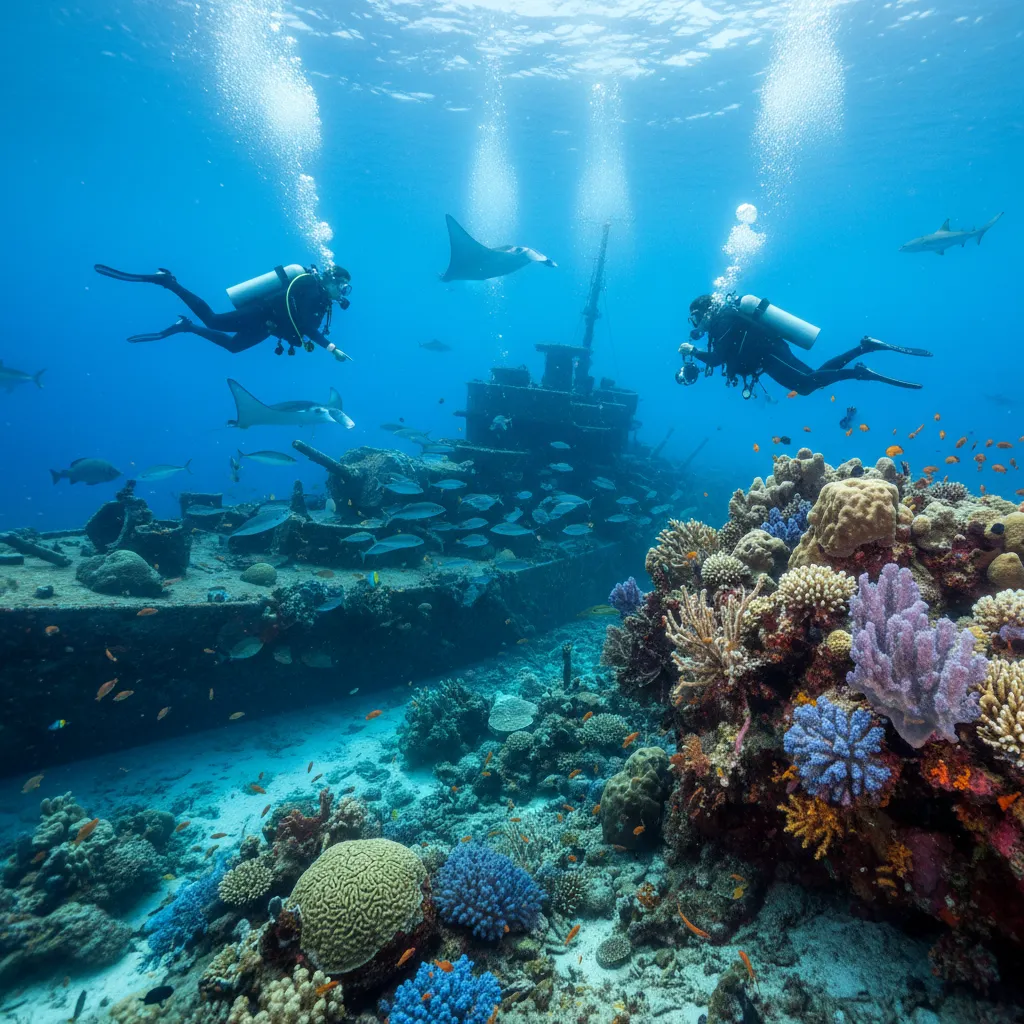
Diving in Bikini Atoll
Why dive here
Bikini Atoll offers some of Marshall Islands's richest diving, with 266+ marine species recorded in the area - including blacktip reef sharks, giant moray eels, grey reef sharks, octopuses and pufferfish. Water ranges 28-30°C, warmest August, September, October.
Bikini Atoll isn’t a quick trip, and that’s part of its appeal. This UNESCO site isn’t for the faint of heart or the beginner. We’re talking serious wreck diving, requiring technical skills and a healthy respect for what lies beneath. The star attractions are a fleet of WWII warships, intentionally sunk during nuclear tests in the 1940s. Imagine descending onto the USS Saratoga, a massive aircraft carrier, or navigating the upright Japanese battleship Nagato. It’s a sobering experience, these steel giants now home to an unexpected explosion of life: speckled groupers patrol bomb bays, blackspot surgeonfish dart through corridors. The sheer scale of these wrecks is what sets Bikini apart. You’ll feel the weight of history as you glide past twisted metal and decaying machinery. Visibility here is generally solid, but strong currents can pick up, so pay attention to your dive brief. Our favorite moments involve finning through open decks, seeing daylight stream through gaping holes, illuminating schools of fusiliers so thick they almost block the light. It’s not a bustling coral reef, it’s a solemn, profound dive into a man-made ghost town slowly reclaimed by the ocean. Come prepared, this is a deep dive into history and marine resilience.
Bikini Atoll Dive Site Map
Dive sites and dive centres in Bikini Atoll
Bikini Atoll Dive Sites
6 dive sites in Bikini Atoll
Bikini Atoll
Diving Bikini Atoll isn't just about seeing big wrecks, it's about feeling the weight of history. We love the sheer scale of the USS Saratoga, an aircraft carrier sitting upright, its flight deck now a massive flat plain at 28 meters. Dropping into her colossal hangar bays, you almost expect to see planes still chained down. The HIJMS Nagato, Admiral Yamamoto's flagship, is another beast entirely, though she’s capsized; her enormous props are still a sight, encrusted with soft corals. The real magic here is the contrast: these steel giants, sunk by atomic tests, are now thriving artificial reefs. Barracuda patrol the bridges, and we’ve seen schools of fusiliers so thick they block the light in the hangars. Visibility in the lagoon is usually incredible, often 30 meters plus, which helps with the depths. You'll need solid deep diving experience and advanced nitrox for this trip; it's serious wreck diving, not for the casual visitor. For those who make the journey, it’s an unparalleled dive into a truly unique, somber, and beautiful underwater museum.
HIJMS Nagato
The Nagato is a monster, a genuinely immense piece of history. We’re talking about the flagship of the Imperial Japanese Navy, the vessel from which Admiral Yamamoto ordered the attack on Pearl Harbor. Now she rests upside down, at about 52 metres, and the scale of the wreck is just humbling. It's not a dive for the faint of heart, or for anyone without solid wreck experience, a deep cert, and preferably, sidemount. Our favourite part has to be the huge bow section, a leviathan of steel covered in life. You drop down, and it just keeps going. Schools of barracuda hang off the structure, shimmering in the shafts of light that pierce the gloom. Look out for the gigantic four-bladed propellers, they’re still mostly intact and give you a sense of the sheer power this ship once had. Inside, the sheer scale of the engine room is incredible – a cathedral of twisted metal, now home to clouds of glasseye snapper and the occasional patrolling reef shark. You can spend an entire dive just on one section of the Nagato and still feel like you’ve only scratched the surface. The wreck is slowly but surely transforming into a thriving artificial reef, with blackfin squirrelfish darting between fire coral and the larger parrotfish grazing on the hull. We'd suggest staying shallow on your deco stops, exploring the upper sections of the superstructure which are now a maze of coral growth.
HIJMS Nagato (Wreck)
The HIJMS Nagato is one of those wrecks that just… demands respect. We love it for its sheer scale, a colossal battleship lying upside down in 51 metres of water. Dropping down, you start to make out the ghostly outline, the immense bulk slowly resolving from the gloom. It’s an intermediate dive, sure, but really, this is for divers who appreciate history and don't mind a bit of depth. Our favourite part is exploring the bridge structure, now completely inverted. It feels surreal, swimming through these upside-down compartments, imagining the chaos of Operation Crossroads. Visibility here is usually good, often 20 metres or more, which helps when you're navigating such a large structure. Keep an eye out for the resident grey reef sharks patrolling the deck guns and the schools of fusiliers that dart through the openings. The Nagato offers a profoundly humbling experience, a silent monument to a bygone era, now a thriving artificial reef.
USS Pilotfish
Diving the USS Pilotfish is like stepping into a time capsule, a powerful reminder of Bikini's past. This isn't just a wreck; it's a hulking, intact submarine, lying on its starboard side at about 40 meters. We love tracing the length of it, from the torpedo tubes right up to the conning tower. The sheer scale is impressive, and the penetration opportunities are fantastic – even a quick peek into the control room gives you that eerie sense of history frozen in time. What makes Pilotfish a standout for us is the way the marine life has adapted. Schools of silver flagtail shimmer around the periscope, and you'll often spot humphead wrasse cruising by. Look closely at the hull and you'll see fire coral and corrugated coral clinging on, providing shelter for black-spotted blowfish and pink squirrelfish. It's an expert dive, no doubt, with strong currents a real possibility, but if you're comfortable at depth and keen for a truly unique wreck experience, this is one to prioritise. We'd suggest getting there early in the day if possible; the light filtering down through the water column really enhances the sense of scale.
USS Saratoga
The USS Saratoga isn't just a wreck, it’s an entire ecosystem, a steel city sunk and now reclaimed. We love how she sits upright, perfectly positioned for exploring her vast flight deck at 28 meters, then descending deeper into the hangar bays and bridge. Drop down and you’ll find schools of twinstripe fusiliers so thick they shimmer, parting just enough for you to glimpse the hull. Our favourite moments are pushing through the darker interior spaces, where the eerie silence is broken only by your own breathing, imagining the history etched into every beam. This is an expert dive, no question. Currents can be tricky, and the sheer scale means you need solid buoyancy and gas management. But for those ready, the rewards are immense. You'll glide past massive gun turrets, marvel at the aircraft still strapped to the deck, and spot jacks and blacktip reef sharks circling above the superstructure. It's a humbling experience, and one we think every serious wreck diver should aim for.
USS Saratoga Wreck
Dropping down onto the USS Saratoga, it’s not just the sheer scale that grabs you, it’s the quiet power of the place. This aircraft carrier, a veteran of both WWII and atomic bomb tests, now rests upright at 45 metres. We love finning along her flight deck, imagining the planes that once launched from here, now replaced by giant groupers and schools of barracuda that shimmer in the filtered light. Inside, the hangar bays are vast, dark caverns. Our favourite moment is always pushing into the medical bay, the old porcelain sinks and instruments still eerily intact. You’ll spend time exploring the anti-aircraft guns, encrusted with thick corals, home to curious reef sharks. The Saratoga offers a profound experience for any diver comfortable with depth and overhead environments, a truly unique blend of history and thriving marine life. Expect to feel a sense of scale you won't find anywhere else.
Bikini Atoll Dive Centres
No dive centres listed in Bikini Atoll yet. Browse all dive centres.
Ocean Wildlife in Bikini Atoll
266 species recorded in Bikini Atoll
Bikini Atoll Daylight & Sunrise/Sunset
Sunrise and sunset times for Bikini Atoll, calculated from coordinates
Today - Sunday 11 October
Sunrise
05:48
Sunset
17:44
Daylight
11h 56m
Golden Hour
17:16
First light (dawn) at 05:27 · Last light (dusk) at 18:05
Monthly Averages
| Month | Sunrise | Sunset | Daylight |
|---|---|---|---|
| Jan | 06:23 | 17:53 | 11h 31m |
| Feb | 06:21 | 18:06 | 11h 46m |
| Mar | 06:07 | 18:10 | 12h 3m |
| Apr | 05:48 | 18:10 | 12h 23m |
| May | 05:36 | 18:15 | 12h 39m |
| JunLongest | 05:36 | 18:23 | 12h 48m |
| Jul | 05:42 | 18:27 | 12h 45m |
| Aug | 05:48 | 18:19 | 12h 31m |
| Sep | 05:49 | 18:01 | 12h 12m |
| OctNow | 05:48 | 17:41 | 11h 53m |
| Nov | 05:56 | 17:32 | 11h 36m |
| DecShortest | 06:10 | 17:38 | 11h 27m |
Times are approximate local times based on longitude. Actual times may vary slightly depending on the exact timezone observed in Bikini Atoll.
Where to Stay near Bikini Atoll
Prices from Booking.com. We may earn a commission at no extra cost to you.
Marine Protected Areas near Bikini Atoll
3 protected areas near Bikini Atoll - please respect local regulations when diving
Rongelap
Bikini
Ailinginae
Getting to Bikini Atoll
Kwajalein
Plan & book
Ways to dive Bikini Atoll, from day trips to liveaboards.
Day trips & courses
via GetYourGuideGuided dives, courses and snorkel trips with instant booking.
Find dive trips in Bikini AtollPlaces to stay
via Booking.comHotels and dive resorts near Bikini Atoll.
Search stays in Bikini AtollDive insurance
Most travel insurance excludes or limits scuba. Check what you need before you go.
Dive insurance explainedPartner links: we may earn a commission if you book, at no extra cost to you. How we make money