Diving in Rabaul & New Britain
Why dive here
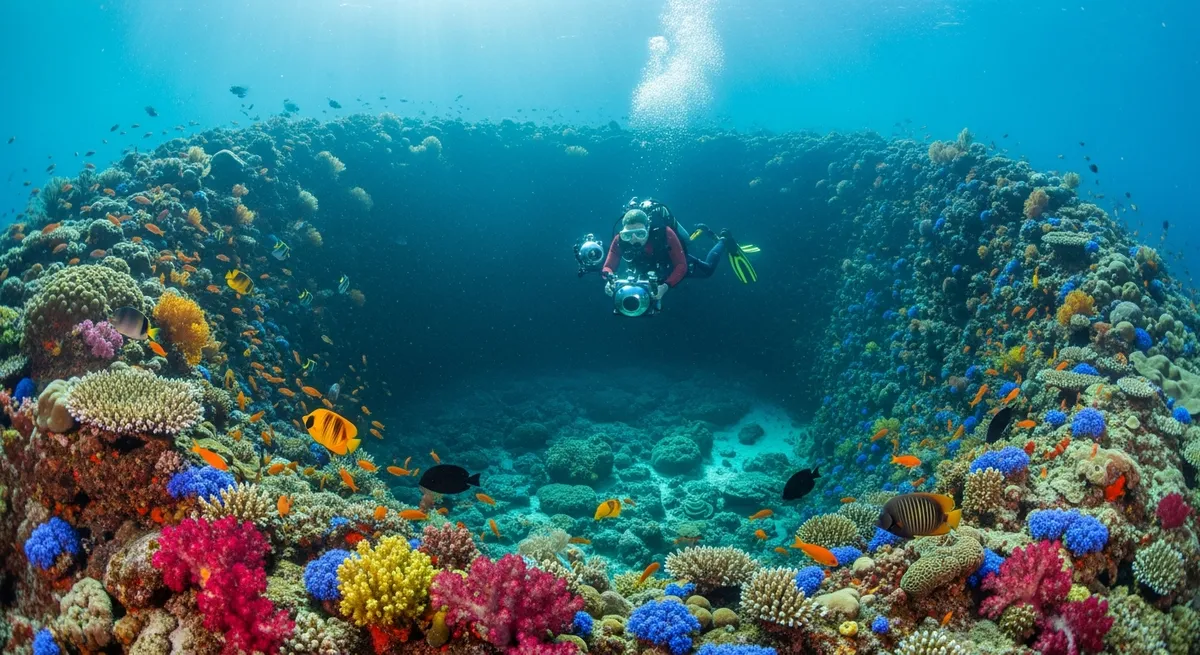
Rabaul & New Britain offers some of Papua New Guinea's richest diving, with 203+ marine species recorded in the area - including barracuda, giant moray eels, lionfish, nautiluses and pufferfish. Water sits around 31°C.
Rabaul is a place that truly grabs you, not just for the diving but for the raw power of nature shaping the landscape. We love the sheer drama of diving among WWII wrecks in a harbour framed by active volcanoes. The water around here often has a slightly eerie, silty feel, especially closer to the eruptions, which only adds to the atmosphere when you’re finning over a Japanese Zero. Our favourite dives blend history with marine life. Imagine a squadron of Blue and Gold Fusiliers streaming past the wing of a sunken bomber, or a Coral Hawkfish perched patiently on a corroded artillery piece. The wrecks aren't just metal husks; they're artificial reefs, home to Rivulated Parrotfish and the odd Blood-stained Frog Shell. We'd suggest aiming for the morning dives - the visibility tends to be at its best before any afternoon thermal layers stir things up. Current can be a factor on some of the deeper wreck sites, so good buoyancy control is a must, but it's rarely a raging torrent. Keep an eye out for those Fringelip Blennies, always a joy to watch darting around the coral.
Rabaul & New Britain Dive Site Map
Dive sites and dive centres in Rabaul & New Britain
Rabaul & New Britain Dive Sites
21 dive sites in Rabaul & New Britain
Albatross Passage
Albatross Passage is one of those spots where you just drop in and let the ocean do the work. It’s a channel between two islands, and the current can really rip through, making for some serious drift diving. We've often seen schools of eagle rays gliding past, sometimes mobulas, and if you’re lucky, a manta or two. Grey reef sharks patrol the edges, and you’ll usually spot dogtooth tuna and barracuda zooming by. On the ridge, the soft corals are a real treat, vibrant and swaying in the flow. It's a dive best suited for those comfortable with strong currents and looking for big pelagic action.
Baudisson Bay
Baudisson Bay offers a dramatic vertical wall, dropping from the surface into an 800-meter abyss. We've often found grey reef sharks and whitetip sharks patrolling the deeper sections, a reliable sight on most dives. The real magic, though, is in the details – the wall is riddled with swim-throughs and crevices, perfect for discovering an impressive variety of nudibranchs and other macro life. It’s a site that rewards a slow drift, keeping an eye out for the big stuff while appreciating the smaller, intricate creatures tucked into every nook.
Bermuda Drop
Bermuda Drop gives you a proper wall dive, starting shallow at 3m before pitching down to 25m, then it just keeps going. We like to follow the slope, looking for the big overhang around 18m, often home to a moray or two tucked away. It's a great spot for the macro stuff – you'll find flatworms and nudibranchs here, plus the occasional leaf scorpionfish if you have a good eye. Keep an eye out for the giant clam at 14m. It's an easy dive, good for new divers looking for that wall experience without heavy current.
Byron Strait
Byron Strait, often called Eagle Ray Passage, is one of those places where you just go with the flow, literally. We’ve drifted along, keeping an eye on the two prominent pinnacles, and watched eagle rays put on a show in the current. It’s a pretty reliable spot for them. During stronger tidal pushes, we’ve also seen bigger pelagics, like the occasional oceanic whitetip or a bronze whaler shark cruising by. If you enjoy a good current dive and a chance at some larger animal encounters, this channel is worth your bottom time.
Catalina Wreck
The Catalina Wreck in Rabaul offers a compelling, if sombre, dive. This American reconnaissance plane met an abrupt end shortly after takeoff, scattering its remains across the seabed at 20 metres. We often spend time in the cockpit, a surprisingly intact section that still gives you a sense of its original layout. Look closely among the debris for resident lionfish and schools of snapper that have made homes in the twisted metal. It’s a site for divers who appreciate history and don't mind a scattered wreck, rather than one perfectly preserved.
Echuca Patch
Echuca Patch sits in the open ocean near Kavieng, a substantial ridge that rises from 45m to a comfortable 12m below the surface. We've often found this to be a real magnet for schooling barracuda and jacks, circling in the current. Close by, around 31 metres, the Korean fishing boat ‘Der Yang’ lies on its side, making for a fascinating wreck dive in conjunction with the lively reef. It's a solid dive for those who enjoy pelagic action and a bit of history.
Ecucha Patch
Ecucha Patch, just outside Rabaul, offers a decent dive for pelagic lovers. The site is essentially a large underwater ridge, starting at around 15 metres, which acts like a magnet for bigger fish. We’ve drifted along, often surrounded by schools of barracuda so dense they dim the light, and frequently spotted trevally, tuna, and a few reef sharks cruising by. There’s also a scuttled Korean fishing boat down there, which is slowly turning into a proper reef, now home to some impressively large Queensland groupers and a fair bit of growing coral. It’s a straightforward dive, best for those who get a kick out of seeing the larger residents of the ocean.
Japanese bi-plane
Dropping onto the Japanese bi-plane in Rabaul feels like finding a forgotten toy at the bottom of a pond. It’s remarkably intact, sitting upright as if ready for take-off, just swapped its runway for a silty seabed. We’ve seen gobies darting from the fuselage, and small reef fish taking shelter in the wings. It’s a gentle, easy dive, probably best for a relaxed second tank or for those who appreciate the quiet history of a well-preserved wreck without the drama of strong currents. Visibility can vary, but even on a middling day, the plane's form is clear.
Kaplaman
Kaplaman gives you a good feel for Rabaul's underwater character. It's a series of pinnacles, some of them rising so close to the surface you can almost reach out and touch them. We've seen an impressive variety of reef fish here, particularly in the shallower sections, with plenty of fusiliers and schooling bannerfish swarming the coral bommies. It’s a solid, enjoyable dive for anyone looking for classic reef action without too much fuss.
Kulau Wrecks
The Kulau Wrecks offer a compelling look at maritime history, resting close together on the north coast. We’ve got a trawler, a barge, and a small coastal freighter all within easy reach, making for a fascinating triple dive. You can poke around the freighter’s bridge, often finding batfish schooling nearby, while the barge provides plenty of nooks for small reef fish to hide. It's an intriguing spot, particularly because so little is known about their origins; it adds a layer of mystery to the whole experience. We think it’s a good pick for divers who enjoy exploring industrial relics and don't need huge pelagics to have a good time.
Lissenung Island House reef
Just off the jetty at Lissenung Island, the house reef offers a gentle introduction to Papua New Guinea's underwater world. We’ve spotted plenty of reef fish flitting through the corals here, along with the occasional turtle gliding past. It's a relaxed dive, perfect for a leisurely afternoon or a check-out dive to get comfortable in the water.
Lissenung Island Reef
Lissenung Island Reef is a genuinely pleasant house reef, wrapping around a good portion of the island. It’s a shallow dive, sticking mostly between two and ten metres, which makes it an absolute win for photographers keen on macro subjects and anyone looking for a relaxed night dive. We’ve spent hours here, poking around for pygmy seahorses and spotting a surprising number of different clownfish species. Keep an eye out for cockatoo waspfish tucked amongst the corals; they blend in remarkably well. It’s a gentle introduction to PNG’s reef life, ideal for shaking off travel rust or just enjoying a calm swim.
Show all 21 dive sites in Rabaul & New Britain
Rabaul & New Britain Dive Centres
10 dive shops and operators in Rabaul & New Britain
Archipelago Diving
Kokopo Beach Bungalow Resort
Kulau Lodge Beach Resort
Lissenung Island Resort
Lissenung Resort
Lissinung Island Resort
Rabaul Dive Centre
Rapopo Plantation Resort
Show all 10 dive centres in Rabaul & New Britain
Ocean Wildlife in Rabaul & New Britain
203 species recorded in Rabaul & New Britain
Rabaul & New Britain Daylight & Sunrise/Sunset
Sunrise and sunset times for Rabaul & New Britain, calculated from coordinates
Today - Sunday 11 October
Sunrise
05:38
Sunset
17:48
Daylight
12h 10m
Golden Hour
17:20
First light (dawn) at 05:17 · Last light (dusk) at 18:09
Monthly Averages
| Month | Sunrise | Sunset | Daylight |
|---|---|---|---|
| Jan | 05:57 | 18:13 | 12h 17m |
| Feb | 06:04 | 18:17 | 12h 12m |
| Mar | 06:01 | 18:09 | 12h 8m |
| Apr | 05:55 | 17:57 | 12h 3m |
| May | 05:53 | 17:52 | 11h 59m |
| JunShortest | 05:58 | 17:55 | 11h 57m |
| Jul | 06:03 | 18:01 | 11h 58m |
| Aug | 06:01 | 18:01 | 12h 1m |
| Sep | 05:49 | 17:54 | 12h 5m |
| OctNow | 05:37 | 17:47 | 12h 10m |
| Nov | 05:33 | 17:48 | 12h 15m |
| DecLongest | 05:42 | 18:00 | 12h 18m |
Times are approximate local times based on longitude. Actual times may vary slightly depending on the exact timezone observed in Rabaul & New Britain.
Where to Stay near Rabaul & New Britain
Prices from Booking.com. We may earn a commission at no extra cost to you.
Marine Protected Areas near Rabaul & New Britain
1 protected area near Rabaul & New Britain - please respect local regulations when diving
Talele Island
Getting to Rabaul & New Britain
Kavieng
Kokopo
Kimbe
Plan & book
Ways to dive Rabaul & New Britain, from day trips to liveaboards.
Day trips & courses
via GetYourGuideGuided dives, courses and snorkel trips with instant booking.
Find dive trips in Rabaul & New BritainPlaces to stay
via Booking.comHotels and dive resorts near Rabaul & New Britain.
Search stays in Rabaul & New BritainDive insurance
Most travel insurance excludes or limits scuba. Check what you need before you go.
Dive insurance explainedPartner links: we may earn a commission if you book, at no extra cost to you. How we make money