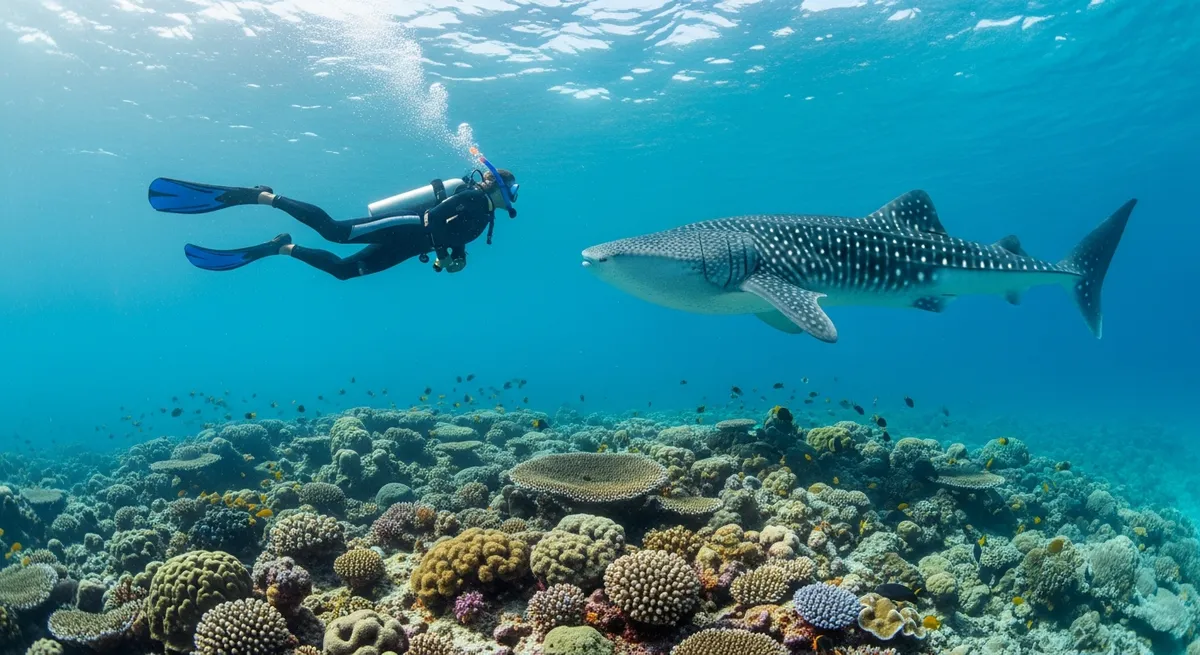
Diving in North Ari Atoll
Why dive here
North Ari Atoll offers some of Maldives's richest diving, with 133+ marine species recorded in the area - including blacktip reef sharks, sea turtles, spinner dolphins and whale sharks. Water ranges 29-31°C, warmest April, May, July.
North Ari Atoll means big fish, pure and simple. We love it for the thilas, those submerged pinnacles that act like magnets for pelagics, especially around the new moon. Fish Head, or Mushimasmingili Thila if you want to be formal, is our favourite, and for good reason. Drop down there and you’ll feel the current tugging, carrying you past grey reef sharks patrolling the drop-offs and Napoleon wrasse cruising by with that distinct, knowing look. The currents are what make it, really. They sweep nutrients in, and with the nutrients come the fusiliers, their schools so dense they sometimes dim the light. Keep an eye out for the smaller stuff too, tucked into the reef - those tiny blennies with their comical expressions, and the intricate patterns of the cowries if you take a moment to slow down. While the big stuff is the draw, we always enjoy drifting past the vibrant Montipora and Staghorn corals, watching the Ternate chromis flit in and out. Go early if you can, before the other boats arrive; it’s when the reef feels most alive.
North Ari Atoll Dive Site Map
Dive sites and dive centres in North Ari Atoll
North Ari Atoll Dive Sites
43 dive sites in North Ari Atoll
Bathala Maaga Kan
Bathala Maaga Kan offers a classic Maldivian channel dive experience. We often find ourselves drifting with the current, looking out into the blue for grey reef sharks and schooling eagle rays. The reef itself has healthy hard corals, attracting a good mix of smaller reef fish. It's a solid choice for divers comfortable with current looking for pelagic action.
Bathala Tila
Bathala Tila is a shallow reef in North Ari Atoll, making it a good spot for newer divers or those looking for a relaxed second dive. We’ve often found groups of white-tip reef sharks resting on the sandy bottom, along with schooling fusiliers darting around the bommies. There’s a gentle current most days, pushing you slowly along the reef’s edge, a nice drift without any drama. It’s a pleasant, easy dive for seeing typical Maldivian reef life.
Bodu Ashey
Bodu Ashey is a straightforward drift dive in North Ari Atoll, perfect for newer divers getting comfortable with currents. You'll move along a gently sloping reef, spotting reef sharks patrolling the drop-off and turtles grazing among the corals. It’s a good spot to build confidence, with consistent fish action and comfortable conditions most days.
Bodu Gah
Bodu Gah offers a straightforward Maldivian dive experience in North Ari Atoll. Expect to see some of the usual reef fish patrolling the reef, with a chance for a passing pelagic if you're lucky. It's a decent spot for a relaxed dive, suitable for those looking for an easy morning or afternoon in the water without too much current.
Cambra Beach
Cambra Beach is a gentle sandy slope, perfect for newer divers or a relaxed afternoon dip. The reef starts shallow and eases down to 18 metres, with scattered coral patches providing shelter for smaller reef fish. You'll likely spot sweetlips, snapper, and perhaps a lazy turtle munching on the seagrass. It's a comfortable spot for refreshing your skills.
Caves
Caves, in North Ari Atoll, gives you exactly what the name suggests: a chance to explore a series of small, shallow caverns and overhangs. We’ve found plenty of reef fish sheltering inside, and sometimes you’ll spot a white-tip reef shark cruising past the entrance. It’s a pretty easy dive, good for newer cave divers looking for a mellow introduction to overhead environments.
De faru
De faru, in North Ari Atoll, offers a gentle coral reef dive. We’ve found it’s a good spot for spotting the smaller reef residents like anemonefish and various wrasse species. It’s a pleasant, relaxed dive, ideal for those looking for a quiet exploration rather than big pelagic encounters. Conditions here are generally calm, suiting newer divers or photographers wanting an easy pace.
De faru reef
De faru reef in North Ari Atoll gives you a mellow drift over coral patches. It’s a good spot to take your time looking for smaller stuff amongst the seagrass beds, particularly the cymodocea and thalassia, which you don’t always see. Currents are generally mild, making this a comfortable dive for those looking for a relaxed exploration rather than a high-octane pelagic encounter.
Fushi Faru
Fushi Faru sits in North Ari Atoll, a gentle reef dive perfect for those getting comfortable with Maldivian waters. We found it’s a calm drift along the reef slope, dropping to around 23 meters. Keep an eye out for whitetip reef sharks resting on the sandy bottom and the occasional eagle ray gliding past. It's a relaxed spot, great for new divers or anyone wanting an easy afternoon in the water.
Gangehi Kandu North
Gangehi Kandu North is a good drift through a channel in North Ari Atoll. It’s not the deepest dive, topping out around 21m, but that means plenty of bottom time if you’re mindful of your air. We find the currents here can be quite lively, which is exactly what you want for a proper drift. Keep an eye out for grey reef sharks cruising the channel edges and schools of fusiliers and snappers hanging in the flow. It’s a solid intermediate dive, best for those comfortable letting the water do some of the work.
Hafsa Thila
Hafsa Thila is a sizeable pinnacle in North Ari Atoll, known for its busy schooling fish action. We often see grey reef sharks patrolling the deeper edges, with big schools of fusiliers and snappers swirling above the reef. Currents can be significant here, so it’s a site best enjoyed by experienced divers comfortable with drift dives. It’s a classic Maldivian thila dive, perfect for those chasing pelagics.
Hammerhead Point
Hammerhead Point lives up to its name, a reliable spot for encountering scalloped hammerheads, especially at first light. We often drop deep, around 30 meters, to catch them rising from the depths. Currents here can be strong, so it’s best for experienced divers comfortable with drift diving. Beyond the hammerheads, you'll likely spot grey reef sharks patrolling the drop-off.
Show all 43 dive sites in North Ari Atoll
- Hammerhead Point, Rasdhoo Atoll
- Holi Faru
- Kuramathi Caves
- Kuramathi Housereef
- Kuramathi Wreck
- Maagiri Thila
- Maavaru Manta Point
- Maayafushi Bay
- Madi Gaa
- Madivaru Beyru
- Madivaru Channel
- Madivaru Finolhu
- Miyaru Faru
- Mushimas Migili Reef
- North Channel
- Rasdhoo Beyru
- Rasdhoo Beyru Kandu
- Rasdhoo Diving: Hammerheads and Other Pelagics
- Rasdhoo Ferry Terminal
- Rasdhoo Miyaru Faru
- Rasdhoo North Channel
- Rasdhoo Reef
- Rasdhoo Try Dive Area
- Reef Explorer (wreck)
- Shark View Point
- Thoddoo Rangabeelu
- Thoddoo South Corner
- Thoddoo Turtle / Vella Ulhey Than
- Three Palms
- Turtle Reef
- Veligand North
North Ari Atoll Dive Centres
11 dive shops and operators in North Ari Atoll
Azure Dive and Water Sports Centre
Bodu Manta Diving
Coco Dive Dhuni Kolhu
Dive Butler Finolhu
Dive Club Buoyancy
Drop Dive Maldives
Kuramathi Dive Club
Maldivica Divers Thoddoo
Show all 11 dive centres in North Ari Atoll
Ocean Wildlife in North Ari Atoll
133 species recorded in North Ari Atoll
North Ari Atoll Daylight & Sunrise/Sunset
Sunrise and sunset times for North Ari Atoll, calculated from coordinates
Today - Sunday 11 October
Sunrise
05:54
Sunset
17:57
Daylight
12h 3m
Golden Hour
17:29
First light (dawn) at 05:34 · Last light (dusk) at 18:18
Monthly Averages
| Month | Sunrise | Sunset | Daylight |
|---|---|---|---|
| Jan | 06:21 | 18:15 | 11h 54m |
| Feb | 06:24 | 18:23 | 11h 59m |
| Mar | 06:15 | 18:21 | 12h 5m |
| Apr | 06:03 | 18:15 | 12h 13m |
| May | 05:56 | 18:15 | 12h 19m |
| JunLongest | 05:58 | 18:20 | 12h 22m |
| Jul | 06:04 | 18:25 | 12h 21m |
| Aug | 06:06 | 18:21 | 12h 16m |
| Sep | 06:00 | 18:09 | 12h 9m |
| OctNow | 05:54 | 17:56 | 12h 2m |
| Nov | 05:56 | 17:51 | 11h 56m |
| DecShortest | 06:08 | 18:00 | 11h 53m |
Times are approximate local times based on longitude. Actual times may vary slightly depending on the exact timezone observed in North Ari Atoll.
Where to Stay near North Ari Atoll
Prices from Booking.com. We may earn a commission at no extra cost to you.
Marine Protected Areas near North Ari Atoll
63 protected areas near North Ari Atoll - please respect local regulations when diving
Vattaru Kan'du
South Ari Marine Protected Area
V.Fussaufaru Sarahahdhu
K.Rasfari Sarahahdhu
Fushi Kan'du
B.Maahuravalhi Faruge Sarahahdhu
Lh.Maagandu (Anemone) Thila
Lh.Fusheefaru Thila
V.Miyaru Kan'du
Karibeyru Thila
Aa.Orimas Thila
V.Hin'gaakulhee Finolhu Sarahahdhu
Showing 12 largest of 63
Getting to North Ari Atoll
Malé
Noonu Atoll
Haa Dhaalu Atoll
Plan & book
Ways to dive North Ari Atoll, from day trips to liveaboards.
Day trips & courses
via GetYourGuideGuided dives, courses and snorkel trips with instant booking.
Find dive trips in North Ari AtollPlaces to stay
via Booking.comHotels and dive resorts near North Ari Atoll.
Search stays in North Ari AtollDive insurance
Most travel insurance excludes or limits scuba. Check what you need before you go.
Dive insurance explainedPartner links: we may earn a commission if you book, at no extra cost to you. How we make money