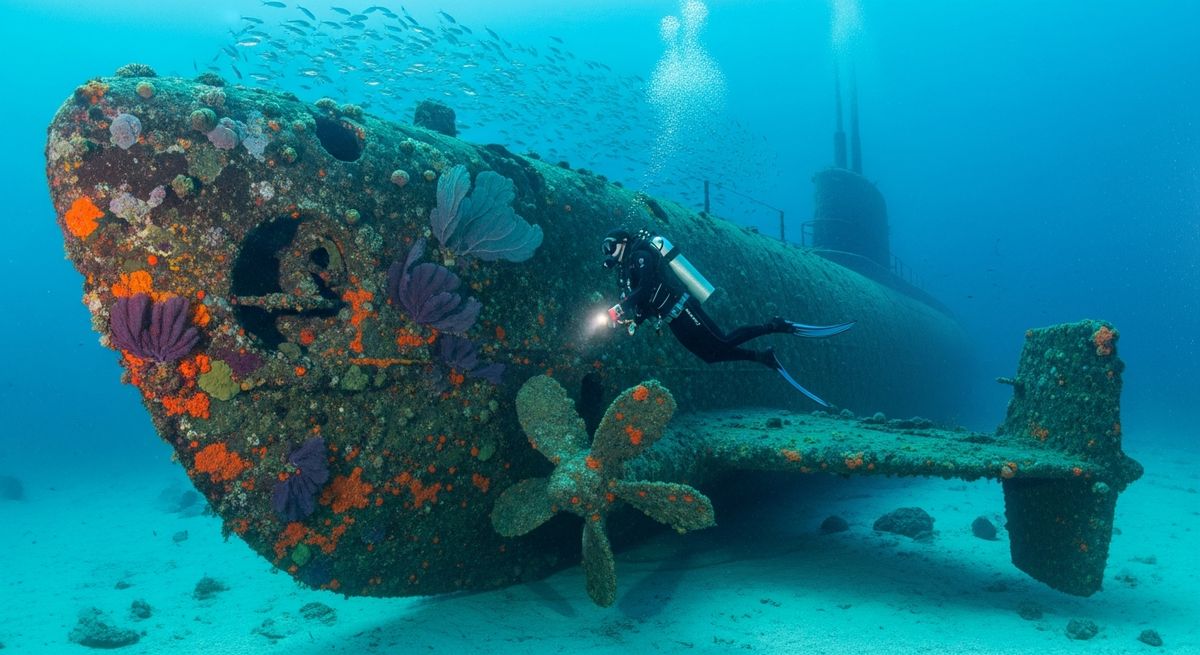
CAPITANO ANTONIO
Protected Area
Fondali di Staletti
Why dive here
With 60+ marine species recorded in the area - including dolphins, sea turtles and sperm whales - CAPITANO ANTONIO offers some of Ustica's richest wreck diving. Water ranges 15-29°C, warmest July, August, September.
The Capitano Antonio is one of Ustica's true standout dives, not just because it’s a wreck, but because of how it rests. You drop onto the stern, which sits upright at 26 metres, a silent sentinel in the blue. This isn't just a pile of metal; it’s a proper motor vessel, sunk in 1968, and the story of its fate feels palpable as you fin past the bridge. We love that you can still make out so much of its original structure – the wheelhouse, the cargo holds – all now cloaked in a beautiful tapestry of Mediterranean sponges and colourful encrusting corals. Our favourite part is always the bow, which collapsed onto its port side. It creates these fantastic caverns and swim-throughs, perfect for spotting groupers lurking in the shadows. Look closely, and you’ll often find scorpionfish camouflaged against the rust, or playful octopuses peeking from crevices. Visibility here is usually excellent, often pushing 30 metres, which lets you appreciate the entire scene as you descend. We'd suggest going in the morning; the light filtering through the water onto the wreck is just something else. It's a dive that really suits those who appreciate both history and healthy marine life, offering a tangible link to the past while buzzing with present-day ocean activity.
Typical CAPITANO ANTONIO Dive Profile
Illustrative profile based on site depth and type. Actual dive profiles vary - always follow your dive computer and training.
Safety Notes
Depth of 26m - Advanced Open Water certification recommended.
Wreck site - avoid penetration without wreck diving certification. Watch for sharp metal and entanglement hazards.
Always perform a 3-minute safety stop at 5m before surfacing.
CAPITANO ANTONIO Wreck History
Vessel Type
cargo ship
Cause
grounding
The history of the Capitano Antonio is shrouded in the murky depths it now calls home. This motor cargo vessel met its end on the rugged coastline of Ustica, near the point known as Punta Omo Morto. While the exact year of its sinking is not well-documented, it is widely believed the ship was caught in a violent storm. Laden with a heavy cargo of large marble blocks, it was driven onto the rocks and sank, spilling its valuable payload onto the seabed.
Today, the Capitano Antonio offers a fascinating dive into a submerged time capsule. The wreck lies at a depth of 26 meters, broken into two main sections with the bow and stern resting apart. Divers can explore the skeletal remains of the hull, now draped in sponges and soft corals. The most unique feature of the dive is the scattered cargo of white marble blocks, which create a stark, almost surreal contrast against the dark volcanic rock of the seabed. The wreck is a popular haunt for moray eels, groupers, and schools of damselfish, making it a classic Ustica dive site.
Nearest Dive Centres to CAPITANO ANTONIO
Dive shops near CAPITANO ANTONIO
View all dive centres in UsticaReviews for CAPITANO ANTONIO
Conditions
Ocean conditions, forecast and tides for CAPITANO ANTONIO
CAPITANO ANTONIO Ocean Conditions
Monthly averages for CAPITANO ANTONIO, sourced from Open-Meteo marine data - nearest station: Open-Meteo marine grid (38.1, 14.46) (15km away)
October Averages
Sea Temperature
24°C
75°F · Range: 22.1–25.7°C
Air Temperature
22°C
71°F
Wind Speed
7.27 m/s
14.1 knots
Atmospheric Pressure
1018.1 hPa
Based on 4 years of monitoring data · Data sources: Open-Meteo marine data
Plan & book
Ways to dive Ustica, from day trips to liveaboards.
Day trips & courses
via GetYourGuideGuided dives, courses and snorkel trips with instant booking.
Find dive trips in UsticaPlaces to stay
via Booking.comHotels and dive resorts near Ustica.
Search stays in UsticaDive insurance
Most travel insurance excludes or limits scuba. Check what you need before you go.
Dive insurance explainedPartner links: we may earn a commission if you book, at no extra cost to you. How we make money
Where to Stay near CAPITANO ANTONIO
Prices from Booking.com. We may earn a commission at no extra cost to you.