ALHAMBRA
Protected Area
Croker Carbonate Slabs
Why dive here
With 118+ marine species recorded in the area - including dolphins, dwarf minke whales, humpback whales, ocean sunfish (mola mola) and orcas - ALHAMBRA offers some of Northumberland & Northeast's richest wreck diving.
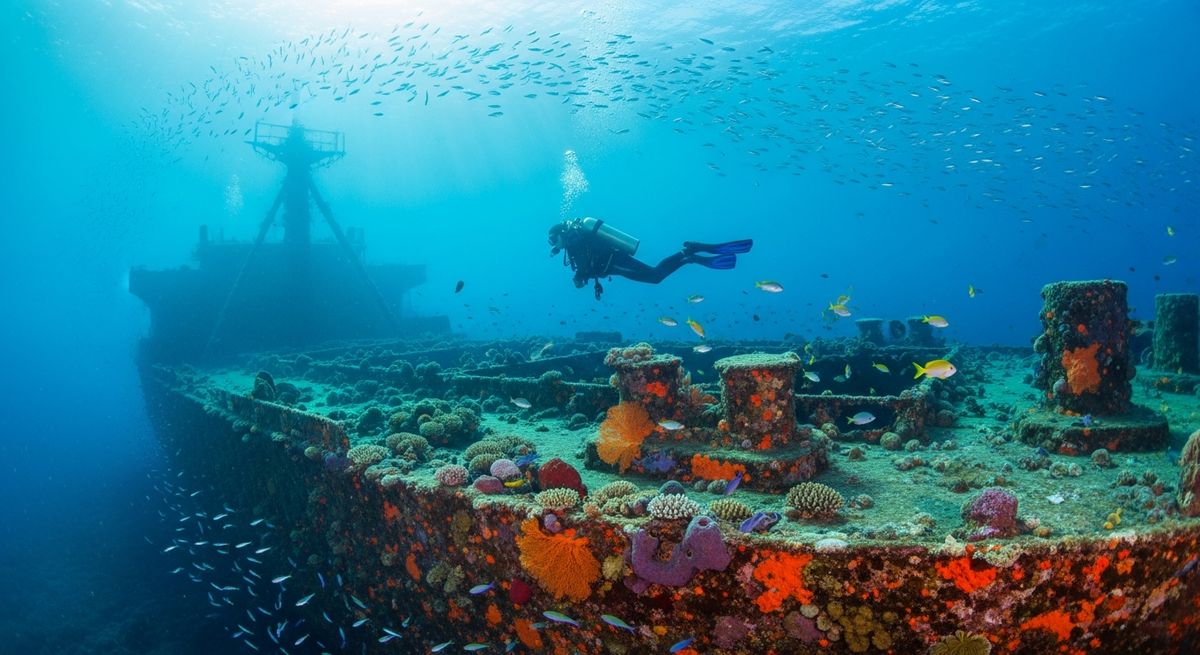
The Alhambra, a wooden sailing vessel from 1885, met its end in a collision in 1883 off the Northumberland coast. We’re always intrigued by these historical wrecks, especially when they’re timber. There’s a particular atmosphere to them, a sense of gentle decay. You won't find towering superstructures here, but rather a scattering of timbers, ribs, and hull plating, now largely broken down. What we love about the Alhambra is how it merges with the seabed. It’s a site for those who appreciate the subtle beauty of a wreck reclaiming its natural state. You’ll weave between sections of hull, spotting resident crabs scuttling into crevices, and sometimes, a shy ling peeking out from beneath a heavier beam. It’s a dive for patient exploration, letting your eyes adjust to the soft light and the textures of barnacle-encrusted wood. This isn't a dive for strong currents, which we appreciate, allowing you to really take your time and soak in the history. It's best experienced on a slack tide, when the water settles and the visibility, usually around 5-10 meters, gives you a clearer view of the remaining structure.
Safety Notes
Wreck site - avoid penetration without wreck diving certification. Watch for sharp metal and entanglement hazards.
ALHAMBRA Wreck History
Year Sunk
1883
Vessel Type
sailing vessel
Cause
collision
Tonnage
1,225 tons
The Alhambra was a beautiful wooden barque built in 1855, a product of the golden age of sail. Owned by the German company F. Dulz & Co. of Bremen, she was a true ocean-going vessel, designed to carry cargo across the world's most challenging seas. In late 1883, she was undertaking one such voyage, having departed Liverpool with her holds full, bound for New York.
On the night of October 31st, 1883, tragedy struck. In the busy shipping lanes, the sailing vessel collided with the steamship SS Holyhead. The impact was catastrophic for the wooden-hulled Alhambra. Fatally damaged, she foundered and sank, her transatlantic journey ending abruptly on the seabed off the Northumberland coast.
With a recorded depth of 0 metres, the wreck of the Alhambra is not a scuba diving site. Her remains lie in the intertidal zone, meaning they are likely buried under sand and shingle, perhaps becoming partially exposed during extreme low tides or after storms. For wreck enthusiasts, the Alhambra represents a different kind of exploration-one of historical research and beachcombing, searching for the last vestiges of a magnificent sailing ship swallowed by the sea over a century ago.
Reviews for ALHAMBRA
Conditions
Ocean conditions, forecast and tides for ALHAMBRA
Plan & book
Ways to dive Northumberland & Northeast, from day trips to liveaboards.
Day trips & courses
via GetYourGuideGuided dives, courses and snorkel trips with instant booking.
Find dive trips in Northumberland & NortheastPlaces to stay
via Booking.comHotels and dive resorts near Northumberland & Northeast.
Search stays in Northumberland & NortheastDive insurance
Most travel insurance excludes or limits scuba. Check what you need before you go.
Dive insurance explainedPartner links: we may earn a commission if you book, at no extra cost to you. How we make money
Where to Stay near ALHAMBRA
Prices from Booking.com. We may earn a commission at no extra cost to you.