ANGLOMAN (POSSIBLY)
Protected Area
The Skerries
Why dive here
With 118+ marine species recorded in the area - including dolphins, dwarf minke whales, humpback whales, ocean sunfish (mola mola) and orcas - ANGLOMAN (POSSIBLY) offers some of Northumberland & Northeast's richest wreck diving.
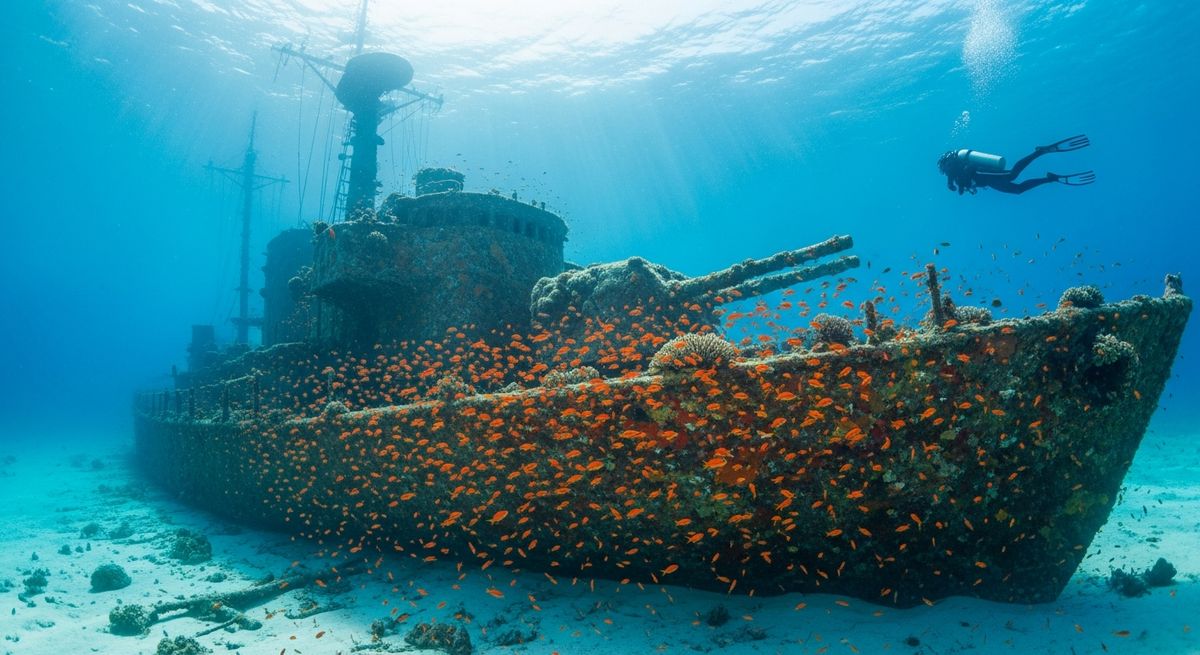
The *Angloman*, or what we strongly suspect is her, sits in the kind of shallow water that makes for surprisingly good diving. At a maximum of 8 metres, you’re looking at long bottom times, which is great because there’s a lot of metal spread out down there. We particularly love the sheer scale of it, even if it is quite broken up. You’ll find the three boilers, still impressive, and the triple-expansion engine standing proud, often swarming with small cod and inquisitive wrasse. Dive it on a calm day, ideally with a bit of sunshine, and the visibility can actually be quite decent, letting you pick out the details of the hull plates. We’ve seen conger eels tucked into some of the darker crevices and massive edible crabs scuttling over the debris. It’s not a deep, dramatic wall, but it’s a brilliant rummage dive for anyone who appreciates the history of these old steamships and doesn’t mind getting up close and personal with the structure.
Typical ANGLOMAN (POSSIBLY) Dive Profile
Illustrative profile based on site depth and type. Actual dive profiles vary - always follow your dive computer and training.
Safety Notes
Wreck site - avoid penetration without wreck diving certification. Watch for sharp metal and entanglement hazards.
ANGLOMAN (POSSIBLY) Wreck History
Year Sunk
1897
Vessel Type
cargo ship
Cause
grounding
Tonnage
4,792 GRT
The SS Angloman was a modern steamship for her time, built in 1892 by the renowned Laird Brothers shipyard for the Dominion Line's transatlantic routes. A substantial vessel of 4,792 GRT, she was powered by a triple-expansion steam engine fed by three boilers, representing the pinnacle of late 19th-century marine engineering. She served her owners for five years, a reliable part of the vital trade network connecting Britain with North America.
In February 1897, the Angloman's career came to an abrupt end. While on a voyage from Liverpool to Newcastle, she sailed into a fierce blizzard off the Northumberland coast. Blinded by the snow and battered by heavy seas, the vessel ran hard aground on the treacherous rocks known as the Scars, near Whitley Bay. Fortunately, the entire crew was rescued from the stricken ship, but the Angloman was a total loss, eventually breaking apart under the relentless force of the sea.
Today, the remains of the Angloman lie scattered in just 8 meters of water, making for a fascinating and accessible shallow dive. Years of storms have flattened the wreck, but divers can still identify key features like her three large boilers, sections of the hull plating, and components of her powerful engine. The wreckage has created a thriving artificial reef, providing a home for crabs, lobsters, and a variety of fish, all set against the dramatic backdrop of this historic steamship.
Nearest Dive Centres to ANGLOMAN (POSSIBLY)
Dive shops near ANGLOMAN (POSSIBLY)
View all dive centres in Northumberland & NortheastReviews for ANGLOMAN (POSSIBLY)
Conditions
Ocean conditions, forecast and tides for ANGLOMAN (POSSIBLY)
Plan & book
Ways to dive Northumberland & Northeast, from day trips to liveaboards.
Day trips & courses
via GetYourGuideGuided dives, courses and snorkel trips with instant booking.
Find dive trips in Northumberland & NortheastPlaces to stay
via Booking.comHotels and dive resorts near Northumberland & Northeast.
Search stays in Northumberland & NortheastDive insurance
Most travel insurance excludes or limits scuba. Check what you need before you go.
Dive insurance explainedPartner links: we may earn a commission if you book, at no extra cost to you. How we make money
Where to Stay near ANGLOMAN (POSSIBLY)
Prices from Booking.com. We may earn a commission at no extra cost to you.