BENSHAW
Protected Area
Granagh Bay
Why dive here
With 118+ marine species recorded in the area - including dolphins, dwarf minke whales, humpback whales, ocean sunfish (mola mola) and orcas - BENSHAW offers some of Northumberland & Northeast's richest wreck diving.
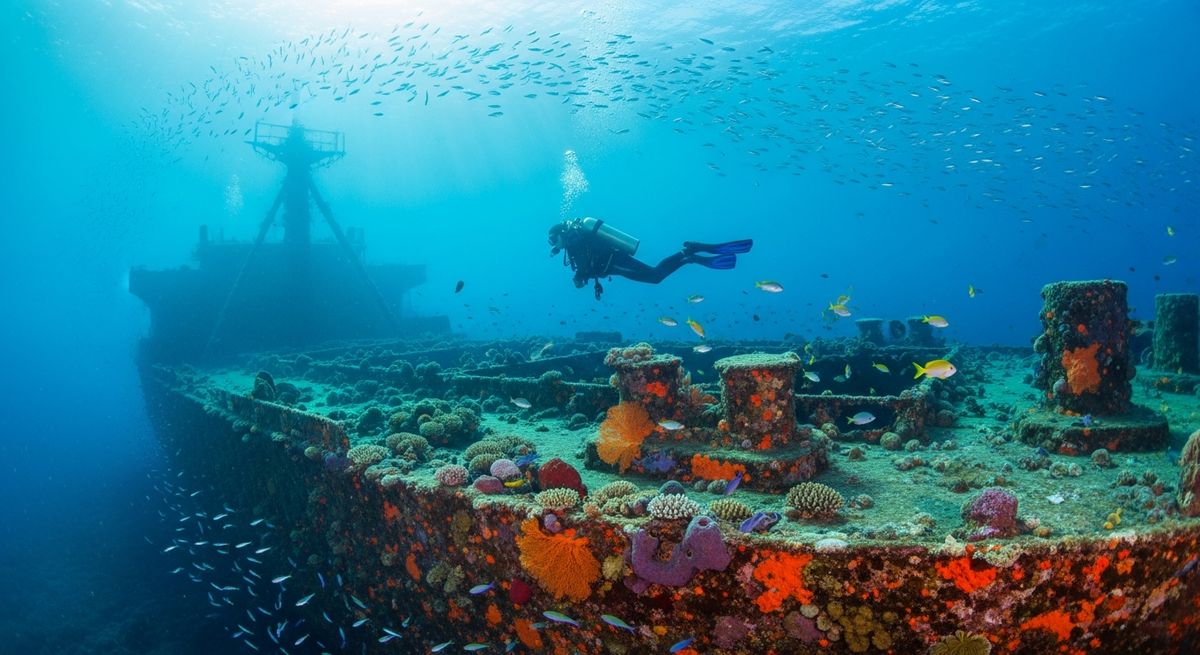
Benshaw is a beauty, even if she sits in the shallows. We love a good wreck, and this one, scattered across just two metres of water, means you get proper bottom time to pick through the remains. She was a steamer, lost in 1916, and the plates and frames are spread out, telling a story in the way only an old wreck can. You’re not going to see intact bows or stern, but what you do get is a fantastic training ground for navigation and wreck appreciation. The two boilers are still prominent, standing proud from the seabed, often draped in kelp. Around them, we’ve found decent lobsters tucked into crevices, velvet swimming crabs scuttling over the steel, and sometimes a few plaice lying camouflaged on the sand nearby. The light filters through the kelp, creating a dappled effect over the wreck, which we find quite atmospheric. It’s a site that suits newer divers looking to get comfortable with wrecks, or photographers who want to play with natural light and macro subjects. Go on a calm day, and it’s a brilliant way to spend an hour.
Typical BENSHAW Dive Profile
Illustrative profile based on site depth and type. Actual dive profiles vary - always follow your dive computer and training.
Safety Notes
Wreck site - avoid penetration without wreck diving certification. Watch for sharp metal and entanglement hazards.
BENSHAW Wreck History
Year Sunk
1916
Vessel Type
cargo ship
Cause
torpedo
Tonnage
3,656 GRT
Built in 1895 by J. Scott & Co. in Kinghorn, the SS Benshaw was a classic steamship of its era, powered by a triple-expansion engine. Owned by the Town Line of London, it dutifully plied the trade routes between Britain and Europe, transporting essential goods. By the time of the First World War, like all merchant vessels, its voyages were fraught with the new and deadly danger of submarine warfare.
On December 18, 1916, while on a passage from Bilbao, Spain, the Benshaw's luck ran out. She was intercepted off the Northumberland coast by the German submarine UB-38 and struck by a torpedo. The explosion tore a hole in her hull, and the ship quickly succumbed to the sea, sinking to the seabed. This attack was part of Germany's unrestricted submarine warfare campaign, which aimed to cripple the Allied supply chain and ultimately claimed thousands of merchant ships.
Today, the Benshaw rests in just 2 meters of water, making it an exceptionally shallow and accessible wreck. It's an ideal site for novice divers and even snorkelers on a calm day. Due to the shallow depth and over a century of North Sea storms, the wreck is heavily broken up. Divers can explore the scattered remains of the hull, identify the ship's two large boilers, and examine the remnants of its powerful engine, all while being reminded of the dramatic WWI history that lies just beneath the waves.
Reviews for BENSHAW
Conditions
Ocean conditions, forecast and tides for BENSHAW
Plan & book
Ways to dive Northumberland & Northeast, from day trips to liveaboards.
Day trips & courses
via GetYourGuideGuided dives, courses and snorkel trips with instant booking.
Find dive trips in Northumberland & NortheastPlaces to stay
via Booking.comHotels and dive resorts near Northumberland & Northeast.
Search stays in Northumberland & NortheastDive insurance
Most travel insurance excludes or limits scuba. Check what you need before you go.
Dive insurance explainedPartner links: we may earn a commission if you book, at no extra cost to you. How we make money
Where to Stay near BENSHAW
Prices from Booking.com. We may earn a commission at no extra cost to you.