CAMBANK
Protected Area
Traeth Lligwy
Why dive here
With 118+ marine species recorded in the area - including dolphins, dwarf minke whales, humpback whales, ocean sunfish (mola mola) and orcas - CAMBANK offers some of Northumberland & Northeast's richest wreck diving.
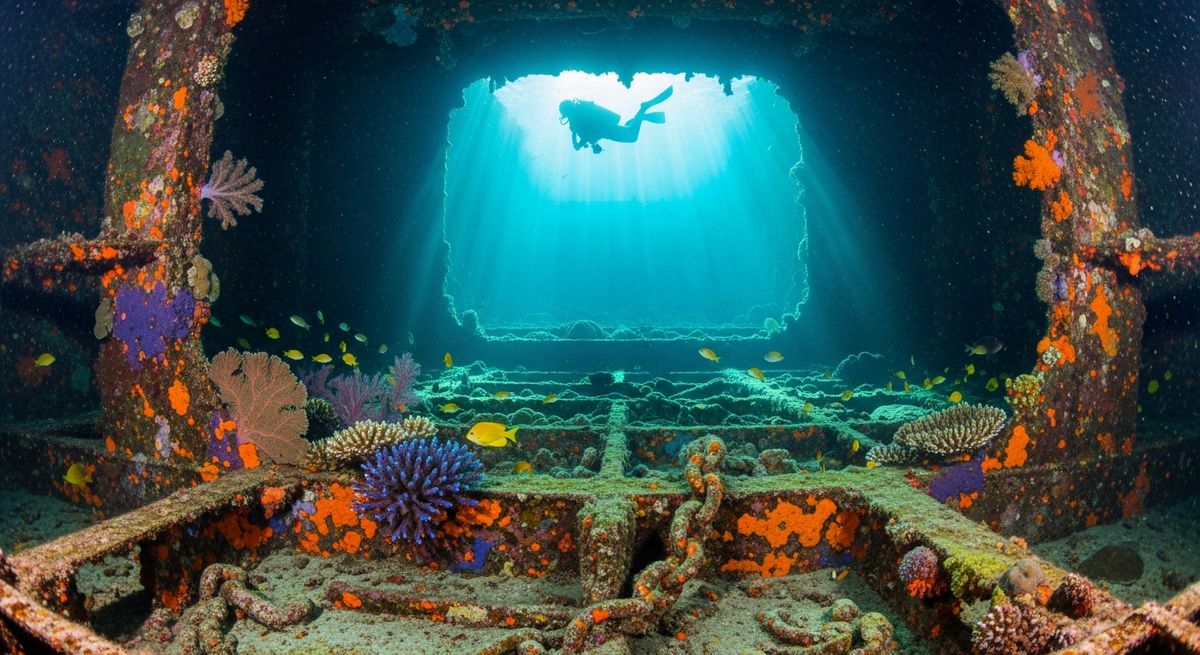
For us, the Cambank is a proper northeast wreck dive, the kind you really earn. Dropping down to 32 metres, you’re often greeted by the sheer scale of her: 98.5 metres long, broken but still impressively intact in places. We love nosing around the twin boilers, a classic feature of these early 20th-century steamers, and the triple-expansion engine is always a fascinating look at maritime engineering from 1915. What really makes the Cambank a standout is the life that has taken over. Expect to find conger eels peering from every dark recess, their thick bodies camouflaged against the rusted metal. Ling often lurk in the deeper sections, and the deck plates are often studded with anemones and dead man’s fingers, adding unexpected pops of colour to the grey steel. It’s a dive that rewards slow exploration, picking through the debris, imagining the steam rising from those boilers over a century ago. You need to be comfortable with depth and sometimes challenging visibility, but if you are, the Cambank offers a genuinely rewarding glimpse into the past.
Typical CAMBANK Dive Profile
Illustrative profile based on site depth and type. Actual dive profiles vary - always follow your dive computer and training.
Safety Notes
Deep dive (32m) - monitor air consumption closely. Advanced certification recommended.
Wreck site - avoid penetration without wreck diving certification. Watch for sharp metal and entanglement hazards.
Always perform a 3-minute safety stop at 5m before surfacing.
CAMBANK Wreck History
Year Sunk
1915
Vessel Type
cargo ship
Cause
torpedo
Tonnage
3,112 GRT
Launched in 1899 as the SS Raithmoor, the vessel later renamed SS Cambank was a typical British steamship built by J. Readhead & Sons in South Shields. For years, she reliably transported goods for the Merevale Shipping Co. of Cardiff, serving as a vital link in the chain of global commerce. When World War I broke out, she, like thousands of other merchant ships, continued her duties under the constant threat of enemy attack.
Her luck ran out on February 20, 1915. While sailing in the Irish Sea, she was spotted by the German submarine U-30. Without warning, a torpedo struck the Cambank, inflicting a fatal wound. She sank quickly, becoming another casualty of Germany's unrestricted submarine warfare campaign, which aimed to cripple the Allied war effort by starving Britain of essential supplies.
Today, the SS Cambank rests in 32 meters of water off the Northumberland coast. The wreck is a classic World War I dive, offering a direct connection to a pivotal moment in history. Divers can explore the ship's two large boilers and the remains of its triple-expansion engine. The hull has collapsed over the decades, but the scattered debris field creates a rich artificial reef, attracting cod, ling, and vibrant communities of anemones.
Nearest Dive Centres to CAMBANK
Dive shops near CAMBANK
View all dive centres in Northumberland & NortheastReviews for CAMBANK
Conditions
Ocean conditions, forecast and tides for CAMBANK
Plan & book
Ways to dive Northumberland & Northeast, from day trips to liveaboards.
Day trips & courses
via GetYourGuideGuided dives, courses and snorkel trips with instant booking.
Find dive trips in Northumberland & NortheastPlaces to stay
via Booking.comHotels and dive resorts near Northumberland & Northeast.
Search stays in Northumberland & NortheastDive insurance
Most travel insurance excludes or limits scuba. Check what you need before you go.
Dive insurance explainedPartner links: we may earn a commission if you book, at no extra cost to you. How we make money
Where to Stay near CAMBANK
Prices from Booking.com. We may earn a commission at no extra cost to you.