BOREALIS
Protected Area
محمية نبق
Why dive here
BOREALIS is a wreck dive where divers can encounter dolphins, spinner dolphins and whale sharks. Water ranges 21-29°C, warmest July, August, September.
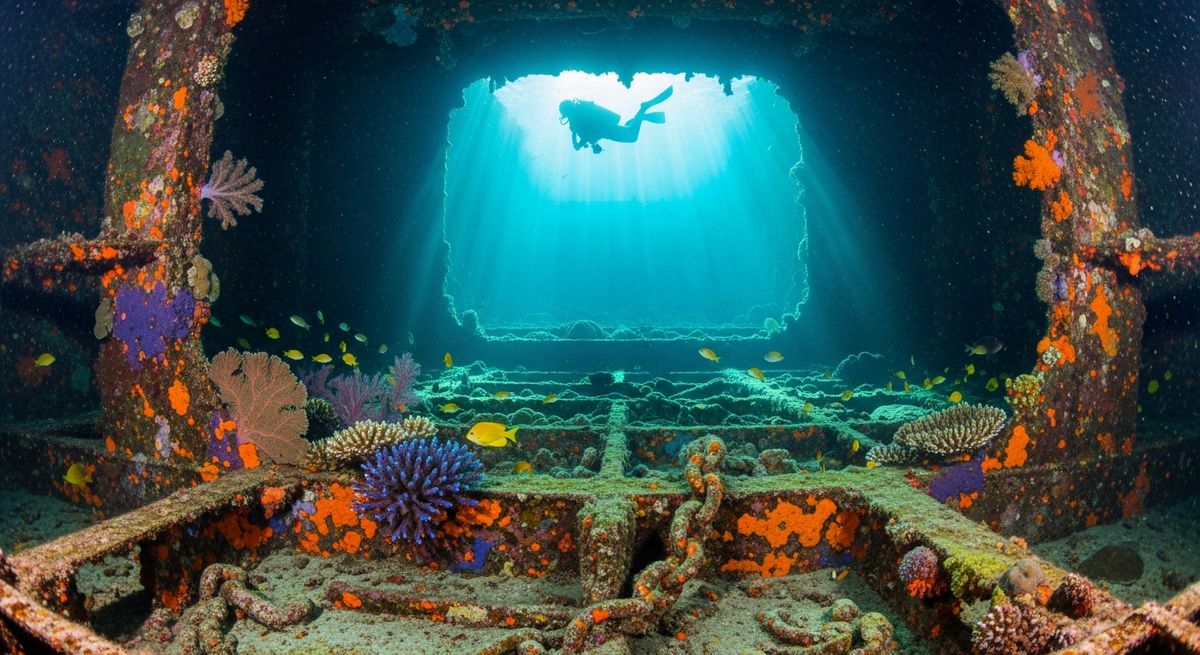
If you’re driving north out of Dahab, you can’t miss the Borealis. She’s beached high and dry, a rusted hulk on the sand, looking like a forgotten toy. Most divers just glance at her from the road, but we love dropping in. This isn’t a deep dive, barely anything at all, more of a snorkel or a shallow swim around her bones. We usually kick out from the shore, maybe 50 metres north of the wreck itself, and let the gentle current carry us back. The real action is around the stern, where the hull plates are scattered, creating little caves and overhangs. It’s a photographer’s playground, with sunlight dappling through the broken metal. Look for moray eels tucked into crevices, their heads peeking out, and we’ve seen some surprisingly chunky lionfish hunting among the shadows. The bow, further inshore, is pretty flattened, but you can still trace the outline of her anchor chain disappearing into the sand. It’s not about big pelagics here; it’s about the intimacy of a wreck taken by the sea, a slow exploration of history and the small creatures that have claimed it. Our pick for a lazy afternoon dip, especially if you’ve had a few deep ones already.
Safety Notes
Wreck site - avoid penetration without wreck diving certification. Watch for sharp metal and entanglement hazards.
BOREALIS Wreck History
Year Sunk
1976
Vessel Type
cargo ship
Cause
grounding
Tonnage
1,595 GRT
Built in Sweden in 1954 as the 'Essi,' the vessel later known as the Borealis was a well-traveled motor freighter. For over two decades, she plied international waters, transporting various cargoes across the globe. By the mid-1970s, she was operating in the busy shipping lanes of the Red Sea, a testament to her durability and service.
In October 1976, while navigating the Gulf of Aqaba, the Borealis was caught in a severe storm. The powerful winds and waves drove the ship hard aground onto the reef at Maqna, on the Saudi Arabian coast. The impact caused extensive bottom damage, and after an assessment, she was declared a constructive total loss and abandoned to the elements, her sailing days over.
For decades, the Borealis has been a dramatic landmark, with her rusting bow and superstructure jutting defiantly out of the turquoise water. The wreck lies with its stern in deeper water and its bow high on the reef, making it an intriguing multi-level dive and snorkel site. Divers can explore the largely intact stern section, swim through corridors, and marvel at the prolific coral growth that now encrusts the hull, attracting a wealth of Red Sea marine life. The dramatic visual of the ship, half-in and half-out of the water, makes it a truly memorable site.
Nearest Dive Centres to BOREALIS
Dive shops near BOREALIS
Scuba zone dahab
Lighthouse Dive Centre
Molchanova Freediving School
Scuba Life
Adventure Dive Centre
Marine garden
Reviews for BOREALIS
Conditions
Ocean conditions, forecast and tides for BOREALIS
BOREALIS Ocean Conditions
Monthly averages for BOREALIS, sourced from Open-Meteo marine data + Copernicus Marine (EU) - nearest station: Open-Meteo marine grid (28.73, 34.63) (13km away)
October Averages
Sea Temperature
26°C
79°F · Range: 25.2–27.2°C
Current Speed
4.24 cm/s
Direction: SE (135°)
Chlorophyll-a
0.073 mg/m³
Very clear (oligotrophic)
Salinity
39.08 PSU
Based on 4 years of monitoring data · Data sources: Open-Meteo marine data + Copernicus Marine (EU)
Plan & book
Ways to dive Dahab, from day trips to liveaboards.
Day trips & courses
via GetYourGuideGuided dives, courses and snorkel trips with instant booking.
Find dive trips in DahabPlaces to stay
via Booking.comHotels and dive resorts near Dahab.
Search stays in DahabDive insurance
Most travel insurance excludes or limits scuba. Check what you need before you go.
Dive insurance explainedPartner links: we may earn a commission if you book, at no extra cost to you. How we make money
Where to Stay near BOREALIS
Prices from Booking.com. We may earn a commission at no extra cost to you.