AQUIDABAN
Protected Area
Área De Relevante Interesse Ecológico Das Ilhas Cataguás
Why dive here
With 55+ marine species recorded in the area - including humpback whales - AQUIDABAN offers some of Arraial do Cabo's richest wreck diving. Water ranges 22-28°C, warmest January, February, March.
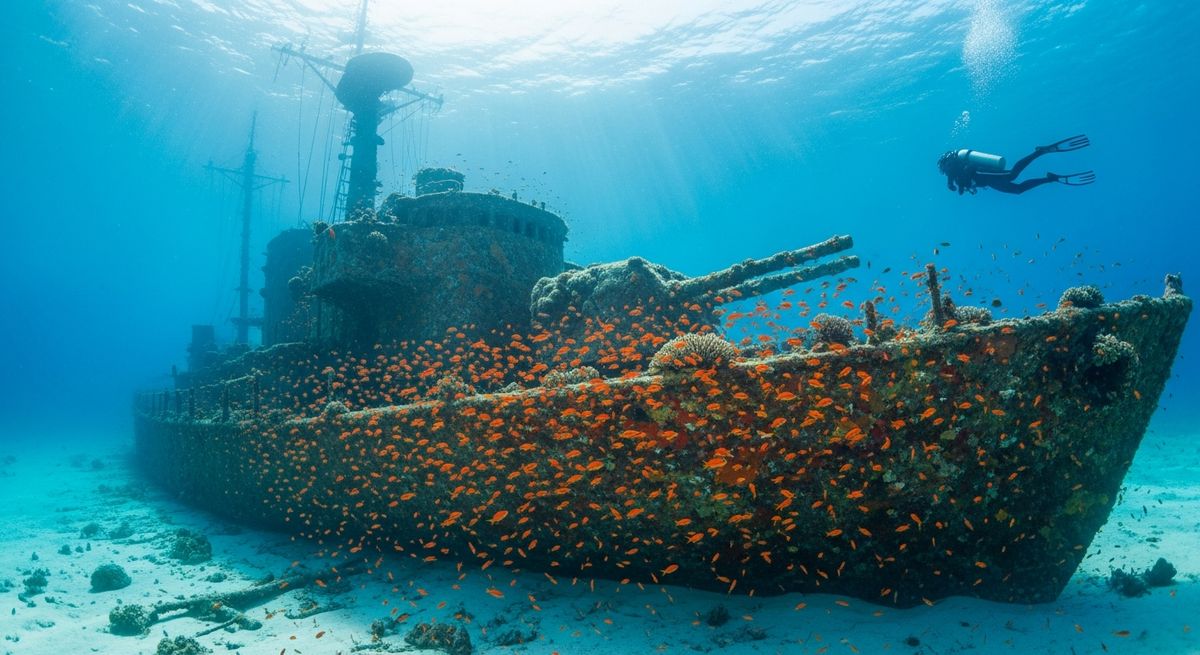
The Aquidabã isn't just a dive, it’s a history lesson playing out at 16 metres. We love this site for its sheer gravitas; it was a battleship, sunk in 1906 after an explosion, and the scale of it is still humbling. As you descend, the shape slowly resolves from the blue, a vast, fragmented structure lying on its side. It's a proper wreck penetration dive if you’re qualified, with plenty of swim-throughs where the light plays off the rusted metal, but even just exploring the exterior is fascinating. Our favourite spot is around the stern, where the prop shaft still protrudes, encrusted with sponges and home to schools of snapper. Look for the resident moray eels peeking from crevices, and we’ve seen some surprisingly large groupers here too. The visibility can be variable, but even on an average day, the sheer size of the Aquidabã ensures it’s an impressive dive. We'd suggest going early in the morning to avoid any crowds and to catch the best light filtering through the wreckage. It’s a site for those who appreciate maritime history and the way the ocean reclaims human endeavour, best suited to experienced wreck divers or those comfortable in overhead environments, though open water divers can certainly enjoy the exterior.
Typical AQUIDABAN Dive Profile
Illustrative profile based on site depth and type. Actual dive profiles vary - always follow your dive computer and training.
Safety Notes
Wreck site - avoid penetration without wreck diving certification. Watch for sharp metal and entanglement hazards.
Always perform a 3-minute safety stop at 5m before surfacing.
AQUIDABAN Wreck History
Year Sunk
1906
Vessel Type
warship
Cause
unknown
Tonnage
5,800 tons
The Aquidabã was a formidable steel ironclad battleship that served as the flagship of the Brazilian Navy in the late 19th century. The vessel had a dramatic career, most notably participating in the 1893 Naval Revolt, during which it was torpedoed and sunk by a government torpedo boat. In an incredible feat of engineering for the time, the warship was raised, repaired, and returned to service, continuing its duties protecting the Brazilian coast.
The ship's luck ran out on January 21, 1906. While anchored in Jacuacanga Bay near Ilha Grande, as officers prepared for a dinner to honor a visiting minister, the ship's powder magazines spontaneously exploded with catastrophic force. The massive blast tore the vessel apart, and it sank in just three minutes, taking 212 sailors and officers with it, including three of Brazil's most promising naval commanders. The cause of the explosion was attributed to the instability of the aging powder.
Lying at a recreational depth of 16 meters, the wreck of the Aquidabã is now a scattered but fascinating historical dive site. The explosion's violence is evident in the debris field, but divers can still identify huge sections of armored hull, deck plates, and the ship's impressive cannons. The site is a protected archaeological treasure and a memorial to those who lost their lives, offering a poignant glimpse into a turbulent period of naval history.
Nearest Dive Centres to AQUIDABAN
Dive shops near AQUIDABAN
Dive Eco Mergulho
NAUTILUS MERGULHO
Jamanta Dive Center
AQUAMASTER Centro de Mergulho
Elite Dive Center
Natura Dive
Reviews for AQUIDABAN
Conditions
Ocean conditions, forecast and tides for AQUIDABAN
AQUIDABAN Ocean Conditions
Monthly averages for AQUIDABAN, sourced from Open-Meteo marine data + Copernicus Marine (EU) - nearest station: Open-Meteo marine grid (-23.23, -44.16) (12km away)
October Averages
Sea Temperature
23°C
73°F · Range: 17.8–26.6°C
Current Speed
8.49 cm/s
Direction: SW (225°)
Salinity
35.38 PSU
Based on 4 years of monitoring data · Data sources: Open-Meteo marine data + Copernicus Marine (EU)
Plan & book
Ways to dive Arraial do Cabo, from day trips to liveaboards.
Day trips & courses
via GetYourGuideGuided dives, courses and snorkel trips with instant booking.
Find dive trips in Arraial do CaboPlaces to stay
via Booking.comHotels and dive resorts near Arraial do Cabo.
Search stays in Arraial do CaboDive insurance
Most travel insurance excludes or limits scuba. Check what you need before you go.
Dive insurance explainedPartner links: we may earn a commission if you book, at no extra cost to you. How we make money
Where to Stay near AQUIDABAN
Prices from Booking.com. We may earn a commission at no extra cost to you.