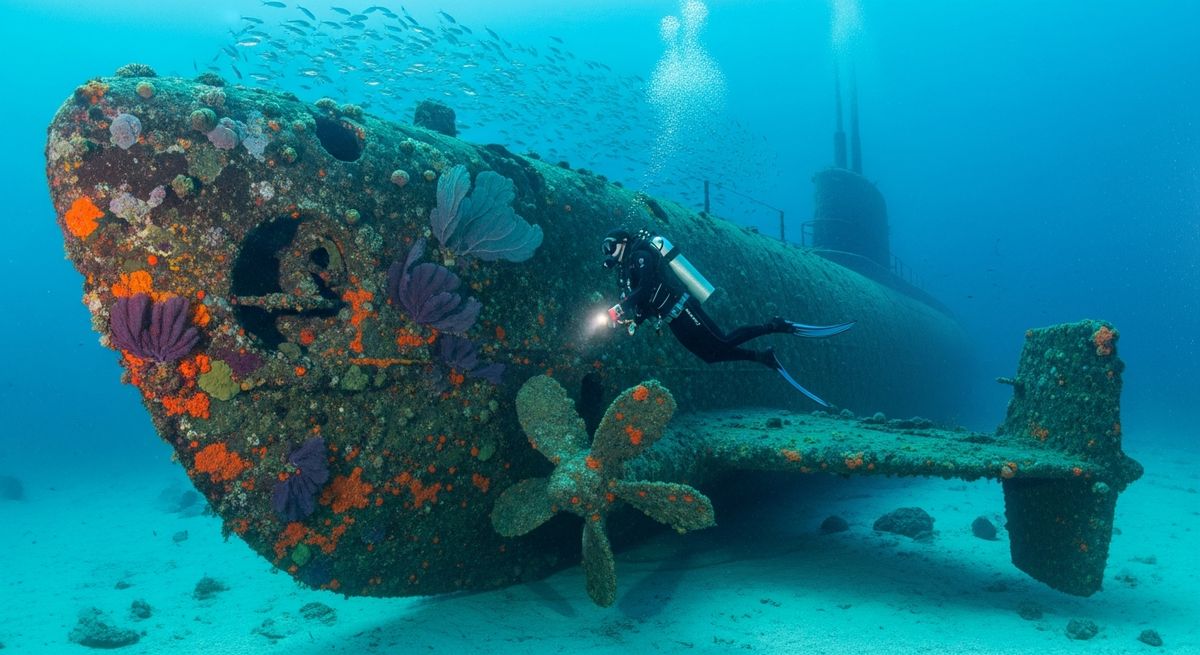
Virgo
Protected Area
Área De Relevante Interesse Ecológico Orla Marítima
Why dive here
With 44+ marine species recorded in the area - including sea turtles - Virgo offers some of Fernando de Noronha's richest wreck diving. Water ranges 27-29°C, warmest March, April, May.
For divers who love a good wreck, the Virgo tugboat in Fernando de Noronha is a real treat. She sits upright at 24 metres, just a short fin-kick from the Taurus, so you get two wrecks for the price of one descent. We love tracing the deck, noting the big mooring bollards up front, and peeking into what was once the control room. The hull is still surprisingly intact, creating plenty of nooks and crannies for life to hide. You’ll find big schools of jacks swirling around the mast, and we’ve often spotted lazy nurse sharks tucked under ledges. The coral and algae growth on the metal is impressive, turning the wreck into a living reef. Keep an eye out for curious hogfish and hamlets, and we’ve even seen some sizable mutton snapper cruising by. Visibility averages around 12 metres, which is usually enough to take in the wreck’s scale and appreciate the blend of metal and marine life. It’s a great dive for anyone who enjoys exploring a bit of history while surrounded by bustling fish.
Safety Notes
Wreck site - avoid penetration without wreck diving certification. Watch for sharp metal and entanglement hazards.
Virgo Wreck History
Year Sunk
1998
Vessel Type
cargo ship
Cause
scuttled
The Adolphus Busch is one of the premier artificial reef dive sites in the Florida Keys, with a fascinating history that spans multiple continents and names. The vessel began its life in 1950 as the cargo ship MV London, built in Fife, Scotland. For nearly five decades, she sailed the world's oceans under various flags and names, including London, Gale, Topsail Star, and finally, Ocean Alley. Her long career came to an abrupt end in 1998 when she was wrecked during a storm in Port-au-Prince, Haiti.
Rather than being scrapped, the ship was given a new purpose. She was purchased by August Adolphus Busch IV of the Anheuser-Busch beer dynasty and renamed in honor of his great-grandfather. In a massive undertaking, the ship was thoroughly cleaned and stripped of all potential hazards to the marine environment. On December 5, 1998, she was carefully and intentionally sunk in the clear waters off Looe Key, beginning her second life as an underwater ecosystem.
Sitting perfectly upright on the sand, the 240-foot Adolphus Busch is a spectacular dive. Her large cargo holds are open for exploration, and the intact superstructure, bridge, and engine room provide an exciting playground for certified wreck divers. In the years since her sinking, she has been colonized by a vast array of marine life, including massive goliath groupers, moray eels, and swirling schools of fish, making her a must-do dive for anyone visiting the Florida Keys.
Nearest Dive Centres to Virgo
Dive shops near Virgo
View all dive centres in Fernando de NoronhaReviews for Virgo
Conditions
Ocean conditions, forecast and tides for Virgo
Virgo Ocean Conditions
Monthly averages for Virgo, sourced from Open-Meteo marine data + Copernicus Marine (EU) - nearest station: Open-Meteo marine grid (-3.84, -32.38) (0km away)
October Averages
Sea Temperature
27°C
81°F · Range: 26.5–27.9°C
Current Speed
29.15 cm/s
Direction: NW (329°)
Chlorophyll-a
0.035 mg/m³
Very clear (oligotrophic)
Salinity
36.39 PSU
Based on 4 years of monitoring data · Data sources: Open-Meteo marine data + Copernicus Marine (EU)
Plan & book
Ways to dive Fernando de Noronha, from day trips to liveaboards.
Day trips & courses
via GetYourGuideGuided dives, courses and snorkel trips with instant booking.
Find dive trips in Fernando de NoronhaPlaces to stay
via Booking.comHotels and dive resorts near Fernando de Noronha.
Search stays in Fernando de NoronhaDive insurance
Most travel insurance excludes or limits scuba. Check what you need before you go.
Dive insurance explainedPartner links: we may earn a commission if you book, at no extra cost to you. How we make money
Where to Stay near Virgo
Prices from Booking.com. We may earn a commission at no extra cost to you.