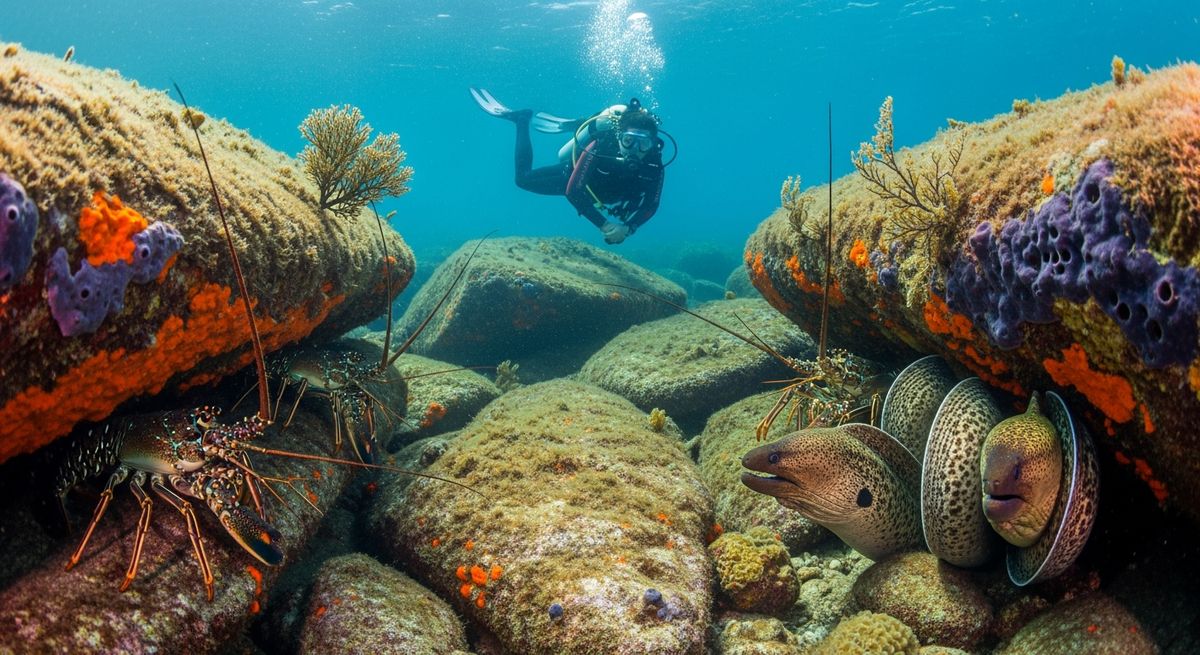
Jam - Sulawesi

Marakura Bay isn't your typical reef dive, and that’s alright. This shore entry in Te Anau gives you easy access to a silty slope that deepens pretty quickly, dropping to 13m within a short swim. You're mostly here for the quiet calm and a chance to spot the resident *koura* – New Zealand freshwater crayfish – tucked into the bottom, along with some small freshwater sponges. Visibility hovers around 4m, so it’s a site for slower exploration, perhaps a good shakedown dive, or when you’re looking for something different from the usual ocean buzz.

Location
Sulawesi, Indonesia, Southeast Asia
Coordinates
-0.164400, 121.668100

Marine Protected Area: Kepulauan Togean

Best Time to Dive in Sulawesi

The warmest water temperatures in Sulawesi occur in November, averaging 30.4°C. The coolest conditions are in September at 28.7°C.

Monthly Water Temperatures

  • January: 29.5°C
  • February: 29.4°C
  • March: 29.8°C
  • April: 30.3°C
  • May: 30.3°C
  • June: 29.7°C
  • July: 29.1°C
  • August: 28.8°C
  • September: 28.7°C
  • October: 29.5°C
  • November: 30.4°C
  • December: 30.2°C

Nearby Dive Sites in Sulawesi

Nearest Dive Centres to Jam

Marine Life in Sulawesi

Home to 252 recorded species including 162 reef fish, 53 hard corals, 9 seagrass & algae, 9 sea snails & nudibranchs, 6 clams & mussels, 4 sea cucumbers.

Notable Species

Recommended Packing List for Jam

Based on average water temperature of 29.7°C, currents 4 cm/s.

  • Shorty or Rashguard - warm 30°C water needs minimal exposure protection
  • Mask - essential for every dive
  • Fins
  • BCD - buoyancy compensator
  • Regulator - your most safety-critical piece of gear
  • Dive Computer - tracks depth, time, and NDL
  • Surface Marker Buoy (SMB) - essential for boat pickups
  • Dive Torch - useful for crevices and colour at depth
  • Underwater Camera - capture your diving memories

Frequently Asked Questions

What is the typical depth for diving at Jam dive site?
The Jam dive site has a maximum depth of 20 meters, making it accessible for many divers. While the dive description mentions starting at 30 meters, the overall profile and maximum recommended depth for the site is 20 meters. Divers can explore various reef systems and a small wreck found around 10 meters.
What kind of marine life and underwater features can I expect to see at Jam dive site?
At Jam dive site, you can expect to explore a vibrant reef network and a small wreck situated around 10 meters. Marine life highlights include the often-spotted barracuda tornado, a huge variety of fish, and numerous nudibranchs nesting amongst the beautiful cabbage coral. For more information on marine species, visit our wildlife database.
Is Jam dive site suitable for beginner divers, or is it considered more advanced?
The Jam dive site is classified as having an intermediate difficulty level. This suggests it is not typically recommended for beginner divers, who might find the depth profile or potential conditions challenging. Divers with more experience will be better suited to enjoy this diverse reef system.
When is the best time of year to dive at Jam dive site for optimal conditions?
Our current data for the Jam dive site does not specify the best time of year for optimal diving conditions. We recommend checking local dive operator information for seasonal variations. You can also explore our general guide on when to dive for broader regional insights.
What scuba diving certifications are required to dive at Jam dive site?
The provided data for the Jam dive site does not explicitly state specific certification requirements. However, given its intermediate difficulty and maximum depth of 20 meters, an Advanced Open Water certification or equivalent is generally recommended to safely and comfortably explore the site. Always consult with your dive operator for their specific requirements.
What are the typical current conditions and visibility like at Jam dive site?
At the Jam dive site, you can typically expect an average visibility of 15 meters, offering clear views of the reef and marine life. While specific current conditions are not detailed in our data, the intermediate difficulty rating suggests that divers should be prepared for potentially varying currents.