MANOKWARI
Protected Area
Sugud Islands Marine Conservation Area
Why dive here
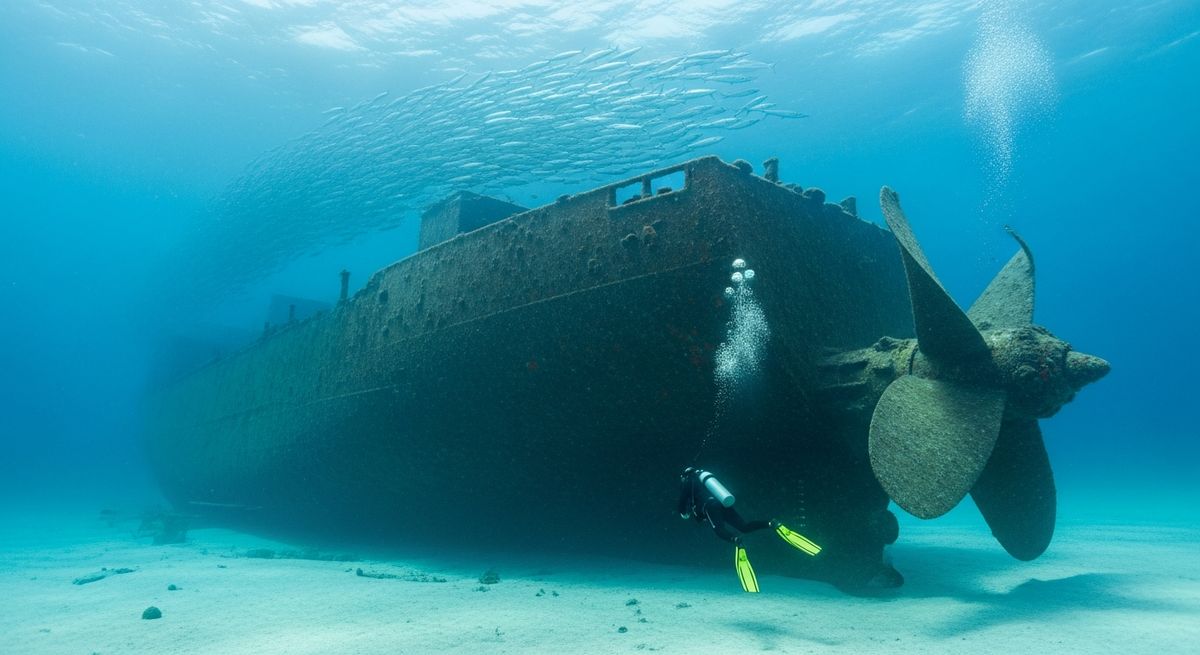
With 142+ marine species recorded in the area - including barracuda, blue-spotted stingrays, eagle rays, sea turtles and sperm whales - MANOKWARI offers some of Sipadan's richest wreck diving. Water ranges 29-31°C, warmest May, October, November.
Manokwari isn’t what most people picture when they hear "Sipadan wreck." Forget deep walls and pelagics for a moment. This is something else entirely. She's a motor vessel, built in '72, resting in the shallows right off the island’s north shore. We’re talking barely a metre deep. We love Manokwari for a snorkel, or better yet, a freedive. You can spend an hour just finning over her, spotting the ghost nets that still cling to the superstructure. The hull is a nursery for juvenile reef fish. Tiny parrotfish nibble on algae, and we've seen baby blacktip reef sharks cruise right over the deck. It’s an eerie, beautiful contrast – this hulking steel vessel slowly being reclaimed by the reef. Look for the way the light refracts through the surface, dappling the deck plates. It’s surprisingly peaceful, a different side to Sipadan’s usual high-octane dives. Our pick? Go at slack tide, early morning, before the dive boats stir up the sand. You’ll have her mostly to yourself.
Typical MANOKWARI Dive Profile
Illustrative profile based on site depth and type. Actual dive profiles vary - always follow your dive computer and training.
Safety Notes
Wreck site - avoid penetration without wreck diving certification. Watch for sharp metal and entanglement hazards.
Reviews for MANOKWARI
Conditions
Ocean conditions, forecast and tides for MANOKWARI
MANOKWARI Ocean Conditions
Monthly averages for MANOKWARI, sourced from Open-Meteo marine data + Copernicus Marine (EU) - nearest station: Open-Meteo marine grid (4.12, 118.63) (0km away)
October Averages
Sea Temperature
30°C
87°F · Range: 29.4–31.5°C
Current Speed
4.12 cm/s
Direction: E (104°)
Chlorophyll-a
0.055 mg/m³
Very clear (oligotrophic)
Salinity
31.68 PSU
Based on 4 years of monitoring data · Data sources: Open-Meteo marine data + Copernicus Marine (EU)
Plan & book
Ways to dive Sipadan, from day trips to liveaboards.
Day trips & courses
via GetYourGuideGuided dives, courses and snorkel trips with instant booking.
Find dive trips in SipadanPlaces to stay
via Booking.comHotels and dive resorts near Sipadan.
Search stays in SipadanDive insurance
Most travel insurance excludes or limits scuba. Check what you need before you go.
Dive insurance explainedPartner links: we may earn a commission if you book, at no extra cost to you. How we make money
Where to Stay near MANOKWARI
Prices from Booking.com. We may earn a commission at no extra cost to you.