Akitsushima
Why dive here
With 176+ marine species recorded in the area - including giant moray eels, sea turtles, sperm whales, lionfish and pufferfish - Akitsushima offers some of Apo Reef's richest wreck diving. Water ranges 28-30°C, warmest May, June, July.
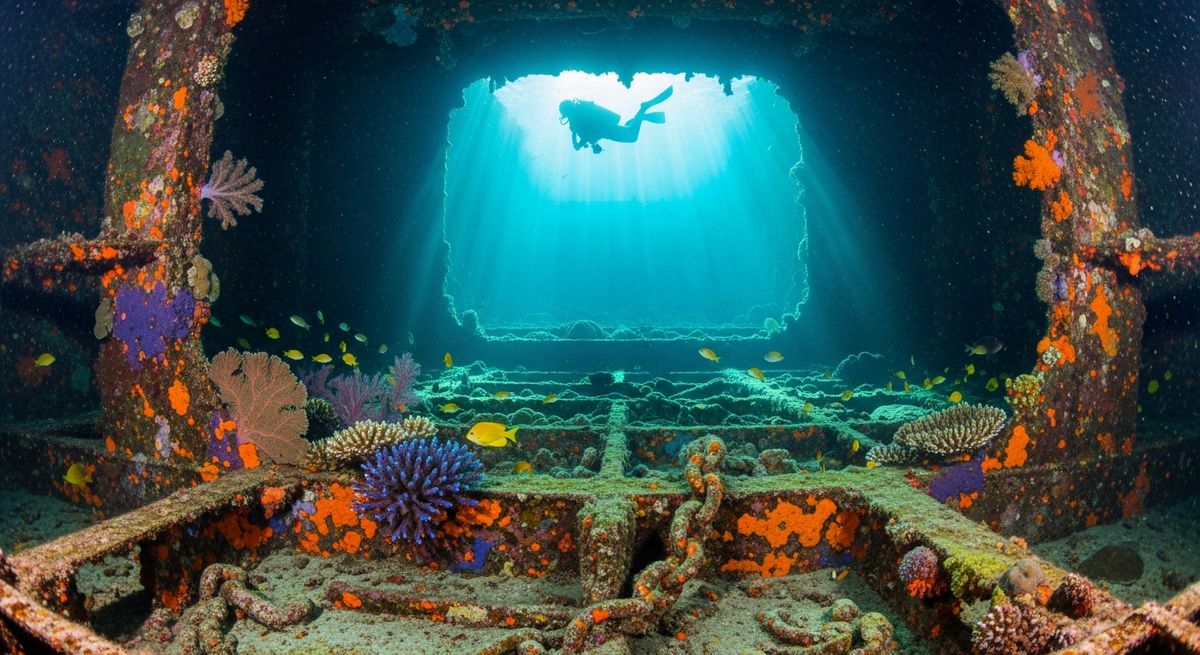
The Akitsushima wreck at Apo Reef isn't just a sunken ship; it’s a time capsule, a huge metal sculpture overgrown with life. We love it because it’s big, offering plenty to explore without being overwhelming. You drop down onto the deck, usually in pretty good visibility, and the sheer scale of the anti-aircraft guns and the crane arms really hits you. It feels like swimming through a ghostly playground. What makes it a standout for us are the details: the way the light filters through the broken superstructure, illuminating schools of fusiliers so thick they momentarily block your view. You'll often find big groupers lurking in the darker crevices and plenty of lionfish perched on the corroded metal. Keep an eye out for nudibranchs, too; they love the nutrient-rich growth on the wreck. This site suits divers who appreciate history and don't mind a bit of current occasionally, which can pick up, especially around the bow. Our tip? Try to get there early in the morning for the best light and fewer other divers.
Typical Akitsushima Dive Profile
Illustrative profile based on site depth and type. Actual dive profiles vary - always follow your dive computer and training.
Safety Notes
Wreck site - avoid penetration without wreck diving certification. Watch for sharp metal and entanglement hazards.
Always perform a 3-minute safety stop at 5m before surfacing.
Akitsushima Wreck History
Year Sunk
1944
Vessel Type
warship
Cause
unknown
Tonnage
4,650 tons
While listed near Apo Reef, the legendary IJN Akitsushima actually rests in Coron Bay, Palawan, and is a crown jewel of Philippine wreck diving. She was no ordinary vessel; as a seaplane tender, her mission was to carry, service, and launch the giant Kawanishi H8K "Emily" flying boats. Her unique design included a massive 35-ton crane on her aft deck for this purpose. On September 24, 1944, US Navy aircraft from Task Force 38 swept into Coron Bay, surprising the Japanese fleet hiding there. The Akitsushima took direct hits, caught fire, and sank rapidly, rolling onto her port side as she went down.
Today, the Akitsushima is a formidable and challenging technical dive. Lying between 22 and 36 meters, the wreck is immense and largely intact. The most prominent feature is the collapsed crane, its huge structure now lying on the seabed beside the hull. Divers can see the anti-aircraft guns still pointing towards the surface, a silent testament to her final battle. For certified and experienced wreck divers, the penetration routes are spectacular, leading through the engine room with its four massive diesel engines still in place. The dark corridors and gear-filled rooms offer a haunting glimpse into a World War II warship, now colonized by groupers, barracuda, and schools of fusiliers.
Nearest Dive Centres to Akitsushima
Dive shops near Akitsushima
D’Divers
Pirate Divers
Chindonan Dive & Beach Resort
Sangat Island Dive Resort
Dive Link Resort
Sea dive Extension
Reviews for Akitsushima
Conditions
Ocean conditions, forecast and tides for Akitsushima
Akitsushima Ocean Conditions
Monthly averages for Akitsushima, sourced from Open-Meteo marine data + Copernicus Marine (EU) - nearest station: Open-Meteo marine grid (12.33, 121.06) (26km away)
October Averages
Sea Temperature
30°C
86°F · Range: 28.1–31.3°C
Current Speed
3.16 cm/s
Direction: E (108.4°)
Chlorophyll-a
0.049 mg/m³
Very clear (oligotrophic)
Salinity
32.63 PSU
Based on 4 years of monitoring data · Data sources: Open-Meteo marine data + Copernicus Marine (EU)
Plan & book
Ways to dive Apo Reef, from day trips to liveaboards.
Day trips & courses
via GetYourGuideGuided dives, courses and snorkel trips with instant booking.
Find dive trips in Apo ReefPlaces to stay
via Booking.comHotels and dive resorts near Apo Reef.
Search stays in Apo ReefDive insurance
Most travel insurance excludes or limits scuba. Check what you need before you go.
Dive insurance explainedPartner links: we may earn a commission if you book, at no extra cost to you. How we make money
Where to Stay near Akitsushima
Prices from Booking.com. We may earn a commission at no extra cost to you.