CAMFAIR
Protected Area
Malilipot-Rawis-Lagbak (MARILAG) Fish Sanctuary and Marine Reserve
Why dive here
With 135+ marine species recorded in the area - including napoleon wrasse and pufferfish - CAMFAIR offers some of Donsol & Sorsogon's richest wreck diving. Water ranges 28-30°C, warmest June, July, August.
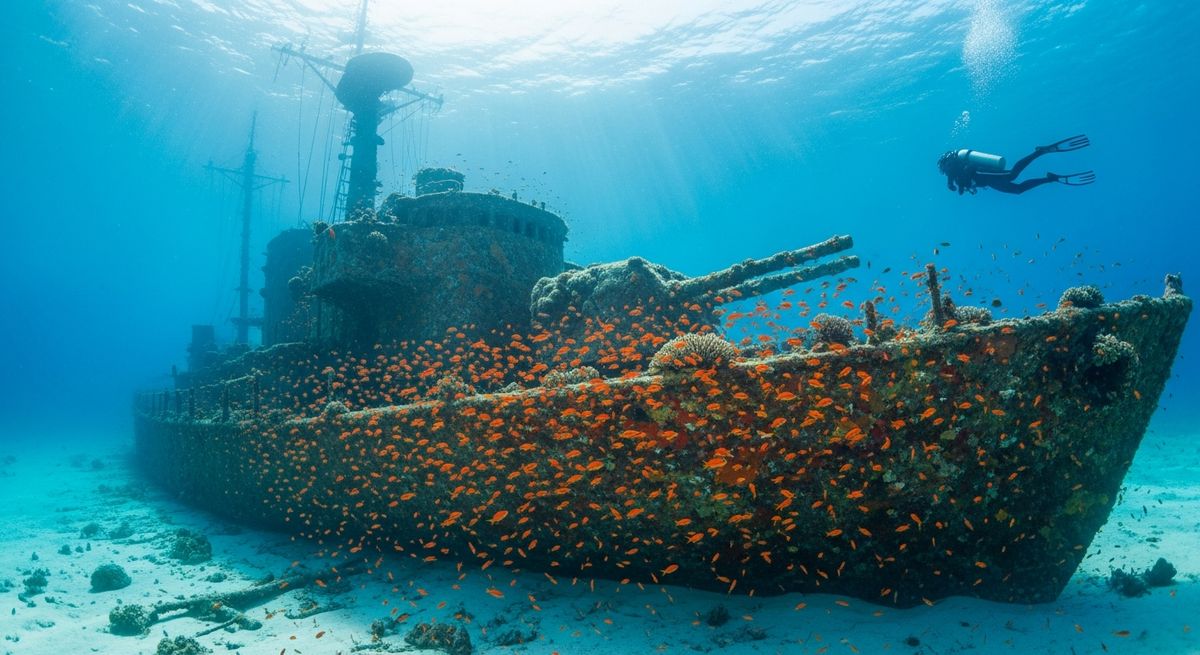
CAMFAIR isn't your average recreational dive. This isn't about deep penetration, it's about scale and history, lying flat on a sandy bed at a mere 11 metres. We love it because it’s a gentle giant, accessible to almost anyone. The sheer length of the vessel, over 100 metres, means you can spend your entire bottom time just finning along the deck, imagining its former life. Our favourite part is the engine room, surprisingly open and inviting, where schools of batfish now hold court amongst the machinery. Look closely, and you’ll spot crocodile fish resting perfectly still on the growth covered steel, masters of camouflage. The bow, twisted and draped in soft corals, makes for some moody photographs, especially when the sun filters through the shallow water. It’s perfect for divers who appreciate the story a wreck tells, and for photographers looking for a unique, less-frequented subject.
Typical CAMFAIR Dive Profile
Illustrative profile based on site depth and type. Actual dive profiles vary - always follow your dive computer and training.
Safety Notes
Wreck site - avoid penetration without wreck diving certification. Watch for sharp metal and entanglement hazards.
Always perform a 3-minute safety stop at 5m before surfacing.
CAMFAIR Wreck History
Year Sunk
1988
Vessel Type
cargo ship
Cause
unknown
The M/V Camfair began its life in 1979, built in Akitsu, Japan, by K.K. Taihei Kogyo. It sailed under the name 'Pakarti Empat' until 1986. By the time of its loss, it was owned by the Blue Sea Maritime Corporation. In December 1988, the Camfair was on a voyage from Rabaul, Papua New Guinea, when it sank off the coast of Donsol in the Philippines. The exact cause of the sinking remains undocumented, leaving a small mystery in its wake.
Today, the Camfair rests in only 11 metres of water, making it a fantastic and highly accessible wreck for novice divers and underwater photographers. Located in an area world-famous for whale shark encounters, this wreck offers a perfect second dive. Over the decades, it has transformed into a vibrant artificial reef, its structure providing a home for schooling fish, moray eels, and a host of macro critters. Its shallow depth allows for long, relaxed bottom times, giving divers plenty of opportunity to explore the coral-encrusted cargo holds and superstructure.
Reviews for CAMFAIR
Conditions
Ocean conditions, forecast and tides for CAMFAIR
CAMFAIR Ocean Conditions
Monthly averages for CAMFAIR, sourced from Open-Meteo marine data - nearest station: Open-Meteo marine grid (12.8, 123.7) (15km away)
October Averages
Sea Temperature
30°C
86°F · Range: 29–31.1°C
Air Temperature
27°C
81°F
Wind Speed
5.19 m/s
10.1 knots
Atmospheric Pressure
1008.6 hPa
Based on 4 years of monitoring data · Data sources: Open-Meteo marine data
Plan & book
Ways to dive Donsol & Sorsogon, from day trips to liveaboards.
Day trips & courses
via GetYourGuideGuided dives, courses and snorkel trips with instant booking.
Find dive trips in Donsol & SorsogonPlaces to stay
via Booking.comHotels and dive resorts near Donsol & Sorsogon.
Search stays in Donsol & SorsogonDive insurance
Most travel insurance excludes or limits scuba. Check what you need before you go.
Dive insurance explainedPartner links: we may earn a commission if you book, at no extra cost to you. How we make money
Where to Stay near CAMFAIR
Prices from Booking.com. We may earn a commission at no extra cost to you.